
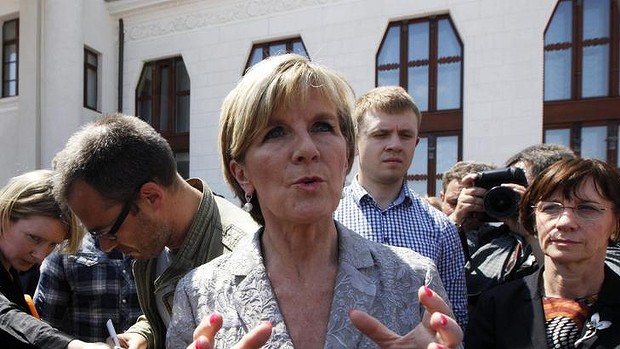
FOREIGN Minister Julie Bishop says Australia is still determined to send unarmed police to the MH17 crash site despite Ukrainian forces mounting a fresh offensive in the rebel-controlled area.
Eleven Australian Federal Police (AFP) officers last night abandoned a planned site visit with a 38-strong Dutch team due to heavy shelling in eastern Ukraine.
“I would have rathered the mission went ahead today but the fighting had intensified so the correct decision was taken not to go in,” Ms Bishop said in Amsterdam.
“It sets us back a day but we are determined to fulfil the promise that we made that we would bring our people home.”
Ms Bishop was speaking at Schiphol Airport before flying to Kiev with her Dutch counterpart Frans Timmermans.
Asked if she was concerned about Ukraine’s military action, Ms Bishop said: “We always knew there was a conflict between the Ukrainian military and the separatists”.
“We had hoped that there would be an exclusion zone,” she added. “But it appears that fighting has in fact taken place within the exclusion and around Donetsk today. It’s a very fluid situation.”
Ukrainian armed forces mounted a major onslaught against pro-Russian separatist fighters yesterday in an attempt to gain control over the area where the Malaysia Airlines plane was downed.
The Australian and Dutch team remains in the rebel stronghold of Donetsk and today will again attempt to travel to the crash site 60km away.
Canberra is relying on the Organisation for Security and Co-operation in Europe (OSCE) to negotiate access with the separatists.
Ms Bishop spoke with OSCE chairman and Swiss president Didier Burkhalter yesterday. And Australia’s special envoy to Ukraine, retired Air Chief Marshal Angus Houston, is in touch with senior Ukrainian officials in Kiev.
The foreign minister said whether AFP officers travelled to the site was “a day by day proposition”. The contingent on the ground provides advice which is then considered by the national security committee.
“We knew it wasn’t going to be easy but we are being very careful to balance the fact of the conflict with our need to get onto the site to carry out this humanitarian task of recovering bodies and remains,” Ms Bishop said.
Canberra believes yesterday’s fighting underlines the need for the Ukrainian parliament to ratify a deal that would allow Australia to send in a small number of armed police and soldiers.
The foreign minister has signed an in-principal agreement with her Ukrainian counterpart Pavlo Klimkin.
Getting it finalised, however, has been complicated by the collapse of the ruling coalition and the resignation of Prime Minister Arseniy Yatsenyuk.
“We will work very hard to have it ratified as soon as possible,” Ms Bishop said.
“(But) there may be a number of reasons why, logistically, the parliament can’t be returned earlier (than Thursday as is currently scheduled).”
Dutch Prime Minister Mark Rutte said yesterday an international military mission to secure the MH17 crash site was “unrealistic”.
“We concluded with our international partners that there’s a real risk of such an international military mission becoming directly involved in the conflict in Ukraine,” Mr Rutte told reporters in The Hague.
The conflict “would then acquire an international dimension that would lead to further escalation”.
There are presently 170 unarmed AFP officers in Ukraine in Donetsk, Kharkiv and Kiev.
Ukraine’s National Security Council said yesterday that government troops have encircled Horlivka, a key rebel stronghold, and that there had been fighting in other cities in the east. Horlivka lies around 30 kilometres north of the main rebel-held city of Donetsk.
The armed forces “have increased assaults on territory held by pro-Russian mercenaries, destroyed checkpoints and positions and moved very close to Horlivka,” the council said in a statement.
A representative of the separatist military command in Donetsk confirmed that there had been fighting in Horlivka, but said that rebel fighters were holding their positions.
Elsewhere, Russian state news agency RIA Novosti reported Sunday that a column of Ukrainian armoured personnel carriers, trucks and tanks had entered the town of Shakhtarsk, 15 kilometres west of the site of the Boeing 777 crash.
Shakhtarsk is a strategic town in the area. By controlling the town, the Ukrainian army would cut off vital rebel supply lines.
Local media reported fighting also taking place in the towns of Snizhne and Torez, the two nearest mid-sized towns to the crash site.
The government accused rebel forces of firing rockets on residential apartment blocks in Horlivka in what they said was an attempt to discredit the army and whip up anti-government sentiment. The separatist self-declared “Donetsk People’s Republic” has accused the army of being responsible for that and other rocket attacks in nearby cities.
The Donetsk regional government — which is loyal to Kiev and based elsewhere since rebels took over the area — said Sunday in a statement that at least 13 people, including two children aged 1 and 5, were killed in fighting in Horlivka. It said another five people were killed as a result of clashes in a suburb north of Donetsk.
source: theaustralian.com.au







 STUDIO 3 NEWCASTLE AUSTRALIA