Daily Archives: July 31, 2014

Constantine Karamanlis:Forty year milestones

Papachelas-Karamanlis%20pic

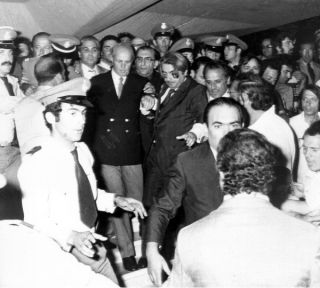
The return of former PM of Greece Constantine Karamanlis (C) to Athens, in July 1974, after the downfall of the military dictatorship.

Constantine Karamanlis told us that whether we liked it or not we belonged to the West and set the country’s entry into the European Community as his goal says Alexis Papachelas.

Forty years have gone by since the dramatic days of July 1974 which essentially defined the country’s modern history. They were intense and unforgettable days – even to a 13-year-old. I still recall a rather expressionless Costantine Karamanlis observing the cheering crowds on his way from the airport. Who knows what was going through his mind right then as history was calling on him to play a leading role after 10 years in exile. I’m absolutely certain, however, that the country was fortunate to have Karamanlis as a national backup. Neither Panayiotis Kanellopoulos nor Georgios Mavros nor anyone from the era’s political establishment was capable of taking over and leading the country to a safe haven at such a difficult time. Karamanlis was firm and well-respected internationally, qualities that allowed him to carry out this difficult mission.

It’s hard for the younger generation to understand exactly what 1974 Greece was like. The junta officers’ system was still powerful, forcing Karamanlis to sometimes spend the night on board a navy vessel. The populist tsunami had already started to grow with the left taking the lead. Part of the population had been under heavy pressure for decades and local society was fuming. Turkey had secured a foothold on Cyprus and was preparing for a second round. The Americans treated Karamanlis with suspicion as they didn’t know whether they could control him and because of his dedication to Greece’s European dream.

Some issues are still up for discussion and analysis regarding possible mistakes he made during those first months in power. For example, would the threat of a Greek-Turkish war between the two Turkish invasions have led to US-British intervention? Why did he opt for Greece to exit NATO’s military arm, a move which cost the country dearly? Why did he give in – in part – to a kind of populism and the period’s growing undercurrent of socialism which eventually legitimised the subsequent demonisation of entrepreneurship?

None of the above issues can ever reduce the major and positive role he played after he returned to Greece. He took us by the hand and oversaw the restoration of stability following the end of the military dictatorship before doing the most important thing of all: he told us that whether we liked it or not we belonged to the West and set the country’s entry into the European Community as his goal. He understood the importance of such a target for a country located in a crucial geopolitical position and whose people were prone to excess. Forty years on we can safely say that he fulfilled a very tough national mission in the best possible way. We owe him this much, at least.

*Alexis Papachelas is the editor of the Greek daily Kathimerini, where this opinion article was first published.

source: Neos Kosmos
 

International appeal for Greek monuments

GR-Gordimer-Grass

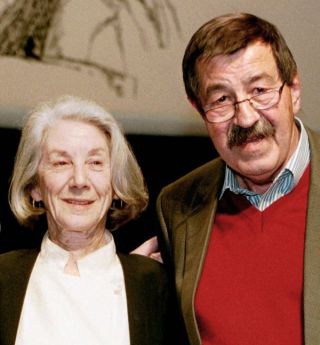
Nobel Prize winners Gunter Grass (R) and the late Nadine Gordimer (L) are two of the prominent members of the international community who have asked UNESCO to protect the cultural heritage of crisis hit Greece. Photo: AP/Christof Stache.

Nobel Prize winners ask UNESCO to protect cultural heritage from the effects of the crisis.

Three Nobel Prize winners and other high-profile individuals have signed an international petition to pressure UNESCO to use its international clout to protect Greek monuments and cultural artefacts from the effects of the crisis.

The Greek Culture Protection petition is reportedly the brainchild of constitutional lawyer George Kasimatis. Effectively it is an effort to go beyond petitioning the Greek state and appeal to the authority of UNESCO to enforce international treaties for the protection of cultural heritage to which Greece is a signatory.

The petition has reportedly already received the backing of several high profile cultural figures including Nobel Prize in Literature winners such as the late Nadine Gordimer, Dario Fo and Günter Grass, the US linguist and philosopher Noam Chomsky, and Greek French director Costa-Gavras amongst others.

The appeal notes the ‘devastating effect’ the economic turmoil is having on Greece’s cultural heritage. The budget of the Ministry of Culture has been more than halved in only 3 years, causing serious problems for the countries 250 organised archaeological sites and 19,000 designated monuments and sites.

“The state authorities can’t implement any more projects concerning the effective protection, conservation, and presentation of monuments and sites. Research and excavations are being abandoned. Museums are closed or shut down entire halls because of a shortage of guards. Clandestine excavations, pillage and illicit trafficking of cultural property increased by 25 per cent in the past 3 years,” writes an explanatory note of the appeal.

Furthermore, the appeal eyes with alarm the prospect of privatisations of Greek archaeological assets, which it says are unconstitutional. According to the Greek constitution and Archaeological Law, archaeological sites and artefacts are national property belonging to all Greeks. “The privatisation and commercialisation of public assets affects this heritage dramatically and weakens its protection and conservation due to the lack of necessary funds.”

The authors also note that the troika-mandated cuts in Greece’s cultural budgets violates UNESCO international treaties to which Greece is a signatory.
“The policy of severe cuts affecting cultural budgets in Greece and in other countries is not in conformity with the relevant UNESCO Treaties.”

The appeal therefore calls upon the director general of UNESCO to use the organisation’s authority via international conventions to ensure that Greece’s archaeological wealth does not become one more sacrifice on the altar of austerity, damaged irreversibly by cutbacks and privatisations. It also asks that the possibility of fund-raising campaigns be launched through the international organisation.

In a not-so-subtle jibe at Greece’s troika of lenders (the European Commission, ECB and IMF) the petition asks that UNESCO “remind Member States and International (Financial) Organisations that cultural heritage, cultural goods and services are vehicles of identity, values and meaning, and must therefore not be treated as having commercial value and should not be considered as objects of privatisation. Further, Member States have the sovereign right to formulate and implement policies aimed at the protection and promotion of the cultural property”.

Cultural property which, if used correctly, the authors believe can help Greece weather its crisis, “as a repository of knowledge, as a driver of economic growth, and as a symbolic force for stability and meaning, to address the challenges of an increasingly complex world”.

Source: thepressproject

Greek Soldiers to sue over wages

imagesCUJ8BZV5

Greek armed forces want their wages restored to pre-2012 levels.

Members of the armed forces and emergency services look set to take legal action to have their wages restored to pre-2012 levels after the government suggested it would not raise their pay to the same standard.

Representatives of the two groups held talks with the president of the Council of State, Sotiris Rizos. The court issued a verdict earlier this year instructing the government to reverse the 10 percent wage cuts it implemented in 2012 and pay soldiers and policemen the salaries they had missed out on since then.

Rizos said he was not in a position to comment on the issue. The public servants now look set to file a suit against the state either at the Supreme Court or the administrative courts.

Source: ekathimerini

Nimetz in Athens without concrete ideas on name dispute

nimetz_440

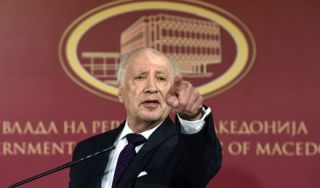
United Nations mediator Matthew Nimitz takes questions from the media during his press conference in the government building in Skopje. Photo: Kathimerini.

United Nations’ special mediator Matthew Nimetz stressed the need for progress.

After visiting the Former Yugoslav Republic of Macedonia (FYROM) where he called for a swift solution to the lingering name dispute with Greece, United Nations’ special mediator Matthew Nimetz arrives in Athens for talks with Foreign Minister Evangelos Venizelos.

Comments made in Skopje suggest that Nimetz would like to scale back the scope of negotiations between the two Balkan neighbours that had recently extended into issues of national identity and language.

“Identity is something I’m not negotiating. Peoples have identities and the UN does not negotiate identities,” Nimetz said.

However, also under growing pressure from EU governments, Nimetz stressed the need for progress. “It is really important to try to resolve issues between countries rather than let them fester on and on,” Nimetz said, although admitting he had only “some ideas” to contribute on how to resolve the dispute.

Source: ekathimerini