Daily Archives: October 13, 2014

Πρόοδος σε αμερικανικό πείραμα πυρηνικής σύντηξης

Πρόοδος σε αμερικανικό πείραμα πυρηνικής σύντηξης

Γαλάζια ηλεκτρικά τόξα πλημμυρίζουν το δωμάτιο όταν το Z Machine τεθεί σε λειτουργία (Πηγή: Sandia National Laboratories)

Μια κολοσσιαία γεννήτρια που δημιουργήθηκε από το αμερικανικό Πεντάγωνο για προσομοιώσεις θερμοπυρηνικών εκρήξεων πέτυχε νέο ρεκόρ απόδοσης σε πειράματα πυρηνικής σύντηξης, ένα είδος πυρηνικής αντίδρασης που θα μπορούσε μια μέρα να προσφέρει ανεξάντλητη, καθαρή ενέργεια.

Το «Z Machine», μια γιγάντια πειραματική διάταξη στα Εθνικά Εργαστήρια Sandia στο Νέο Μεξικό, παράγει παλμούς ηλεκτρικής ενέργειας με ισχύ πολλών εκατομμυρίων Ampere. Το ρεύμα περνάει μέσα από μια μικρή κάψουλα με υδρογόνο, το οποίο φτάνει σε θερμοκρασίες εκατομμυρίων βαθμών Κελσίου και μετατρέπεται έτσι σε ήλιο.

Σε αντίθεση με την πυρηνική σχάση, η οποία απελευθερώνει ενέργεια από τη διάσπαση βαρέων στοιχείων όπως το ουράνιο, η πυρηνική σύντηξη αφορά τις αντιδράσεις που τροφοδοτούν τη λάμψη των άστρων, αντιδράσεις στις οποίες ελαφρά στοιχεία συνδυάζονται για να σχηματίσουν βαρύτερα.

Δεδομένου ότι η σύντηξη δεν παράγει μακρόβια πυρηνικά απόβλητα, ενώ το υδρογόνο που απαιτείται ως καύσιμο μπορεί να παραχθεί σε πρακτικά ανεξάντλητες ποσότητες με υδρόλυση του νερού, οι φυσικοί προσπαθούν εδώ και 60 χρόνια να δαμάσουν αυτή τη μορφή ενέργειας.

Είναι ένας δύσκολος στόχος, δεδομένου ότι οι συνθήκες που απαιτούνται για σύντηξη είναι πραγματικά ακραίες: οι πυρήνες των ατόμων είναι θετικά φορτισμένοι και απωθούνται, είναι επομένως δύσκολο να πλησιάσουν σε αρκετά μικρή απόσταση ώστε να αντιδράσουν. Για να συμβεί αυτό το οι πυρήνες πρέπει να συγκρουστούν με ταχύτητες γύρω στα 1.000 χιλιόμετρα το δευτερόλεπτο, κάτι που απαιτεί θερμοκρασίες γύρω στα 50 εκατομμύρια βαθμούς Κελσίου.

Σε όλο τον κόσμο δοκιμάζονται σήμερα διάφορες προσεγγίσεις. Η πλέον υποσχόμενη θα μελετηθεί την επόμενη δεκαετία στον Διεθνή Πειραματικό Θερμοπυρηνικό Αντιδραστήρα (ITER), στον οποίο ένα σύννεφο υπέρθερμου υδρογόνου θα συγκρατείται μετέωρο μέσα σε ένα ισχυρό μαγνητικό πεδίο. Μια δεύτερη προσέγγιση, η συμπίεση μιας κάψουλας υδρογόνου με ισχυρούς παλμούς ακτινοβολίας, δοκιμάζεται με τη βοήθεια του ισχυρότερου λέιζερ στον κόσμο.

Μέχρι στιγμής, πάντως, κανένα πείραμα σύντηξης δεν έχει καταφέρει να απελευθερώσει περισσότερη ενέργεια από αυτή που απαιτείται για τη θέρμανση του υδρογόνου -μια βασική προϋπόθεση για να γίνει πρακτικά βιώσιμη η νέα τεχνολογία.

Λίγο πιο κοντά σε αυτόν τον στόχο βρίσκονται πλέον οι ερευνητές του Ζ Machine, μιας γεννήτριας παλμών ηλεκτρικής ενέργειας που είχε αρχικά αναπτυχθεί για την προσομοίωση θερμοπυρηνικών εκρήξεων για λογαριασμό του Πενταγώνου (η ερευνητική υπηρεσία Sandia υπάγεται στο υπουργείο Άμυνας).

Στην καρδιά της πειραματικής διάταξης βρίσκεται μια κάψουλα με υδρογόνο (για την ακρίβεια περιέχει το ισότοπο του υδρογόνου δευτερίου) με διαστάσεις μόλις 5 x 7,5 χιλιοστά. Η τεράστια γεννήτρια στέλνει στην κάψουλα παλμούς ηλεκτρικού ρεύματος στην απίστευτη ένταση των 19 εκατομμυρίων ampere, οπότε δημιουργείται ένα ισχυρό μαγνητικό πεδίο που κάνει την κάψουλα να καταρρεύσει προς τα μέσα με ταχύτητα γύρω στα 70 χιλιόμετρα το δευτερόλεπτο, οπότε δημιουργούνται στο εσωτερικό της συνθήκες σύντηξης.

Στον τελευταίο γύρο δοκιμών το Z Machine θέρμανε το πυρηνικό καύσιμο στους 35 εκατομμύρια βαθμούς Κελσίου και οδήγησε στην απελευθέρωση περίπου δύο τρισεκατομμυρίων νετρονίων ανά βολή. Ο αριθμός των νετρονίων είναι μέτρο των αντιδράσεων σύντηξης, καθώς η σύντηξη δύο πυρήνων δευτερίου απελευθερώνει έναν πυρήνα ήλιου και ένα νετρόνιο.

Η παραγωγή πρωτονίων έχει πλέον αυξηθεί κατά 1.000 φορές σε σχέση με την απόδοση που προσέφερε το Z Machine πριν από μόλις έναν χρόνο, αναφέρουν οι υπεύθυνοι του πειράματος στην έγκριτη επιθεώρηση Physical Review Letters.

Παρόλα αυτά, η απόδοση θα πρέπει να αυξηθεί περαιτέρω κατά 10.000 φορές μέχρι να ξεπεράσει η ποσότητα της παραγόμενης ενέργειας την ενέργεια που καταναλώθηκε στο πείραμα, επισημαίνει στο Nature.com ο Μάικ Κάμπελ, ερευνητής της Sandia.

Το επόμενο βήμα για την επίτευξη αυτού του στόχου θα μπορούσε να έρθει με την αύξηση της έντασης του ηλεκτρικού ρεύματος στα 60 εκατομμύρια ampere. Η αναβάθμιση, όμως, δεν έχει ακόμα εγκριθεί.

Πηγή:in.gr

Stress over brothel phone calls drove Greek Australian to kill wife

George Misalis

George Misalis arrives at the Supreme Court in a prison van. Picture: Jay Town

George Misalis killed his wife Zaharia in 2013 after a number of “stressors” in his life.

A 61-year-old Greek Australian man killed the love of his life after becoming depressed because he was under investigation for a rape case 30 years ago, and the couple’s home had been bombarded with misdirected phone calls to a Melbourne brothel, a court has heard.

George Misalis killed his wife Zaharia in March 2013 in a mystifying attack that he has been unable to explain, other than to claim she had made an inflammatory comment.

Misalis strangled his wife of nearly 40 years with a ligature in their South Morang home before stabbing her body with scissors.

At a plea hearing, his lawyer Peter Morrissey SC told Justice Betty King that Misalis had plunged into depression shortly before the murder.

This followed him being interviewed by police about a 30-year-old rape and falling from a balcony, rendering him unable to work.

“He had a number of stressors and he just wasn’t able to handle them,” Mr Morrissey said.

The couple’s home had also been subjected to repeated calls from ‘brothel seekers’ because their home number was similar to a brothel in Carlton.

“There were beastly individuals on the other end of the line,” Mr Morrissey said.

The couple had three children, who provided their father with a character reference.

Misalis initially pleaded not guilty to his wife’s murder but subsequently changed his plea to guilty, avoiding a trial.

He will be sentenced at a later date.

Source: Herald Sun

Safari shot garners Greek boy top award nomination

Safari shot garners Greek boy top award nomination

Leon’s “Watchful Cheetah” photo.

Leon Petrinos nominated for best Wildlife Photographer of the Year for his “Watchful Cheetah” photo.

‘The Watchful Cheetah’, an image of a female big cat resting in the grass at the Maasai Mara reserve in Kenya, has propelled young Greek shutterbug Leon Petrinos into the under-10 category of the prestigious international competition for best Wildlife Photographer of the Year, presented by London’s Natural History Museum and the BBC, and celebrating its 50th anniversary this year.

Petrino’s image of the feline is among 42,000 photographs from 96 countries submitted to the competition. He was eight years old when he captured the shot while on safari in the east African country with his family.

“You can tell the animal’s feelings from the look in the eye, the way the fur lies and the ears move,” Leon says in the note accompanying his entry. He particularly likes portraits, he says, because “the animal’s feelings talk to you”.

Presenter at this year’s award ceremony at the Natural History Museum in London on October 21 is David Attenborough, who will announce the winners selected by a panel of judges, including American environmentalist and photographer Jim Brandenburg, Norwegian photographer Pal Hermansen and South Korean curator Sujong Song.

All 100 photographs will be exhibited at the NHM from October 24 to August 30.

Source: Kathimerini

Philhellene David Hill assembles his monuments men

Philhellene David Hill assembles his monuments men

Despite overwhelming public support to see the marbles returned, the British government is unmoved on the issue.

George Clooney’s new wife Amal Alamuddin will be in Greece this week alongside two other prominent international lawyers to advise the Greek government on what its next steps should be in getting the Parthenon Marbles back. Heading the group, Australian David Hill talks to Neos Kosmos about what’s next for the ongoing deadlock.

George Clooney’s new wife Amal Alamuddin might have stolen the limelight off the troop of four heading to Greece to help Greece’s case to the Parthenon Marbles, but its coordinator, Australian David Hill is confident the publicity will help put more pressure on the British.

Mr Hill has been in Greece for the past three weeks getting ready to meet with Greek Prime Minister Antonis Samaras, while working to assemble three famous international lawyers, Geoffrey Robertson, Amal Alamuddin and Professor Norman Palmer to work on a legal case to get the marbles back home.

As the president of the International Association for the Reunification of the Parthenon Sculptures, Mr Hill has seen years of talks between the two countries end fruitlessly, despite the tries of large international bodies like UNESCO.

The meeting scheduled for Tuesday and Wednesday will be the first time Greece will consider its legal options.

Mr Hill says it’s in Greece’s best interest to up the ante and address its legal rights.

“I don’t think it has any alternative,” Mr Hill told Neos Kosmos from Greece.

“I think Greece should now look at its legal entitlements and its legal rights and consider a legal claim.”

Mr Hill was asked by Prime Minister Samaras to assemble a group of prominent international lawyers to advise the government of what its legal claim
might be, resuming a plan Greece had in the works for years.

The former Papandreou government was set to do the same until the financial crisis stopped the talks.

Amal Alamuddin was actually going to be legal counsel on the topic in 2011 before the meetings were cancelled.

Now, a team of three coincidentally British high-profile lawyers will front the case for Greece.

Mr Hill, himself a British born Australian child migrant says he chose the three for their expertise in the field, not for their profile.

“I think we’ve got, in those three people it’s a repository of extraordinarily high calibre advice,” he says.

“You’d be hard pressed to do better.”

Greece has been reluctant in the past to start legal proceedings fearing it will look confrontational, but after 15 years of the same response from the British and trying everything in its arsenal to get them to the negotiating table, the government is out of patience.

If the case does reach litigation, it won’t be the first of its kind Mr Hill says.

“All over the world there where there is dispute on cultural property people resort to having the matter rationally and fairly sorted out through the judicial process,” he says.

“In fact a lot of people would say what took the Greeks so long to do this.

“It’s not a precedent, it’s far from it. It’s very reasonable and sensible.”

After so many years, the British approach to the matter hasn’t changed despite the growing international chorus of disapproval.

Surprisingly, British locals are very much in favour of returning the marbles to Greece. A poll in the Guardian newspaper saw 88 per cent of respondents want to see the marbles returned.

Sadly all three British prime ministers and the British Museum have been immovable on the issue.

In the meetings, Mr Hall and the contingent will also meet with Greece’s deputy prime minster Evangelos Venizelos, the culture minister Konstantinos
Tasoulas and director of the Acropolis Museum Dimitrios Pandermalis.

It’s hoped the government can decide on its next steps to tackling the issue before it becomes too late.

As a true Philhellene, Mr Hill says the issue is still as important as ever.

“There aren’t many situations where you come across a great wrong that can be righted. And here’s one that can be,” he says.

Married to a Greek woman, and with his 13-year-old son studying the language at Greek school, Mr Hill has never wavered from his campaign to have
the marbles returned.

“Since I first saw the Parthenon marbles in Athens in the sculptures in the British museum I always been struck by the injustice,” he says,
“It is a great wrong to leave these statues and sculptures in Britain. They should be in Greece.”

source: Neos Kosmos

Greece – Australia Work and Holiday visa: Greek Government not interested!

Visa fury

Signed, sealed but not yet delivered: Greece’s Minister for Tourism Olga Kefalogianni and Immigration Minister Scott Morrison sign the Work and Holiday visa agreement in Canberra in May.

Six months after Greece and Australia signed an agreement to introduce a Work and Holiday visa for young people to visit and find temporary employment in each others’ countries, the start of the scheme is still way off, and the reason for the hold-up has to be laid squarely at the door of the Greek government.

Neos Kosmos has identified that legislation in Greece to allow the program to start is yet to come before the Greek parliament, and before it does, it needs to jump the not inconsiderable hurdle of being signed by seven ministers, representing foreign affairs, tourism, health, the national economy, labour, education and development.

After being signed off at ministerial level, Neos Kosmos understands the bill will pass to the secretariat of the Greek cabinet, who will then brief the parliamentary committee on foreign affairs. Only then will it be finally voted on by the Greek Parliament.

A simple process it is not, and it is one that now begs the question as to whether the Greek Government has a motive for keeping the reciprocal visa on the shelf.

Greece’s Ambassador to Australia His Excellency Mr Haris Dafaranos explained his government’s actions this week, telling Neos Kosmos: “There is a ratification process which is continuing, and we the embassy have asked the competent authorities to expedite the process as soon as possible.”

A spokesman for Greece’s Ministry of Tourism followed suit, saying that verification of the agreement was “in process and will take some months.”
But while bureaucratic procedures may present a rational explanation, the Greek community in Australia has become increasingly exasperated over the affair, and its frustration has reached fever pitch.

While the convoluted workings of the Hellenic Republic’s internal bureaucracy is the prime suspect in the delay, others believe there may be more to the situation than meets the eye, with the problem going beyond a document lying forlorn in the bulging in-tray of a ministerial desk.

Despite Prime Minister Antonis Samaras recently talking up Greece’s ability to reduce unemployment next year, last week the OECD reported the country’s unemployment rate will remain around 27 per cent to the end of 2015.

Despite “moderate signs of recovery” according to OECD, the rate will remain stuck at close to its highest level since the onset of the economic crisis in 2008.

For young Greeks the situation is even worse. For the twelve months to July, the youth unemployment rate in Greece has hovered between 59 per cent and 51 per cent.

For some, it’s one reason why the Greek Government might find opening new doors to foreigners, eager to take the few jobs on offer, politically sensitive.

An alternative theory lies in Greece’s reticence to encourage a further brain drain, with many young Greeks continuing to look for opportunities abroad.

If either view holds any sway, going slow on ratifying the agreement and others like it, might be understandable in the ‘realpolitik’ affecting Greece’s coalition government that holds a narrow majority in the 300-seat parliament.

Victorian Federal MP Maria Vamvakinou, who took part in discussions over the visa’s introduction with Greece’s Deputy Foreign Minister Kosta Tsiaras last year, told Neos Kosmos that “given the protracted nature of this visa coming into affect, one can only now question the will of the Greek Government.”

“One has to ask, beyond due process, what other reasons might there be for their bureaucracy to stall?” said Ms Vamvakinou.

“Australia’s Greek community are frustrated over this issue, and are asking serious questions as to the Greek Government’s commitment to introducing the visa.”

President of the Greek Orthodox Community of Melbourne and Victoria, Bill Papastergiadis, said he was “dismayed and disappointed” that the visa’s introduction could still not be determined.

“We had a senior minister here in May who apparently ratified the agreement and we’ve heard absolutely nothing since.

“What the situation tells us, is that there is a complete lack of interest by the Greek Government on this issue, an issue so vital to the diaspora in Australia.”

Mr Papastergiadis, who was at the helm of GOCMV four years ago when it began lobbying the Australian and Greek governments to initiate the reciprocal visa agreement, said that Greece’s inaction since the agreement’s signing affected the standing of the Greek Government in Australia and globally.

“Working Holiday visa agreements have been ratified by Australia and are in force with practically every other European country,” he said.

“We will now write to Prime Minister Antonis Samaras on this matter to ask him personally to intervene and expedite the agreement.”

Meanwhile, an identical work and holiday visa agreement was signed by Australia with Poland on 28 March this year, just six week before Greece’s Tourism Minister Olga Kefalogianni and Immigration Minister Scott Morrison signed the Greece/Australia agreement in May.

Australia’s Work and Holiday visa program with Poland has been up and running since August 1.

source: Neos Kosmos

«Λυτρώθηκε» με Ρούνεϊ η Αγγλία

«Λυτρώθηκε» με Ρούνεϊ η Αγγλία

Με τον Γουέιν Ρούνεϊ να σκοράρει στο 73’ η Αγγλία νίκησε με σκορ 1-0 την Εσθονία στο Ταλίν, στο παιχνίδι για την τρίτη αγωνιστική των προκριματικών για το Euro 2016. Τα «λιοντάρια» έφτασαν με άνεση τους 9 βαθμούς στον 5ο όμιλο και έχουν συγκομιδή γκολ 8-0!

Για τον τρίτο όμιλο η Ουκρανία επικράτησε στο Λβιβ με 1-0 των Σκοπίων και ανέβηκε στους 6 βαθμούς. Τέλος, η Ρωσία… κόλλησε στο 1-1 στην Μόσχα με αντίπαλο την Μολδαβία.

Η 3η αγωνιστική:

3ος ΟΜΙΛΟΣ
Ουκρανία – Σκόπια 1-0 (45’+2 Σίντορτσουκ)
Λευκορωσία – Σλοβακία (21:45)
Λουξεμβούργο – Ισπανία (21:45)

Η βαθμολογία

1. Σλοβακία 6 (3-1)
2. Ουκρανία 6 (3-1)
3. Ισπανία 3 (6-3)
4. Σκόπια 3 (4-8)
5. Λευκορωσία 1 (1-3)
6. Λουξεμβούργο 1 (3-4)

5ος ΟΜΙΛΟΣ

Εσθονία – Αγγλία 0-1 (73′ Ρούνεϊ)
Λιθουανία – Σλοβενία (21:45)

Η βαθμολογία

1. Αγγλία 9 (8-0)
2. Λιθουανία 6 (3-0)
3. Σλοβενία 3 (1-1)
4. Εσθονία 3 (1-2)
5. Ελβετία 0 (0-3)
6. Σαν Μαρίνο 0 (0-7)

7ος ΟΜΙΛΟΣ

Αυστρία – Μαυροβούνιο 1-0 (24′ Οκότιε)
Ρωσία – Μολδαβία 1-1 (73′ πέν. Τζιούμπα / 74′ Επουρεάνου)
Σουηδία – Λίχτενσταϊν (21:45)

Η βαθμολογία

1. Αυστρία 7 (4-2)
2. Ρωσία 5 (6-2)
3. Μαυροβούνιο 4 (2-1)
4. Σουηδία 2 (2-2)
5. Μολδαβία 1 (2-5)
6. Λίχτενσταϊν 1 (0-4)

Πηγή: zougla.gr

Nέα ευρήματα στην Αμφίπολη: ψηφιδωτό δάπεδο πίσω από τις Καριυάτιδες

Ρεπορτάζ: Xρήστος Μαζάνης

Δέος και θαυμασμό σε όλη την αρχαιολογική κοινότητα προκαλούν τα νέα ευρήματα του ταφικού μνημείου της Αμφίπολης, που είδαν το φως της δημοσιότητας την Κυριακή. Το ψηφιδωτό δάπεδο πίσω από των χώρο των Καρυάτιδων είναι μοναδικό, ενώ, σύμφωνα με διακεκριμένους αρχαιολόγους που μίλησαν στο zougla.gr, θα δώσει περισσότερα στοιχεία για την ταυτότητα του νεκρού ή των νεκρών. Αν και από την πλευρά κάποιων επιστημόνων υπάρχει ακόμα επιφυλακτικότητα στο να κάνουν δηλώσεις, φαίνεται ότι υπάρχει ένα σημείο στο οποίο πολλοί συμφωνούν. Κι αυτό αφορά τον συμβολισμό του Ερμή ως ψυχοπομπού.

Ωστόσο, εξαιρετικό ενδιαφέρον παρουσιάζει το γεγονός ότι στον τάφο της Περσεφόνης στις Αιγές, υπάρχει μία αναπαράσταση η οποία φέρεται να παρουσιάζει πολλές ομοιότητες με το συγκεκριμένο ψηφιδωτό!

Ο Ερμής ως ψυχοπομπός οδηγούσε τις ψυχές στον Κάτω Κόσμο, δηλαδή στον ΆδηΑδιαμφισβήτητα λοιπόν, ο Ερμής, ο οποίος απεικονίζεται και στο ψηφιδωτό της Αμφίπολης, θεωρούνταν πως οδηγούσε τις ψυχές στον Κάτω Κόσμο, δηλαδή στον Άδη. Σύμφωνα όμως με κάποιους ερευνητές και ιστορικούς, ο Ερμής οδηγούσε και άρμα θεοτήτων.

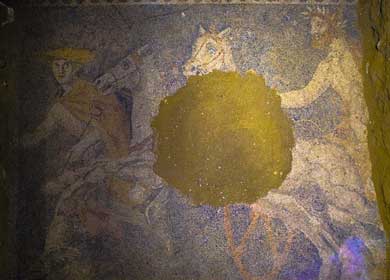
Το ποιος είναι τελικά ο δαφνοστεφανωμένος άνδρας πάνω στο άρμα στο εσωτερικό του ταφικού μνημείου στον λόφο Καστά, αλλά και το τι κρύβεται στον επόμενο χώρο θα το διαπιστώσει η αρχαιολογική έρευνα, η οποία συνεχίζεται. Η κεντρική παράσταση πάντως απεικονίζει άρμα σε κίνηση που σύρεται από δύο λευκά άλογα και το οδηγεί γενειοφόρος άνδρας με στεφάνι δάφνης στο κεφάλι. Μπροστά από το άρμα απεικονίζεται ο θεός Ερμής ως ψυχοπομπός, ο οποίος φορά πέτασο, μανδύα, φτερωτά σανδάλια και κρατά κηρύκειο. Η σύνθεση έχει κατεύθυνση από τα ανατολικά προς τα δυτικά.


(Ερμής Πετασοφόρος Ψυχοπομπός – Μακεδονικό 325 300 π.Χ. Αμφίπολη τύμβος Καστά)

Τι λέει η μυθολογία για τον Ερμή που έφερνε τους νεκρούς στον Κάτω Κόσμο

Ο Ερμής, γνωστός και με το επικό Ερμείας, είναι ένας απ’ τους παλαιότερους θεούς με γνήσια ελληνική λαϊκή καταγωγή. Κατά τη μυθολογία, γεννήθηκε σε μια σπηλιά στην Κυλλήνη (στο σημερινό όρος Ζήρια) της Κορινθίας, από τον Δία και την πανέμορφη νύμφη Μαία, την κόρη του Άτλαντα.

(Πολλές είναι οι αρχαίες πηγές που παρουσιάζουν τον Ερμή συνδεδεμένο με καθαρά χθόνιες θεότητες, όπως είναι η Δήμητρα, ο Πλούτων, ο Τροφώνιος κ.ά.)


(Ο ψυχοπομπός Ερμής σε αγγειογραφίες εμφανίζεται να επαναφέρει στον Επάνω Κόσμο τη βασίλισσα του Άδη, την Κόρη Περσεφόνη)

Στον Όμηρο μνημονεύεται με το αρχαιότερο όνομά του Ερμής ο Κυλλήνιος, αλλά και με τους επιθετικούς προσδιορισμούς «εύσκοπος αργεϊφόντης», «διάκτορος», δηλαδή ψυχοπομπός. Στον Όμηρο χρησιμοποιούνται συχνότερα τα επίθετα «χρυσόραβδος» και «αγγελιοφόρος», ενώ στον Ησίοδο αποκαλείται «ξακουστός κήρυκας των θεών» και «προστάτης των βοσκών και των αιγοπροβάτων».

Η μυθολογία αναφέρει ότι αμέσως μετά τη γέννησή του επινόησε και κατασκεύασε την πρώτη λύρα και έδειξε, από τη βρεφική του ακόμη ηλικία, την επιδεξιότητά του να μπορεί να κλέβει ακόμη και τα βόδια του Απόλλωνα.


(Ερμής σε ζωγραφική αγγείου από την Ν.Δήλο 450-400 π.Χ.)


(Βυζαντινό μωσαϊκό του 5-6 αι μ.Χ.)

Ο Ερμής, όπως και ο Προμηθέας, επειδή ανακάλυψε τη φωτιά και τα πυρεία, και συγχρόνως τη θυσία, προφανώς μια θυσία για το δωδεκάθεο, θεωρείται κατά βάση «ένας ανταγωνιστής του δόλιου πυρφόρου Προμηθέα».

Ο Ερμής γρήγορα εξελίχθηκε σε τόσο πολυσχιδή θεότητα, ώστε κάλυπτε σχεδόν κάθε εκδήλωση της ζωήςΜολονότι στην επική ποίηση φαίνεται να έχει βοηθητική θέση έναντι των άλλων ολύμπιων θεών, πολύ γρήγορα εξελίχθηκε σε τόσο πολυσχιδή θεότητα, ώστε κάλυπτε σχεδόν κάθε εκδήλωση της ζωής. Είναι ο πλέον πολυάσχολος θεός, καθώς έχει πολλά καθήκοντα στον Επάνω Κόσμο: κατ’ αρχάς είναι ο αγγελιοφόρος του Δία, είναι επίσης θεός των διασταυρώσεων των δρόμων και των ορίων-συνόρων (Ερμής Τρικέφαλος ή Τετρακέφαλος), προστάτης των θυρών των σπιτιών και των πυλών των ναών (Πύλαιος και Προπύλαιος Ερμής), θεός των γραμμάτων και της ρητορικής (λόγιος Ερμής), προστάτης των αθλητών και των αγώνων (αγώνιος Ερμής), προστάτης των εμπόρων (αγοραίος και κερδώος Ερμής). Μάλιστα προστάτευε όχι μόνο το θεωρούμενο σήμερα ως νόμιμο, αλλά και το τυχαίο εύρημα, το λεγόμενο έρμαιον, που σημαίνει «δώρο του Ερμή», δηλαδή το θεόσταλτο δώρο (εξ ου και Ερμής Τύχων) ή το απροσδόκητο πολύτιμο εύρημα ή ακόμη και το προϊόν κλοπής ή αρπαγής (εξ ου και άναξ φηλητών ή δόλιος ή ληιστήρ Ερμής). Διαβάστε περισσότερα ΕΔΩ.

O τάφος της Περσεφόνης στις Αιγές και οι ομοιότητες

Μεγάλες ομοιότητες υπάρχουν με την παράσταση του τάφου της Περσεφόνης στη Βεργίνα
Όπως ανέφεραν αρχαιολόγοι στο zougla.gr, στις Αιγές και συγκεκριμένα στον τάφο της Περσεφόνης υπάρχει μια παράσταση η οποία φέρεται να έχει κάποιες ομοιότητες με αυτήν του ταφικού μνημείου της Αμφίπολης.


(Παράσταση που βρίσκεται στον τάφο της Περσεφόνης στις Αιγές)

Τι αναφέρει η αρχαιολόγος Αγγελική Κοτταρίδη για τον τάφο της Περσεφόνης
στις Αιγές

Όπως αναφέρει η διευθύντρια της ΙΖ Εφορείας Προϊστορικών και Κλασσικών Αρχαιοτήτων, υπεύθυνη για τον αρχαιολογικό χώρο των Αιγών, Αγγελική Κοτταρίδη, πρόκειται για «τάφο χτισμένο με ιδιαίτερη προσοχή από μεγάλους πώρινους γωνιόλιθους, με διαστάσεις 3Χ4,5 μ. κι είναι ένα από τα μεγαλύτερα μνημεία του είδους του που έχουν βρεθεί, ωστόσο παρά το μέγεθός του το μνημείο δεν έχει πρόσοψη και κανονική είσοδο και εξακολουθούσε να λειτουργεί σαν υπόγεια θήκη, όπου η ταφή έγινε από πάνω.

Ο τάφος είχε συληθεί πιθανότατα από τους Γαλάτες που λεηλάτησαν την βασιλική νεκρόπολη των Αιγών. Η λιγοστή κεραμική που βρέθηκε μέσα σ’ αυτόν δείχνει πως χρονολογείται γύρω στο 350 π.Χ.

Το μνημείο ανήκε σε μια νεαρή γυναίκα περίπου 25 χρονών που πρέπει να πέθανε στη γέννα και θάφτηκε εδώ μαζί με το βρέφος της. Τα οστά ενός άντρα που υπήρχαν μέσα στα πεσμένα χώματα, από τον τρόπο και τη θέση που βρέθηκαν, φαίνονται να σχετίζονται με την μεταγενέστερη τυμβωρυχία, πράγμα όχι ασυνήθιστο στη νεκρόπολη των Αιγών.

Η γειτνίαση του τάφου της με εκείνον του Φιλίππου Β΄ δείχνει πως η γυναίκα αυτή θα πρέπει να ήταν μια από τις επτά συζύγους του βασιλιά, πιθανότατα η Νικησίπολις από τις Φερές, η μητέρα της Θεσσαλονίκης».

Το διακοσμητικό πλαίσιο του ψηφιδωτού και η ασπίδα του Φιλίππου 

Υπάρχει ακόμα μια παρατήρηση που επισημαίνουν στο zougla.gr ιστορικοί και ερευνητές. Στο ανάκτορο των Αιγών υπάρχει ένα διακοσμητικό πλαίσιο στην ασπίδα του Φιλίππου το οποίο φέρεται να μοιάζει με αυτό του ψηφιδωτού της Αμφίπολης.


(Το διακοσμητικό πλαίσιο του ψηφιδωτού της Αμφίπολης)

(Η ασπίδα του Φιλίππου)

Δείτε το οδοιπορικό του zougla.gr και ξεναγηθείτε στον αρχαιολογικό χώρο των Αιγών:
Στους τάφους των Μακεδόνων βασιλιάδων

Διακεκριμένοι αρχαιολόγοι και ερευνητές μιλούν στο zougla.gr για τα νέα ευρήματα

Η ηλεκτρονική μας εφημερίδα συνομίλησε με διακεκριμένους ιστορικούς ερευνητές και αρχαιολόγους, οι οποίοι εξέφρασαν μεταξύ άλλων τον θαυμασμό τους για τα νέα ευρήματα, ενώ κάποιοι από αυτούς εξήγησαν και τον συμβολισμό του συγκεκριμένου ψηφιδωτού.

«To ψηφιδωτό θα δώσει νέα σημαντικά στοιχεία για το ταφικό μνημείο»

Ο διακεκριμένος ιστορικός-ερευνητής και πρόεδρος του Ινστιτούτου Μελετών Αρχαίας και Μεσαιωνικής Αλεξάνδρειας Χάρης Τζάλας ανέφερε στο zougla.gr πως αυτή η νέα ανακάλυψη είναι πάρα πολύ σημαντική και θα βοηθήσει στη χρονολόγηση όλου του μνημείου. Όπως υποστήριξε: «Ένα ψηφιδωτό με βότσαλα είναι κάτι πάρα πολύ σημαντικό. Πρέπει η ανασκαφέας να είναι πολύ ικανοποιημένη, διότι το εύρημα αυτό θα δώσει πολλές σημαντικές πληροφορίες. Η παράσταση πρέπει να μελετηθεί. Δεν είναι συνηθισμένο να έχουμε σε τάφους τόσο μεγάλες παραστάσεις και ψηδιφωτές. Αυτό είναι κάτι ξεχωριστό». Όσον αφορά τον συμβολισμό του Ερμή ως ψυχοπομπού, ο κ. Τζάλας προσθέτει:«Στις παραστάσεις έχουμε την απαγωγή της Περσεφόνης σε διάφορους τάφους στην Αλεξάνδρεια. Είναι ό,τι έχει σχέση με την ψυχή που φεύγει, που πάει παραπέρα. Αυτά είναι μοτίβα νεκρικά και συνηθισμένα».

«Η μορφή με τη γενειάδα υποθέτω ότι είναι ο νεκρός»

«Είναι συγκλονιστική αυτή η εικόνα που βλέπουμε. Είναι ένα θαυμάσιο ψηφιδωτό και είναι πολύ συμβολικό. Ο Ερμής είναι ο θεός που μεταφέρει τις ψυχές στον Άδη και υποθέτω ότι και η άλλη μορφή με τη γενειάδα πρέπει να είναι ο νεκρός. Άρα πλησιάζουμε στη λύση του μυστηρίου» λέει στο zougla.gr η διακεκριμένη αρχαιολόγος Καλλιόπη Λημναίου-Παπακώστα. Παράλληλα επισημαίνει: «Έχουμε πάντως την παράσταση με τον Πλούτωνα και την Περσεφόνη σε μακεδονικό τάφο στη Βεργίνα. Είναι μια παράσταση που μας οδηγεί στον συμβολισμό της ζωής μετά τον θάνατο».

Ο Ερμής της Αρχαίας Μεσσήνης

Ο αρχαιολόγος Πέτρος Θέμελης, μιλώντας στο zougla.gr, αναφέρθηκε μεταξύ άλλων και στο άγαλμα του Ερμή ως ψυχοπομπού που έχει βρεθεί στην Αρχαία Μεσσήνη. «Της Μεσσήνης ο Ερμής, σε μαρμάρινο άγαλμα εικονιζόμενος, ήτανε ψυχοπομπός. Κρατούσε στο δεξί του χέρι το κηρύκειο, το σύμβολό του, και οδηγούσε τις ψυχές των νεκρών στον άλλον κόσμο, οι οποίες απεικονίζονται καμιά φορά ως θνητοί, πάνω σε άρμα. Κάποιες φορές όμως ο Ερμής οδηγεί και άρμα θεοτήτων» αναφέρει.


(Ο Ερμής της Μεσσήνης απεικονίζεται στη θέση όπου αποκαλύφθηκε)

«Πρέπει να ανοίξει ο τάφος για να μάθουμε τον νεκρό»

Ο Βασίλειος Πετράκος, αρχαιολόγος, ακαδημαϊκός και γενικός γραμματέας της Εν Αθήναις Αρχαιολογικής Εταιρείας, μιλώντας στο zougla.gr εμφανίστηκε επιφυλακτικός όσον αφορά τον νεκρό. Όπως δήλωσε: «Ο Ερμής έπαιρνε τις ψυχές και τις πήγαινε στον Άδη. Το ψηφιδωτό αυτό εικονογραφεί το ταξίδι του νεκρού. Το ποιος είναι ο νεκρός θα το δούμε όταν ανοίξει ο τάφος. Το άρμα πάντως δείχνει έναν πλούτο».

«Στο ψηφιδωτό απεικονίζεται ο νεκρός»

Ο Μιχάλης Τιβέριος, ακαδημαϊκός και καθηγητής κλασικής αρχαιολογίας στο Αριστοτέλειο Πανεπιστήμιο Θεσσαλονίκης, δήλωσε πως «σε αυτό το ψηφιδωτό απεικονίζεται ο νεκρός, ο οποίος βρίσκεται πάνω στο άρμα, και ο Ερμής τον οδηγεί στον κάτω κόσμο». «Ο Ερμής ο ψυχοπομπός απαντά σε μακεδονικούς τάφους και γενικά σε τάφους. Σε ψηφιδωτό όμως, είναι το πρώτο που ξέρουμε. Είναι ένας μακεδονικός τάφος πρωτόγνωρης μορφής. Το ψηφιδωτό αυτό εικονίζει τη μεταφορά του κατόχου του τάφου στον Κάτω κόσμο από τον Ερμή» πρόσθεσε ο καθηγητής.

«Ο νεκρός επέλεξε για τον τάφο του ένα θέμα μυθολογικό»

Η αρχαιολόγος Ευτέρπη Μαρκή, πρώην συνεργάτιδα του αείμνηστου Δημήτρη Λαζαρίδη, σε δηλώσεις της στην ηλεκτρονική μας εφημερίδα δηλώνει ενθουσιασμένη από τα νέα ευρήματα στον λόφο Καστά. «Αδιαμφισβήτητα ο Ερμής είναι ψυχοπομπός, δηλαδή αυτός που συνοδεύει τους νεκρούς. Απ’ ό,τι είδα, ο άνδρας ο οποίος βρίσκεται πάνω στο άρμα πρέπει να είναι κατά πάσα πιθανότητα ο νεκρός. Δαφνοστεφανωμένος και ο Ερμής που τον οδηγεί στον Άδη. Στοιχεία για τον Ερμή έχουμε από τον Όμηρο και τη μυθολογία. Είναι ένα σπάνιο ψηφιδωτό, πολύ ωραίο. Δείχνει έναν άνθρωπο ο οποίος επέλεξε για τον τάφο του ένα θέμα μυθολογικό. Έχει παιδεία, έχει μόρφωση. Το άρμα δείχνει πλούτο».

«Ο ηνίοχος είναι ο Θεός Πλούτωνας»

O καθηγητής του τμήματος Ιστορίας και Αρχαιολογίας του Πανεπιστημίου Κύπρου Θεόδωρος Μαυρογιάννης δίνει μια άλλη εκδοχή για το ποιος είναι ο άνδρας πάνω στο άρμα. Μιλώντας στο zougla.gr, υποστηρίζει ότι είναι ο Πλούτωνας. «Το ψηφιδωτό αυτό επιβεβαιώνει οπωσδήποτε τη χρονολογία της κ. Περιστέρη και μάλιστα εγώ πιστεύω ότι είναι πριν το 315 π.Χ.. Πρέπει να είναι περί το 320 π.Χ. Όσον αφορά την εικονογραφία, ο ηνίοχος, δηλαδή αυτός που βρίσκεται πάνω στο άρμα, κατά πάσα πιθανότητα είναι ο Πλούτων. Αυτό βέβαια θα το δούμε στη συνέχεια. Ο Ερμής ο οποίος προηγείται του άρματος του Πλούτωνα είναι γνωστό θέμα. Είναι ο Πλούτων, κατά την άποψή μου. Ο Θεός του Κάτω Κόσμου. Επειδή φοράει στεφάνι, δεν σημαίνει κάτι. Αυτό είναι το άρμα του θεού του Κάτω Κόσμου» τονίζει χαρακτηριστικά.

«Μπορεί να είναι κάποιος θεός ή ο νεκρός πάνω στο άρμα»

Η επίτιμη διευθύντρια Αρχαιοτήτων Κατερίνα Ρωμιοπούλου, σε δηλώσεις της στο zougla.gr, διευκρινίζει πως «πάνω στο άρμα φαίνεται ένας στεφανωμένος άνδρας ώριμος, που δεν ξέρουμε ποιος είναι. Μπορεί να είναι κάποιος θεός, αλλά μπορεί να είναι και ο ίδιος ο νεκρός. Το ότι έχει στεφάνι στο κεφάλι του είναι ένα σημαντικό στοιχείο. Περιμένουμε να δούμε και την υπόλοιπη σύνθεση. Στους τάφους της Βεργίνας έχει βρεθεί το ίδιο θέμα αλλά σε ζωγραφική. Είναι ένα θέμα αγαπητό, να δείχνουν πως κατεβαίνει κάποιος στον κάτω κόσμο, αλλά βέβαια όταν πρόκειται για κάποιο σημαντικό άτομο. Στον τάφο της Περσεφόνης υπάρχει κάτι ανάλογο, αλλά όχι ακριβώς το ίδιο, υπάρχει η κάθοδος στον Άδη».

Πηγή: zougla.gr

How Amal Alamuddin Clooney became involved in the Parthenon Marbles case

A couple visits the Parthenon hall at the Acropolis Museum in Athens on Friday. Human rights lawyer Amal Alamuddin Clooney, fresh from her marriage to Hollywood heart-throb George Clooney last month, is heading to Athens to advise the Greek government in its battle to repatriate the ancient Elgin Marbles statues from Britain.

The arrival of three London-based lawyers in Athens on Monday on the invitation of the Greek government, has caused a stir. Journalists are scrambling to get in touch with the prime minister’s office to find out every detail of their schedule and members of the public want to know whether they will have a chance to get a peek at them. But this excitement is hardly associated with the reason why the lawyers are coming to Greece, which is to explore the legal route for the return of the Parthenon Marbles from the British Museum to Greece. It is more likely linked to the fact that the youngest of the three visiting legal experts, 36-year-old Amal Alamuddin, recently became Mrs George Clooney after marrying the Hollywood star in Venice.

Needless to say, many in Greece think that the arrival of the lawyer has something to do with an off-the-cuff comment made by Clooney while promoting the film “The Monuments Men” in February, suggesting that the return of the sculptures that once graced the ancient citadel “is probably the right thing to do.” But the truth is that Alamuddin has been involved in the issue since February 2011.

It was then that David Hill, the English-born Australian archaeologist who chairs the International Association for the Reunification of the Parthenon Marbles and believes that Greece must take judicial recourse, asked Norman Palmer, a lawyer specializing in cultural heritage issues, to explore Greece’s legal options. The two men had met at a conference in Athens and had kept in touch over the years, so Hill was very familiar with Palmer’s numerous successes, including the return of Aborigine remains to Australia from London’s Natural History Museum.

Palmer accepted Hill’s request and sought the help of another lawyer he had worked with on the Australian claim, Geoffrey Robertson, known for his eccentric sartorial style and the important international cases handled by his firm, one of the biggest in London.

The two prestigious British lawyers and three more associates conducted exhaustive research into British law as well as exploring at which courts Greece could make its claim, and drafted a proposal. One of the signatures on the 10-page brief is that of Alamuddin.

Hill received the brief in 2011 and immediately got on a plane to Athens. The Foreign Affairs Ministry showed some interest at first, but a few weeks later Hill got a call saying that the time was not right for such a move because of the crisis. Hill decided to take one more trip when the new government was elected in 2012 and sought a meeting with Prime Minister Antonis Samaras, whom he had met in 2009 at the opening of the new Acropolis Museum. The two men had sat together for a moment and Hill shared with Samaras his thoughts for a more aggressive legal approach to the matter. Samaras was interested in what the British lawyer had to say and asked that they meet again. The meeting was delayed because of the elections but once Samaras became prime minister Hill sent the brief and the two men met again.

At that encounter the prime minister asked for a meeting with the legal team that put together the brief.

Their trip to the Greek capital had originally been planned to take place in the first half of September. Alamuddin and Clooney’s wedding pushed it to Monday.

According to the official schedule of the visit, the three lawyers will start with a tour of the Acropolis Museum and will then meet with Samaras, as well as Deputy Prime Minister and Foreign Minister Evangelos Venizelos and Culture Minister Costas Tasoulas, together with other officials from the ministries of Culture and Foreign Affairs.

source: ekathimerini.com

IMF pledges support in Athens’s next steps

lagarde_390_1210

The International Monetary Fund will assist Athens’s project of disengagement from international funding, said Finance Minister Gikas Hardouvelis after his meeting with the IMG managing director, Christine Lagarde in Washington on Sunday.

“The IMF will be of assistance to the Greek effort in what we are trying to achieve,” Hardouvelis said after the half-hour meeting in the US capital.

According to a Fund statement on Sunday, talks focused on “the progress noted in the context of the program and the possible next steps.”

source: ekathimerini.com


Giant mosaic unearthed in mysterious Greek tomb

amphipoli_mosaic_390_1210

An imposing mosaic of a man driving a chariot has been uncovered in the largest antique tomb ever found in Greece, in Amphipolis in northern Macedonia, the culture ministry said on Sunday.

Tiny pieces of white, black, blue, red, yellow and grey create a picture of a chariot drawn by two white horses, driven by a bearded man wearing a crown of laurel leaves.

Hermes, the messenger of the gods in ancient Greece, stands in front of the chariot.

“This mosaic, the largest on the site, measures 4.5 meters by three meters (14.8 by 9.8 feet) and is not completely uncovered,» a statement said.

The mosaic dates from the fourth century BC.

Archaeologists unearthed the enormous tomb dating to the time of Alexander the Great of Macedonia in early August.

There is widespread speculation over who was buried at the site: from Roxana, Alexander’s Persian wife, to Olympias, the king’s mother, to one of his generals.

source:ekathimerini.com