
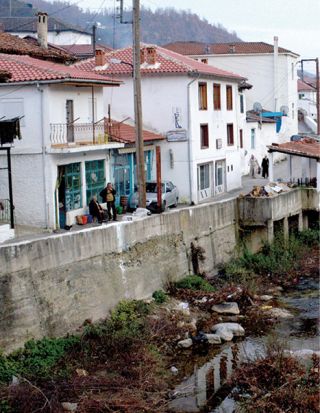
“No one ever thinks of us,” say the Pomaks. “They only pretend to remember us at election time. For all they know, this may as well not be Greece.” This grievance echoes through the Muslim villages of Thrace’s mountains, villages with forgotten inhabitants, decaying infrastructure and long-lost names.
The Greek road signs are strange and poetic in the villages of Gorgona (Mermaid), Oreo (Beautiful), Chloi (Chloe), Zoubouli (Hyacinth), Siroko (Sirocco) and Kyknos (Swan). Life around here looks to Turkey as much as to Greece, and the further you get from the prefectural capital town of Xanthi, the less Greek you hear. As the locals confess, “Nie sme Pomatsi” or “We’re Pomaks”.
Thrace’s Pomaks are a minority religious community. They are Bulgarian-speaking Muslim citizens of the Greek state. The 1923 Treaty of Lausanne, which settled the exchange of populations between Greece and Turkey and laid down the status of the religious minorities, allowed them to stay, and gave them the same rights and obligations as any other Greek citizen.
The temperature is nearing freezing point. From the village of Sminthi to those of Myki and Echinos, smoke is rising from the chimneys and steam from the coffee. “Is the coffee Turkish or Greek?” I ask. “Pomak!” laughs Sminthi’s cafe owner. Pass by an open kitchen window and you can catch a whiff of spice. The muezzin’s voice echoes through the streets. Three kids are speaking Turkish as they kick a ball in the middle of the road. They’re some of the 40 students of the village’s minority school. The nearest Greek-language school is a taxi-ride away in Xanthi.
The road to Xanthi also passes by a small military base. Until 1996, checkpoints surrounded the Pomak villages, which required residents to present permits when leaving and entering. Now, all that is history.
Mr Doukenzi is standing in his shop with one hand raised, his flat palm holding up a baking dish of touloubakia (fried pastries in syrup). “Have one on me before you tell me anything,” says the 35-year-old pastry chef.
He was born and raised in the village of Kentavros. “Up here, it was very difficult to go to school. Pomaks and school didn’t get on. I finished primary school, and then I went to Turkey where I studied childcare. And now my family and I have ended up back here. I wanted to come back: it’s our homeland. I missed the country. Your home is where you were born and grew up. And that’s where you will always want to return.”
“This was always Greece, but we were always foreigners. You couldn’t buy a house or a car, nor could you get a driver’s licence. How could you feel that your country wanted you?” asks a young man from Echinos. “This country makes people into fanatics. We’re a role model for minorities. We don’t depend on the state, we don’t cause problems, we respect our neighbours. And yet the state hardly notices us. Turkey sends its ministers to see us. But Greece? Apart from Alexis Tsipras [the Syriza leader], nobody has come here.”
The village of Echinos lies about 26km from Xanthi. Here, they boast about their successes in Germany. “We have 15 companies trading there,” they all say when you ask them to tell you about their village. “The men work in Germany, manufacturing and repairing yachts,” says Ahmed.
The same is true in Myki. It’s the village women who have stayed behind to work in the tobacco fields and to raise the children.
One of these women is Belkis Basia. I find her out walking with her husband, who has just returned on a break from Germany. “The men return for a little while in March before heading off again. Of the village’s 500 inhabitants, most are women,” she says. She is holding the hand of her two-year-old daughter, who is dressed in a traditional Pomak costume. The houses here are in a bad state. “For years, we had no right to repair our houses,” she says, referring to an old rule that obliged the minority community to apply for special permits to build or renovate homes.
Jemal works in a shipyard in Germany. “When I come back, I help my old man with the animals. Don’t talk to me about it. We produce organic milk, but we’re not paid for it. We supply major Greek companies, but they rob us. They don’t pay us.”
On the other side of the bridge that links the two halves of the village lies the minority school. “The status of minority schools is still governed by the agreements Greece and Turkey signed back in the 1950s. The cultural agreement of 1968 decreed that the Muslims of Greek Thrace be educated in Turkish,” says Nikos Kokkas, a teacher who has highlighted the Pomaks’ predicament.
Aynur comes from Echinos, but Turkey has won her over. It used to take her an hour every day to get to school in Xanthi. “Now it only takes me five minutes,” she says. She wears a red scarf and tells me in broken Greek about her nice new school in Istanbul. Her bed and board there cost €1,000 a year. Her father works in Germany.
“If you decide to leave for Turkey, the Turkish state will help you. If you decide to study in Greece, you might find it easy to pass the university entrance exams, but you’ll probably drop out,” says one villager.
source: Neos Kosmos





 STUDIO 3 NEWCASTLE AUSTRALIA