
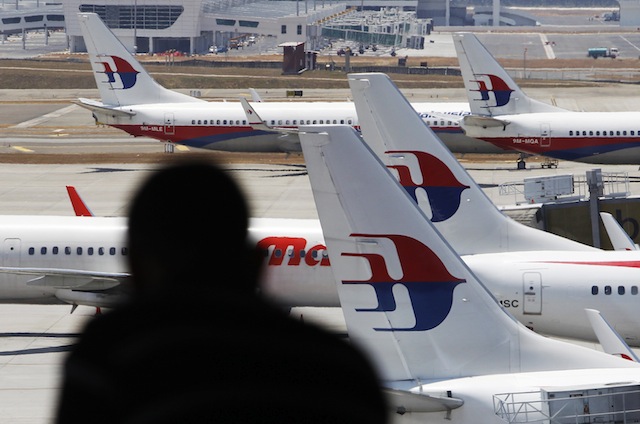
After countless false leads and 100 days of searching for Malaysia Airlines flight MH370, all the world knows of its fate is that nobody knows anything at all. There have been numerous theories across social media on the possible causes for the flight’s disappearances with everyone giving their Sherlock Holmes best.
But what are the possible and plausible theories? Former Boeing aviation safety engineer Todd Curtis, the creator of AirSafe.com, shares his thoughts here on what could have happened to MH370, which now has passed into aviation history’s biggest mystery.
Hijacked to an unknown location
As the aircraft headed towards the Middle East and Europe, it pinged satellites along the way for at least four hours. Was the aircraft hijacked and then taken to an unknown location? Perhaps with the intention of using it for a different purpose? This theory was initially considered by American officials, although it was later dismissed.
It has been reported widely that the Aircraft Communications Addressing and Reporting System (ACARS) aboard MH370 was disabled, which suggested that the aircraft did not fall out of the sky. It was also reported that the aircraft’s two communication systems were shut down separately and the aircraft followed a commonly used navigational route headed to the Indian Ocean.
Hijacking?
An accidental crash into the ocean? The New York September 11, 2011 attacks are the best known examples of what happens to a hijacked jetliner. Hijackers may have unintentionally flown the aircraft into the sea, perhaps running out of fuel while heading towards a destination. However, if this was the case, there should be debris, which has yet to be found despite extensive searches in the southern Indian Ocean. Reuters quoted a source as saying that sabotage had not been discounted, nor hijacking. However, CNN still believes that MH370 may have gone down in the Indian Ocean.
Hijacking with intentional rapid descent into the ocean.
Data has shown that MH370’s Rolls Royce engines showed the aircraft descending 12,000m in the space of a minute. However, such a quick fall also has officials ruling out this possibility equally fast. The Times reported that too much stock could not be put in altitude data which was sent from the engines. “A lot of this does not make sense,” it reported.
Hijacking of the aircraft by the pilot to an unknown location
In February this year, the co-pilot of an Ethiopian Airlines flight hijacked his own aircraft by locking the pilot out of the cockpit. The co-pilot then flew the aircraft to Geneva, Switzerland, where he sought asylum. The Ethiopian Airlines flight was supposed to be headed for Rome, Italy. Ethiopian Airlines claimed the aircraft had been forced to head to Geneva. Fariq Abdul Hamid, the co-pilot of MH370, had raised eyebrows over his behaviour of inviting passengers into the cockpit in the past. Captain Zaharie Ahmad Shah had also raised eyebrows when it was revealed that he had built a flight simulator in his home. Was he practising something? However, if this was the scenario, then surely MH370 would have turned up by now, which it has not.
Cyber-hijacking
This is one of the scenarios which is being explored although it is unprecedented. Were the 227 passengers and 12 crew members of flight MH370 victims of the world’s first cyber-hijacking? The Sydney Morning Herald quoted a British anti-terrorism expert as saying it was possible for hackers to change the aircraft’s speed, altitude and direction. However, this was conditional upon the hackers successfully sending radio signals to the aircraft’s flight management system.
Piracy for financial gain
An aircraft is worth a lot of money, whether whole or in pieces. A plane-trading website owner was quoted as saying an aircraft was worth big money. Military data indicated the aircraft was heading towards India’s Andaman Islands.
A catastrophic series of events resulting in a crash near its last-known position
Former Boeing engineer Curtis said a possible scenario was a catastrophic series of events made it impossible to fly MH370. “Very soon after these events occurred, MH370 crashed somewhere in the ocean near the last recorded position.” This would, of course, mean that search workers would find debris, the question is, where?
Rapid or slow decompression
Explosive, rapid or slow decompression can occur from any number of unfortunate instances while travelling in an aircraft – but what happens to the people on board during a rapid or slow decompression is notable for cases when the plane doesn’t disintegrate. One of the more notorious airplane crashes in recent memory involves the Learjet crash that killed professional golfer Payne Stewart in October 1999. While investigators never concluded what caused the decompression itself, what’s known is that the pilots were rendered incapacitated because of a lack of oxygen in the plane (which can occur in minutes if a cabin were to lose pressure slowly). The pilots – and their passengers – died of hypoxia, a deadly condition caused by low oxygen conditions. The plane, however, continued to fly on autopilot for hours. It eventually ran out of fuel and crashed into a field. It’s possible this happened to Malaysia Airlines flight 370, especially given recent reports that the jet’s engines continued sending back data for four more hours after the point of last contact. China is searching its mainland and India its waters, for any signs of the missing plane – that may have soared on for hours with no signs of life inside.
Systemic failure
Any of the systems aboard MH370 could have failed. These include electrical systems, communications and hydraulic controls. “What could have occurred in the air is unclear,” Curtis said. It could have been any one of the above, or tragically, one system’s failure affecting the others.
Pilot error
Many of modern aviation’s worst accidents have been caused by pilot errors. Curtis said humans flew these machines, even with the aid of robotics. An example would be Adam Air flight 574, which went down in Indonesia with 102 on board on January 1, 2007 because the pilots simply lost control. The aircraft debris was not found for a week and it took an additional week to confirm that it belonged to the missing aircraft. The majority of the debris and aircraft had simply disappeared under the ocean.
Mechanical failure
Japan Airlines flight 123, which is considered the single deadliest aircraft crash of all time with 520 fatalities, was a result of a previous incident which weakened the structure of the plane. Many doomed airlines which have crashed over the years were the result of mechanical failure of the aircraft, Curtis said. Some of these incidents were because of weakened portions of the fuselage. In the case of MH370, some suspect that a weak spot may be the cause of the aircraft’s disappearance. However, if this happened to MH370, investigators would have found debris in the South China Sea. In the early days of MH370’s disappearance, search and rescue operations were focused on the South China Sea and Strait of Malacca.
On-board mechanical fire or explosion
On the possibility that MH370 crashed after catching fire mid-air, Curtis said an in-flight fire, where flames were visible outside the aircraft, was fairly rare. “This type of things happens after a mid-air collision.” When TWA Flight 800 was blown to bits by what is believed to have been fumes in a petrol tank, satellites searching for signs of a nuclear blast saw the fireball just off of the United States’ eastern shore. Those satellites detected no blast over the skies of Southeast Asia. “This does not mean the aircraft did not break up,” Curtis said, just that there was no notable explosion. “You can have an airline fall apart in the sky but no fireball.”
Mid-air disintegration
This theory is more the result of any number of unfortunate circumstances listed above or below, and was floated in a Reuters report. “The fact that we are unable to find any debris so far appears to indicate that the aircraft is likely to have disintegrated about 10,000m,” Reuters quoted a source. The same source said it could have been a bomb or a mechanical incident although it is still too soon to say.
Controlled ditching
There had been very few successful water landings in American aviation history until Captain Chesley Burnett Sullenberger successfully executed an emergency water landing of US Airways flight 1549. Sullenberger’s successful landing of the flight in the Hudson River off Manhattan, New York City ensured the survival of all 155 crew members and passengers aboard. However, Curtis said if a similar feat had been attempted on the open seas, the aircraft would have sunk after everyone had gotten out. “The crew and passengers would have been in life preservers, life crafts and not much else.” “Assuming there was a controlled ditching in the open seas, there would be very little in the way of floating debris or floating survivors,” Curtis said.
Pilot suicide
There have been a few instances of pilot suicide since the rise of the age of aviation. Fortunately, they are not that common, and just 24 American pilots have killed themselves while flying their planes in the last 20 years. Still, the question has to be posed. Silk Air flight 185 and Egypt Air flight 990 are the two commonly cited examples of this type of tragedy, with investigators concluding that the pilots deliberately caused the crashes.
Explosive decompression
Aloha Airlines flight 243 is an often-cited example of a case where an aircraft suffered explosive decompression and its passengers lived to tell the tale. It was April 28, 1988, when a Boeing 737-297 making its way from Hilo and Honolulu suffered from explosive decompression, a result of corrosion to the airplane’s body. As the plane soared high over Hawaii, a section of the roof blew out – and a stewardess was sucked out the gaping hole (she was the only fatality). Her body was never found. The aircraft landed safely less than 15 minutes later. The official National Transport Safety Board report found that a passenger had actually noticed a crack in the fuselage but failed to inform anyone of the damage.
A bomb
There have been many commercial aircraft which have been felled by bombs over the years. Often they tear a hole in the cargo section of an airplane, resulting in explosive decompression or shattering the plane into pieces and sending its occupants flying out into the sky. Such is what happened over Lockerbie, Scotland when Pan Am flight 103 was destroyed by a terrorist’s bomb, killing 270 people, including 17 on the ground. Had that happened with Malaysia Airlines flight, two things should have happened by now: the blast detected by satellites, and the debris found by ships. “There have been no confirmed sightings or recovery of any debris from that aircraft,” said Curtis.
Military missile
Commercial aircraft have been targeted by militaries in the past, most notable Iran Air flight 655 in 1983 and Korean Air flight 007 in 1988. But did it happen again in the skies over Malaysia or Vietnam? “Doubtful, as there has been no indication of that happening,” he said. “Possible – but no indication.” – June 15, 2014.
source:themalaysianinsider.com








 STUDIO 3 NEWCASTLE AUSTRALIA