
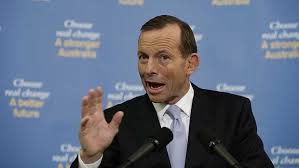
FAMILIES will lose access to taxpayer benefits under a hard-line plan to slash budget spending as Tony Abbott signals a new income threshold of $100,000 to determine who gets “handouts” from Canberra. Social security payments will be scaled back and eligibility rules tightened in a bid to save billions of dollars while forcing people out of welfare and into work.
Outlining his plans in a major speech last night, the Prime Minister also made it clear that “high-income earners”, including politicians, would feel some of the budget pain amid growing talk of a new levy on millions of taxpayers.
As Labor accused Mr Abbott of breaking his election promises, reports last night suggested the deficit levy would be set at 1 per cent of income for those earning more than $80,000 and double to 2 per cent for those earning $180,000 or more.
Mr Abbott ruled out changes to the pension before the next election but made the case for sweeping reform after 2017 while also leaving room for an increase in the retirement age over the long-term.
He insisted on the need for immediate reform to other benefits, however, by warning that indexation rates would have to change to slow the growth in payments.
“Not for a second would I label families as ‘rich’ just because they are earning $100,000 a year,” Mr Abbott said last night at The Sydney Institute’s annual dinner. “A teacher married to a part-time shop assistant with children to feed, clothe and educate is certainly not rich, especially paying a capital city mortgage.
“But the best way to help families on $100,000 a year is long-term tax relief and more business and job opportunities, not social security handouts.”
The toughening stand on welfare payments revives a political fight over “working families” after Labor scaled back benefits to households earning more than $150,000 a year, sparking a furious attack from Mr Abbott as opposition leader in 2011.
Mr Abbott’s remarks also run counter to a key aspect of his own paid parental leave scheme, which applies a threshold of $150,000 a year to cap payments despite a push by the Greens to set the level at $100,000 instead.
Mr Abbott last night contrasted the “temporary” pain of the budget savings measures with a long-term economic improvement, holding out the prospect of a reward for families in five years.
“The changes in this budget will make personal tax cuts much more likely in four or five years’ time,” he said.
The timetable confirms expectations that taxpayers will get no relief from “bracket creep” for at least five years, moving into higher tax brackets as inflation increases their earnings.
Those on the top of the income scale will have to carry some of the new burdens, however, amid confirmation from government sources yesterday that a “deficit levy” was on the agenda.
“I can assure you that everyone will be involved, including high-income earners such as members of parliament,” Mr Abbott said of the budget overhaul.
Attacking Labor’s “unsustainable” spending measures, Mr Abbott promised a budget that would put the nation on track to a “strong surplus within a decade” to “keep faith” with his election commitments. But Labor has stepped up claims the Prime Minister is breaking election promises, citing assurances from Mr Abbott in September there would be “no change to pensions” and no cuts to education or health spending.
Bill Shorten disputed the government’s central assumptions that deficits would amount to $123 billion over four years and federal debt would reach $667bn without action to cut spending. The Opposition Leader said the Abbott government had “concocted a budget emergency” to justify measures that broke election promises and apply a new tax on households.
“By their decisions that they’ve made since coming into power, they’ve doubled the deficit,” Mr Shorten said. “Now because they’ve doubled deficit they want all Australians to pay a deceit tax because of the broken promises of the Abbott Liberal government.”
Treasury’s pre-election fiscal outlook, issued last August, forecast $63bn in deficits over four years but Mr Hockey’s midyear update, four months later, forecast $123bn over the same period. “It is clear to most reasonable Australians that the Abbott government said one thing in opposition and are now doing something else in government,” Mr Shorten said.
On the defensive over his election pledges, Mr Abbott ruled out changes to the pension during this term of parliament but made the case for reforms after the next election. He also drew a crucial distinction between curbing the growth in payments and cutting them in absolute terms.
“To keep our commitments, there will be no changes to the pension during this term of parliament but there should be changes to indexation arrangements and eligibility thresholds in three years’ time,” he said. “There are other social security benefits where indexation arrangements and eligibility thresholds should be adjusted now so that our social safety net is more sustainable for the long-term. Such benefits won’t be less tomorrow than they are today but the rate of increase will be slower and needs to be slower if a comprehensive social safety net is to be preserved for everyone’s future.”
Mr Abbott also claimed the removal of the carbon tax and the retention of Labor’s household compensation measures would leave pensioners and families better off, removing an impost that costs average households $550 a year. On education, he countered claims of broken promises by noting that he had “explicitly” refused to commit to Labor’s spending programs beyond the four years of the budget forward estimates.
Mr Abbott also restated his vow that there would be no cut to overall health funding but insisted this would allow changes to individual programs.
As the government proceeds with a $6 co-payment from patients visiting the doctor, Mr Abbott said new charges would include “more price signals” on health services because “free” services were not free to taxpayers.
The PM’s speech went beyond the warnings from Hockey last week, and argued for all Australians to share the budget burden.
The Coalition has promised not to means-test the Child Care Benefit, which goes to many families on high incomes.
source: theaustralian.com.au







 STUDIO 3 NEWCASTLE AUSTRALIA