Daily Archives: April 11, 2014

Bomb explodes outside Bank of Greece

93monspegetty

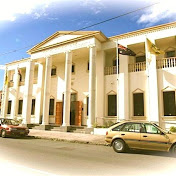
A bomb exploded outside a Bank of Greece building in central Athens at 5:55 am this morning, causing some damage but no reports of injuries yet.

A bomb exploded outside a Bank of Greece building in central Athens at 5:55 am this morning, causing some damage but no reports of injuries yet.

The explosion was heard throughout the area. It was preceded by two anonymous calls to a news website and a newspaper warning that a bomb had been planted in a car outside the central bank offices.

Police cordoned off the area, but did not immediately approach the actual site of the explosion.

As dawn broke, television footage from the area showed the remnants of a car in the middle of an Athens street, with debris strewn around. It was unclear whether nearby buildings were damaged.

The news site that received one of the anonymous calls said the caller warned a bomb containing 75 kilograms (150 pounds) of explosives had been planted in a car and would explode in 45 minutes’ time.

The explosion comes hours before Greece plans to return to bond markets for the first time since its international bailout began four years ago.

Source: AP, Reuters


Greece re-enters bond market

imagesN6VMJ8DZ

Greece returning to bond markets after four years in wilderness

Almost four years to the day since it issued its last sovereign bond, Greece will return to international markets with a five-year note, seeking to tap investors for 2.5 billion euros that the Greek government argues will help bring down its short-term borrowing costs as well.

The Finance Ministry confirmed on Wednesday afternoon that the book building would happen on Thursday and that a number of international banks (Bank of America, Deutsche Bank, Goldman Sachs, HSBC, JP Morgan and Morgan Stanley) had been mandated. The bond is to be issued under UK, rather than Greek, law.

Sources said late on Wednesday that the bond would be comfortably oversubscribed, with the final order book stretching to well over 13 billion euros. The yield is expected to reach between 5 and 5.25 percent. Greek Finance Ministry sources said that Athens would be happy with an interest rate below 5.3 percent. On Wednesday, the yield on Greece’s 10-year bonds fell below 6 percent for the first time since 2010.

“The fact that there is major interest leads to the belief that the interest rate will be low but it also shows that markets view the discussion about [Greek] debt sustainability in different terms,” a Finance Ministry official who wished to remain anonymous told Kathimerini.

The government believes that apart from the strong message the bond issue will send about Greek prospects, it will also save about 200 million euros per year in short-term borrowing costs by helping to bring down the yield for T-bills. These projected savings, however, will have to be offset against some 500 million euros in interest that Greece is due to pay to investors who buy the bond.

The government will be looking to build on Greece’s return to the market as it gears up for the May local and European Parliament elections.

“This is an important step in Greece’s effort to fully exit the crisis,” government spokesman Simos Kedikoglou told The Associated Press.

He also criticized SYRIZA leader Alexis Tsipras for arguing that the return to the markets was politically driven. “Mr Tsipras wants us to remain in the [EU-IMF] memorandum so he has a reason to exist,” said Kedikoglou. “He wants to wallow in his misery. We will leave him to it.”

The news of the impending bond issue fueled an angry reaction from opposition parties. Leftist SYRIZA spokesman Panos Skourletis referred to a “staged, expensive return to the markets for pre-election reasons” in comments to Sto Kokkino radio, which is affiliated with the leftist party.

In comments to Alpha Radio, prominent SYRIZA lawmaker Dimitris Papadimoulis claimed that the planned foray into international markets would increase Greece’s debt and burden the country’s taxpayers with an additional 500 million euros in interest over the next five years.

Democratic Left (DIMAR), which used to be the government’s third coalition partner until last June when it quit over Samaras’s abrupt decision to shut down state broadcaster ERT, also questioned the timing of the bond issue, saying that the move was “rushed and serves pre-election priorities.” “The return to the markets should not be subject to public relations exercises but part of a clear and comprehensive strategic management of debt to ensure that refinancing interest rates do not increase.”

Source: Kathimerini

New ‘pings’ stoke optimism for Malaysia plane hunt

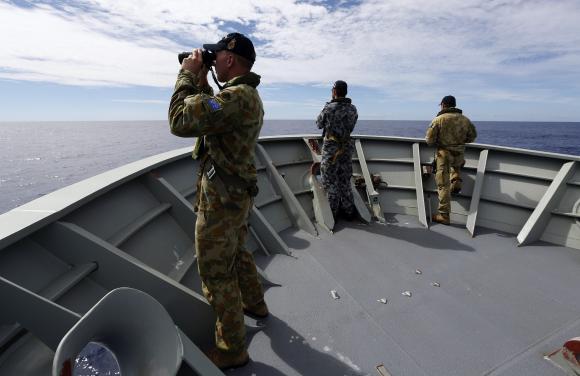
Gunner Brown of Transit Security Element looks through binoculars as he stands on lookout with other crew members aboard Australian Navy ship HMAS Perth as they continue to search for missing Malaysian Airlines flight MH370

Gunner Richard Brown (L) of Transit Security Element looks through binoculars as he stands on lookout with other crew members aboard the Australian Navy ship HMAS Perth as they continue to search for missing Malaysian Airlines flight MH370 in this picture released by the Australian Defence Force April 10, 2014. Credit: Reuters/Australian Defence Force/Handout via Reuters

A new acoustic signal was detected in the hunt for Malaysia Airlines Flight MH370 on Thursday, further boosting confidence that officials are zeroing in on the missing plane after weeks of searching.

The signal, which could be from the plane’s black box recorders, brings to five the number of “pings” detected in recent days within the search area in the Indian Ocean.

The first four signals were detected by a U.S. Navy “Towed Pinger Locator” (TPL) aboard Australia’s Ocean Shield vessel, while the latest was reported by an aircraft picking up transmissions from a listening device buoy laid near the ship on Wednesday.

“Whilst conducting an acoustic search this afternoon a RAAF AP-3C Orion aircraft has detected a possible signal in the vicinity of the Australian Defence Vessel Ocean Shield,” Angus Houston, head of the Australian agency co-ordinating the search, said in a statement.

The data would require further analysis overnight but it showed the potential of being from a “man-made source”, he said.

The mystery of Malaysia Airlines Flight MH370, which disappeared more than a month ago, has sparked the most expensive search and rescue operation in aviation history, but concrete information has proven frustratingly illusive.

The black boxes record cockpit data and may provide answers about what happened to the plane, which was carrying 227 passengers and 12 crew when it vanished on March 8 and flew thousands of kilometres off its Kuala Lumpur-to-Beijing route.

But the batteries in the black boxes have already reached the end of their 30-day expected life, making efforts to swiftly locate them on the murky ocean floor all the more critical.

“We are still a long way to go, but things are more positive than they were some time ago,” Martin Dolan, chief commissioner of the Australian Transport Safety Board, which is involved in the search mission, told Reuters.

NARROWING THE SEARCH AREA

Up to 10 military aircraft, four civil aircraft and 13 ships

are involved in the search effort that has proven fruitless in identifying any physical evidence of wreckage from the flight.

Efforts are now focused on two areas – a larger one for aircraft and ships about 2,240 km (1,392 miles) northwest of Perth and a smaller area about 600 km (373 miles) closer to that west Australian city.

The smaller zone is around where the Ocean Shield picked up the acoustic signals and where dozens of acoustic sonobuoys were dropped on Wednesday.

Each of the sonobuoys is equipped with a listening device called a hydrophone, which is dangled about 1,000 ft below the surface and is capable of transmitting data to search aircraft via radio signals.

“That does provide a lot of sensors in the vicinity of the Ocean Shield without having a ship there to produce the background noise,” said Australian Navy Commodore Peter Leavy, operational head of the Australian search.

But experts say the process of teasing out the signals from the cacophony of background noise in the sea is a slow and exhausting process. Operators must separate a ping lasting just 9.3 milliseconds – a tenth of the blink of a human eye – and repeated every 1.08 seconds from natural ocean sounds, as well as disturbances from search vessels.

An autonomous underwater vehicle named Bluefin-21 is also onboard the Ocean Shield, and it could be deployed to look for wreckage on the sea floor once the final search area has been positively identified.

As with so many things in this unprecedented search effort, experts say that will not be easy.

“Working near the bottom of the ocean is very challenging because this is uncharted territory; nobody has been down there before,” Erik van Sebille, an oceanographer at the University of New South Wales, told Reuters.

source: reuters.com