Daily Archives: September 12, 2014

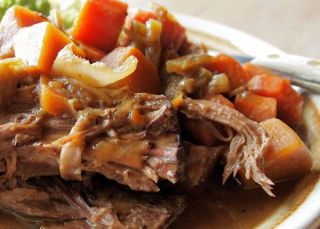
Rosto (pork casserole)

recipe%201-naxos%2001

Naxos’ most iconic celebration dish.

Christina Kannelopoulou and her son Giorgos run the Mythodia restaurant, near the town hall, where the cook showed us her version of rosto, the island’s most iconic celebration dish. The recipe serves 4-5.

Ingredients:
1.5 kilo piece of pork shank, tightly wrapped in twine or netting
4-5 cloves garlic, finely sliced
300 ml dry red wine
4 bay leaves
150 ml olive oil
3 large ripe tomatoes, crushed, or 500 gm diced and tinned
1 tbsp tomato paste
salt and pepper
1 stick cinnamon
3-4 allspice berries
2 cloves
1 tsp dried oregano
3-4 sprigs fresh thyme or 1/2 tbs dried
400 gm thick pasta

Method:
1. Score the meat and rub with salt and pepper, stuffing the cuts with garlic and oregano. Drizzle with olive oil.
2. Heat the rest of the olive oil in a large saucepan and evenly brown the meat over a high heat. Add the wine and wait for 2 minutes until the alcohol has evaporated.
3. Add the grated tomato, tomato paste and as much hot water as needed to just cover the meat. When it comes to the boil turn the heat down to medium, cover the pot and cook for 45 minutes.
4. Then add the allspice, bay leaves, cinnamon, cloves and thyme, cover the pot and cook for another 45 minutes until the meat is tender.
5. Remove from the heat, put the meat on a board, remove the string and carefully cut into one-inch slices. Place slices back in the sauce and cook for an additional 10 minutes.
6. Meanwhile, cook the pasta for 3 minutes less than recommended on the packet and finish off in the sauce. Remove the spices before serving. An aged grated cheese, preferably a Naxos variety, goes well on top.

source: Neos Kosmos


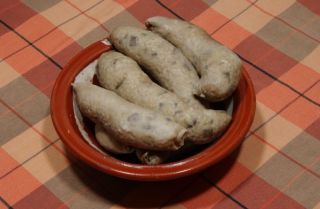
Amathies (pork intestines stuffed with rice)

recipe%202-naxos%2001

Make sure you wash the pork intestines thoroughly.

Ingredients:
intestines of a pig
1/2 kilo wild beet leaves
1 bunch fennel leaves
1 bunch parsley
1 bunch dill
3 spring onions
1 finely chopped onion
1 cup olive oil
1 cup glazed rice
1 tbsp salt
pepper
3 cups water

Method:
1. Wash the intestine thoroughly inside and out. Pour half a cup of olive oil into a deep pan and sauté the onions and herbs, which have been washed and chopped finely.
2. When they soften slightly add 1 cup water, half a tablespoon of salt and a pinch of pepper.
3. When the mixture comes to the boil, add the rice and stir. Allow a few minutes for the rice to absorb the water and then remove from heat.
4. Stuff the intestines with the mixture, making sure to allow enough room for the rice to expand.
5. Tie a knot at the two ends of the intestines and place in the pot, adding the rest of the oil and water. Salt lightly and cook for around 40 minutes.

source: Neos Kosmos

Hellas Cakes: A piece of sweet history

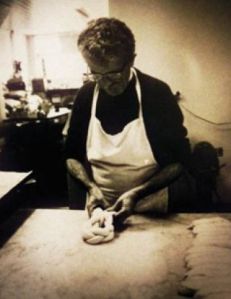
hellas

Opened in 1962, Hellas Cakes has outlasted and outrun many Greek zaharoplastia in Melbourne.

Even if you may not have visited Hellas Cakes, chances are you’ve tasted one of their cakes.

The business has been in the hands of Greek migrants for over 50 years and has catered some of Melbourne’s most prestigious parties, while also supplying local cafes with their fair share of kourabiethes, baklava and galaktoboureka.

Currently one of the biggest suppliers of koliva and sperna at Greek funerals and memorials, Hellas Cakes is a production line on the weekends, churning out more than 40 individual offerings and delivering them to churches around the state.

It’s a labour of love for the business that has always offered the service since its inception.

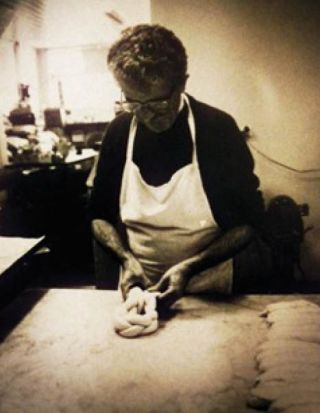
Founding owner Iraklis Kenos set up the zaharoplastio in 1962 after he migrated from Athens. Already an established pastry chef back home, the business in Australia was set up to cater to the huge demand of Greek migrants living in Melbourne.

As one of the few functioning Greek cake stores in the country at the time, Mr Kenos had the nous to keep recipes unaltered, opening his doors to curious Australians and thankful Greeks.

His business flourished, and when pastry chef George Laliotis came to Australia in 1974, the cake shop would get staying power.

George Laliotis’ son, and current owner of the business, Peter Laliotis says his father’s early days in Melbourne actually didn’t have much to do with his old profession, but soon enough he was brought back to the world of baking.

“When he came here he got a job at Olympic tyres, and working an eight hour shift, he thought it was grouse because in Greece he’d work sunrise to sunset,” Peter tells Neos Kosmos.

Not long after that, his father was to happen upon Hellas Cakes. Old acquaintances in Athens, Laliotis found Kenos working in the heart of Richmond.

“When dad rolled up here, he basically got the job on the day and by the end of the day he was offered a partnership,” he says.
Kenos was smart enough not to chase such talent away and create an unwilling competitor; so he drew up the papers to make him a partner.

In 1977, George offered another employee, George Kantaras, a partnership offer, and the two continued to work together until their retirement. Now it’s in the hands of the next generation, with son Peter taking over the business in 1988 and his partner Andrew Kantaras coming on board in 2004.

Peter’s earliest memories are of the store, helping out his father with neverending orders.

“I grew up in here,” he says.

“I remember wrapping tsourekia, carrying trays.

“My earliest memory was in 1977, we used to write the date on the vasilopita. I can’t remember earlier than that but I remember ’77, I was only six at that stage.”

He took the business seriously, and became an apprentice at the age of 15 at Hellas Cakes. While working hard, he also studied at the William Angliss Institute.

With his experience, Peter actually took out the best baker award at 19 for the institute, one of the
youngest in Australia to do so.

He would later become the pastry coordinator for the institute, working four days a week teaching the next generation of chefs, and the other three days filling weekend orders at Hellas Cakes.

The hours were brutal, but the experience was invaluable.

At Hellas Cakes, their traditional Greek cakes are still the best sellers, but that doesn’t mean the store hasn’t changed.

Peter has introduced new additions and adapted to current trends to keep new customers happy and coming back.

“The recipes are very, very similar, some lines have stopped, because some of the stuff like touloumbes today won’t sell, they’re too heavy, too sweet,” Peter says.

“Some are altered, where now we do gluten free or chocolate ganache or a butter cream so it’s more light on the palate.”

What sets Hellas Cakes apart from the hundreds of Greek cake shops in Melbourne is that it’s on the list of some of the biggest food catering companies.

A supplier to Spotless, which feeds 210,000 people a day, Hellas Cakes has supplied thousands of biscuits, baklavas, galaktoboureka, and yo-yos for events.

Clients like Crown Casino and the Melbourne Grand Prix have been Hellas Cakes’ regulars.

As well as the big one-off events, Peter and his team of 11 also supply many of the local cafes with scrumptious Greek treats.

Most of the time, the Hellas Cakes staff have no idea where their goods are going, and on more than one occasion, Peter has unknowingly ordered his own creations.

“I actually went to the Portsea Hotel for a day trip, and we couldn’t help noticing there was a baklava on the menu,” he says.

“Everyone at the table thought it was hysterical I was going to buy a $7 baklava. As the lady was walking towards me I said, ‘oh no, that’s my baklava’.

“I asked ‘Are you sure that you guys make it here?’.

“The girl got a bit embarrassed and said no. I said ‘it’s OK’. Everyone laughed at the table and said ‘this is the sucker who actually made it’.

“It was really funny, but it was expensive.”

His family is still intertwined in the business. During big holidays like Easter and Christmas, the family gets called in to help out with the influx of orders.

“Every year it’s groundhog day,” he says. “Easter and Christmas we supply tsourekia all over Melbourne and Adelaide.”

Something they don’t like to advertise is their Greek funeral services.

Their koliva and sperna businesses have been a labour of love. At the start, when Peter’s father would have it on their distribution list, the effort would far outweigh the profit. They would get more orders for cakes than sperna, but George kept offering it.

Now, the orders for sperna far outweigh their cake orders, making it much more economically viable and a very stable source of income.

At the heart of Hellas Cakes are its customers. Peter has seen generations of families go through their milestones from all their cake orders.

From sweet sixteens, 21st birthdays even to their wedding cakes, Peter has been a part of their celebrations.

That connection is why Peter changed the whole layout of the shop two years ago, opening the front half of the shop to customers to grab a coffee and a cake.

The kitchen is still the pièce de résistance in the building. Double the size of the cafe, the kitchen houses more than six huge ovens, all original from 1962. Peter says they don’t make them like they used to, hence why he’s been reluctant to upgrade.

Customers also get to have a peek at the huge kitchen when they walk through to get to the toilets, a clever idea from Peter.

Hellas Cakes is both a product of its past and its present. Its customers might be a bit different, but the philosophy is exactly the same.

Hellas Cakes is open seven days, 322 Lennox St, Richmond, Melbourne. Visit www.hellascakes.com.au or phone 03 9428 6805 for more information.

source: Neos Kosmos

Εγχειρίστηκε αγοράκι που γεννήθηκε με τέσσερα χέρια και τέσσερα πόδια

ouganta_agori_4podia_4xeria_692994250

Στις 27 Μαΐου η Margaret Awino έφερε στον κόσμο τον Paul Mukisa, με τη βοήθεια της πεθεράς της, στο σπίτι της στο Nabigingo, ένα μικρό χωριό στην ανατολική Ουγκάντα. Αλλά αντί για συναισθήματα χαράς και αγαλλίασης, η γέννηση του πέμπτου παιδιού της έφερε στην 28χρονη μητέρα έκπληξη και σοκ, καθώς ο νεογέννητος γιος της γεννήθηκε με τέσσερα πόδια και τέσσερα χέρια.

Η οικογένεια έσπευσε στο κοντινότερο νοσοκομείο για βοήθεια, αλλά παραπέμφθηκαν αμέσως στο Νοσοκομείο Mulago στη Καμπάλα. Εκεί, μία ομάδα γιατρών εξέτασε το βρέφος και διέγνωσε ένα “παρασιτικό δίδυμο”, μια παραλλαγή των σιαμαίων διδύμων στην οποία το ένα από τα δύο δίδυμα δεν είναι πλήρως ανεπτυγμένο – ο Paul γεννήθηκε και με τα τέσσερα άκρα του, αλλά και με τέσσερα ακόμα άκρα ενός διδύμου, χωρίς κεφάλι και καρδιά, το οποίο δεν αναπτύχθηκε πλήρως.


Οι γιατροί στην Ουγκάντα πραγματοποίησαν μία σειρά από εξετάσεις στο νεογέννητο, οι οποίες έδειξαν ότι μοιραζόταν το πυελικό οστό με το παρασιτικό δίδυμο. Εξετάσεις στα εσωτερικά όργανα του Paul αποκάλυψαν περαιτέρω ανωμαλίες: η καρδιά του βρισκόταν στη δεξιά πλευρά του σώματός του, ενώ το συκώτι του βρισκόταν στην αριστερή. Στη συνέχεια, ο Paul επέστρεψε για τρεις μήνες στο σπίτι του, καθώς οι χειρουργοί θεώρησαν ότι πρέπει να αναπτυχθεί περισσότερο πριν υποβληθεί σε εγχείριση.

Τελικά, στις 18 Αυγούστου, μία ομάδα αποτελούμενη από τρεις χειρουργούς, τρεις αναισθησιολόγους και δύο νοσηλευτές ολοκλήρωσαν με επιτυχία μία τρίωρη επέμβαση για την αφαίρεση των μελών του παρασιτικού διδύμου. Τρεις εβδομάδες μετά, το μωρό νοσηλεύεται ακόμα στο νοσοκομείο και η νοσηλεία του θα διαρκέσει δύο ακόμα εβδομάδες. Η υγεία του, ωστόσο, καλυτερεύει μέρα με τη μέρα και πλέον, ο μικρός Paul είναι σε θέση να θηλάσει, σύμφωνα με τους γιατρούς.


Οι γιατροί του Νοσοκομείου Mulago, πραγματοποίησαν για πρώτη φορά μία τέτοια επέμβαση. “Δεν είχαμε προηγούμενη εμπειρία με παρασιτικό δίδυμο, αλλά έχουμε εγχειρήσει πολλά παιδιά με πολλές πολύπλοκες εκ γενετής ανωμαλίες σε πολλά όργανα, όπως εντερικές, ουρολογικές, καρδιακές και ορθοπεδικές”, είπε ο Δρ. Nasser Kakembo, ένας από τους τρεις χειρουργούς της ομάδας. “Περιμένουμε ένα υγιές μωρό που μπορεί να έχει ένα ευρύ βηματισμό, λόγω του μεγάλου πυελικού οστού, κάτι που μπορεί να απαιτεί μελλοντική ορθοπεδική αποκατάσταση”, προσέθεσαν οι γιατροί.


Η συχνότητα εμφάνισης σιαμαίων διδύμων είναι 1 στις 50.000, ενώ τα παρασιτικά δίδυμα είναι εξαιρετικά σπάνια. Η κατάσταση αυτή δημιουργείται συνήθως, όταν ένα από τα δίδυμα σταματά να αναπτύσσεται σε ορισμένο σημείο της κύησης, και ό,τι απομένει συγχωνεύεται με το δίδυμο που συνεχίζει να αναπτύσσεται. Το 2007 ένα κορίτσι με οκτώ επίσης άκρα από την Ινδία, ήταν στα πρωτοσέλιδα των εφημερίδων όλου του κόσμου, αφού μία ομάδα 30 χειρουργών ολοκλήρωσε με επιτυχία μία μαραθώνια εγχείριση 27 ωρών, για την αφαίρεση του “παρασιτικού διδύμου”.

Πηγή: CNN

Oscar Pistorius Not Guilty of Murder; Court Adjourns With Lesser Charge Pending

pistorious-verdict-videoSixteenByNine540

PRETORIA, South Africa — After clearing the Paralympic athlete Oscar Pistorius of the gravest charges against him, the judge in his murder trial abruptly suspended the proceedings on Thursday, leaving one charge of unlawful homicide pending until a further court session on Friday.

“We’ll have to stop here and resume tomorrow morning,” Judge Thokozile Matilda Masipa said less than half an hour after hearings resumed following a lunch break. She did not explain the adjournment.

Earlier, in three hours of detailed appraisal of a trial that has transfixed many around the world and that has been compared to the O.J. Simpson case in the United States, the judge cleared Mr. Pistorius of two charges — premeditated murder, which carries a minimum mandatory term of 25 years, and a lesser charge of homicide known simply as “murder.”

Judge Masipa then turned to the lesser charge of culpable homicide, which is comparable to involuntary manslaughter.

Without pronouncing a verdict, she said that Mr. Pistorius had failed three tests to escape culpable homicide charges. One of the tests was what a “reasonable” person would have done under the same circumstances.

Since his trial opened in March, Mr. Pistorius, 27, a double amputee who has also challenged able-bodied runners, has faced accusations by the prosecution that he deliberately took the life of his girlfriend, Reeva Steenkamp, 29, when he fired into a locked toilet cubicle at his villa in the South African capital in the pre-dawn hours of Feb. 14, 2013. Mr. Pistorius has insisted that he killed her by mistake, believing an intruder had entered his home.

Pointedly, the judge compared Mr. Pistorius’s reaction and behavior to that of the majority of people in South Africa who live under daily threat of crime. “Many people in this country have experienced crime, but they have not resorted to sleeping with a firearm under their pillow,” she said.

Mr. Pistorius has said he became alarmed when he heard what he thought was the sound of a bathroom window being opened at his villa in a gated complex with round-the-clock guards. “All the accused had to do was to pick up his cellphone and call security or the police,” the judge said, finding that Mr. Pistorius “acted too hastily,” “used excessive force” and had been negligent in his conduct.

At that point, with many observers in the courtroom forecasting that she was about to deliver her judgment, she adjourned the hearing until Friday.

Earlier, calmly and coolly taking up piece after piece of evidence, dismissing some, discounting others, offering practical interpretations of still more, Judge Masipa said that although Mr. Pistorius made a poor and evasive witness, she found large parts of his story credible. Most significantly, she said it seemed — or at least that the prosecution had been unable to prove otherwise — that when he shot and killed Ms. Steenkamp, he genuinely believed that intruders had broken into his home and were hiding in the bathroom at the time.

Sitting in a wooden dock in a dark suit, white shirt and black tie, Mr. Pistorius slumped forward and sobbed as the judge cleared him of the two murder charges.

There are no jury trials in South Africa, so it has been left to Judge Masipa, with the help of two aides, to render the verdict on her own. According to normal procedures in the country, the judgment includes a summation of the facts, an analysis of the evidence, and then the announcement of the verdict, charge after charge.

Judge Masipa also dismissed out of hand large portions of the prosecution’s evidence, in particular the testimony of neighbors who said they had heard the sounds of a man and woman arguing in Mr. Pistorius’s house before the shots were fired. And she said that prosecution evidence culled from WhatsApp text messages and meant to demonstrate that Mr. Pistorius and Ms. Steenkamp’s relationship was “on the rocks,” as she put it, could not be considered relevant. Nor, she said, could seemingly contradictory text-message evidence from the defense meant to show that the couple had a loving relationship be helpful in reaching a verdict.

“In my view, none of this evidence, from the state or defense, proves anything, she said. “Normal relationships are dynamic and unpredictable sometimes.”

In being acquitted of the two harshest charges against him Mr. Pistorius has possibly escaped a lengthy prison sentence. But culpable homicide, which is defined as the negligent killing of another person and is roughly comparable to involuntary manslaughter, can carry a wide range of sentences, at the discretion of the judge, from no jail time to more than 15 years incarceration.

The judge’s were a huge setback for the prosecutor, Gerrie Nel, who had called for Mr. Pistorius to be convicted of murder and whose pugnacious courtroom manner earned him the nickname the Pit Bull.

In his version of the shooting, Mr. Pistorius has described walking on the stumps of his legs in a darkened passageway, with a handgun thrust out before him, before he opened fire on a locked toilet door. When he broke down the door with a cricket bat, he said, he discovered the bloodstained body of Ms. Steenkamp.

“Before I knew it, I had fired four shots at the door,” Judge Masipa quoted Mr. Pistorius as saying, as she listed the various ways he described the shooting during the trial. At times, he said he shot “in the belief that the intruders were coming out” to attack him. At other moments, he said “he never intended to shoot anyone” and had not fired purposefully at the door, the judge said. Part of Mr. Pistorius’s evidence, she said, was “inconsistent with someone who shot without thinking.”

Ms. Steenkamp, Judge Masipa added, “was killed under very peculiar circumstances,” but “what is not conjecture is that the accused armed himself with a loaded firearm.”

Nonetheless, the judge ruled, the prosecution’s evidence to support a charge of premeditated murder was “purely circumstantial.”

“The state clearly has not proved beyond reasonable doubt that the accused is guilty of premeditated murder,” she said. “There are not enough facts.”

Much of the trial, with 41 days of testimony since it opened in March, has revolved around Mr. Pistorius’s state of mind and intentions when he opened fire. During cross-examination in April, Mr. Pistorius sobbed, wailed and retched as he recalled the events surrounding Ms. Steenkamp’s death.

While she accepted that Mr. Pistorius “would feel vulnerable” because of his disability,” the judge said, he had been “a very poor witness” and had been evasive and “lost his composure” under cross-examination.

Until the killing, Mr. Pistorius, who had challenged able-bodied runners only months earlier at the London Olympics in 2012, seemed to be reveling in a glittery career of sporting success and celebrity acclaim.

As the trial unfolded, the defense and the prosecution offered Jekyll-and-Hyde depictions of Mr. Pistorius’s character.

The prosecutor, Mr. Nel, described him as trigger-happy, mendacious, narcissistic and prone to rage. By contrast, the lead defense lawyer, Barry Roux, sought to present him as anxious, vulnerable and fearful of South Africa’s violent crime, laboring under the psychological burden of growing up since the age of 11 months with both legs amputated below the knee.

In part, the trial has been held up as evidence of a dramatic reversal of South Africa’s white-dominated apartheid-era legal system. In 1998, four years after South Africa’s first democratic election, Judge Masipa, who is 66 today, became only the second black female judge to be appointed to the High Court. Born in a poor township, she had been a social worker and newspaper journalist before studying law at the height of the apartheid era. Now, under South African judicial protocols, lawyers and witnesses are obliged to address her with the honorific “My Lady.”

But the trial has also highlighted the country’s continued racial preoccupations and its high levels of crime against women. In other cases, Judge Masipa has handed down tough sentences in cases of rape and violence against women.

Mr. Pistorius also faces three counts relating to firearms offenses.

source:nytimes.com