
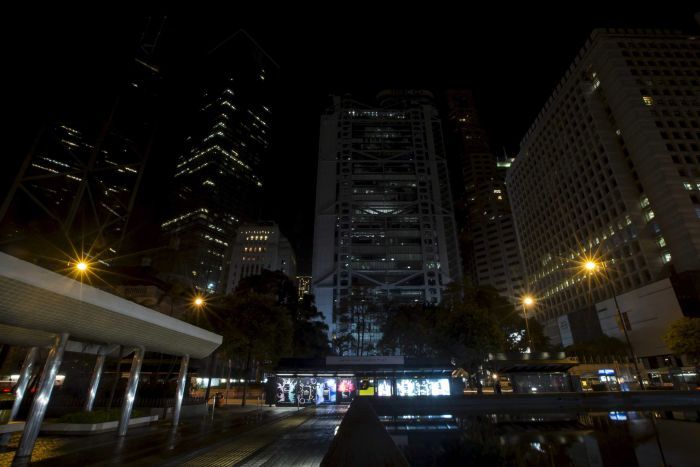
Photo: Hong Kong’s central financial district goes dark for Earth Hour. (Reuters: Tyrone Siu)
Hong Kong’s iconic skyline dimmed and Sydney’s Harbour Bridge went dark, as lights on landmarks across Asia were switched off for the global climate change awareness campaign Earth Hour.
Millions are expected to take part around the world in the annual event organised by conservation group WWF, with hundreds of well-known sights including the Eiffel Tower in Paris and the Seattle Space Needle set to plunge into darkness.

“It’s almost like the thing vanished,” Tony Jennings from Earth Hour said after standing under the Sydney Harbour Bridge as the lights went off at 8:30pm.
Hong Kong’s signature high-rise skyline along the Victoria Harbour was a shadow of itself, with usually lit-up skyscrapers standing dark — among them was the city’s tallest building, the 118-story International Commerce Centre.
In Taiwan the lights went off on the Taipei 101 tower, the world’s tallest building before it was overtaken by Dubai’s Burj Khalifa, while in Kuala Lumpur the usually dazzling Petronas Twin Towers were dark.
In neighbouring Singapore all Earth Hour events were cancelled because of the mourning mood following the death of the city-state’s founding prime minister Lee Kuan Yew.
In Australia, the initiative this year is focusing on farming, with fears that rising temperatures could ultimately damage the ability to produce food.
“In Australia agriculture is the most vulnerable industry to the impacts of climate change,” national Earth Hour manager for Australia Anna Rose said.
Rising temperatures, increased pests and weeds, changes in planting times, and more extreme weather events were already beginning to impact farmers, she said.
More than 1,200 landmarks join Earth Hour
Earth Hour takes place from 8:30pm local time, and encourages citizens, communities, businesses and organisations to switch the lights off for an hour to highlight the plight of the planet.
 Photo: The Taipei 101 building before (top) and during Earth Hour in Taipei. (Reuters: Pichi Chuang)
 This year it comes ahead of a crucial UN meeting in Paris in December which is bringing together the global community in an effort to limit global warming.
The initiative began in Sydney in 2007 but quickly went global.
“Over 170 countries and territories have already confirmed their participation; more than 1,200 landmarks and close to 40 UNESCO world heritage sites,” Earth Hour head Sudhanshu Sarronwala said ahead of the event.
These range from the Christ the Redeemer statue in Rio de Janeiro, the Acropolis in Athens, Edinburgh Castle, Big Ben, Ecuador’s Quito historical centre to New York’s Times Square.
This year will include a glow-in-the-dark Zumba party in the Philippines, a coordinated candlelit dinner in Finland billed as the world’s largest, restaurant dinners by candlelight in London, and a power-generating dance floor to light up the Eiffel Tower after its hour-long sleep, said WWF.
Earth Hour’s goal is not to achieve measurable electricity savings, but to raise awareness of the need for sustainable energy use, and this year also to demand action to halt planet-harming climate change.
“We hope that with each light switch that goes off, the light cast on people calling for action becomes clearer and paves the way ahead for climate action,” Mr Sarronwala said.

source:abc.net.au







 STUDIO 3 NEWCASTLE AUSTRALIA