
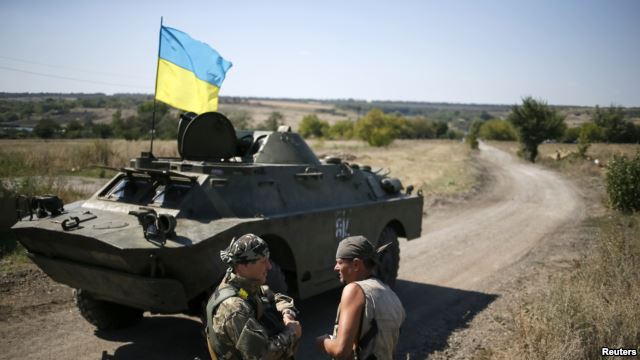
Ukrainian servicemen speak near an armored vehicle in their camp near Donetsk Sept. 2, 2014.
Russian President Vladimir Putin has put forward what he called an “action plan” for peace in eastern Ukraine, amid contradictory reports on whether a cease-fire had been reached between Ukrainian government forces and pro-Russian separatist rebels.
Speaking in the Mongolian capital of Ulan Bator, Putin said both the Ukrainian government forces and the rebels should halt “active offensive operations” in the Donetsk and Luhansk regions of eastern Ukraine, where the two sides have engaged in fierce clashes.
He also said government forces should withdraw to a distance from which they cannot hit populated areas with artillery and other “volley fire” weapons.
Russia’s leader urged “full-fledged and objective international control” over cease-fire compliance, a ban on the use of military aviation against civilian areas, an unconditional prisoner exchange, the opening of “humanitarian corridors” for refugees and relief supplies, and the possibility of sending in teams to repair damaged infrastructure.
Ukraine and NATO say Russian troops and armor have crossed the border in recent days, forcing the retreat of Ukrainian units, which had been gaining ground against the rebels. Moscow denies its armed forces are involved in the fighting.
Earlier Wednesday, the office of Ukrainian President Petro Poroshenko said he and Putin had agreed in a phone conversation on a “permanent cease-fire.”
But Poroshenko’s office subsequently revised that statement to say mutual understanding was reached on steps that will contribute to establishing peace, without giving any details.
Separatists skeptical
Pro-Russia separatists reportedly were wary. Russia’s RIA Novosti state agency on Wednesday quoted Vladislav Brig – a spokesman for the Defense Ministry of the separatists’ self-proclaimed Donetsk People’s Republic – as saying there could be no cease-fire as long as Ukrainian government forces remain in the Donbas, the section of eastern Ukraine that includes the Donetsk and Luhansk regions.
In a separate statement Wednesday, the Kremlin said Putin and Poroshenko did not agree on a cease-fire in Ukraine, noting that Russia is not a party in the conflict. The statement said the two presidents discussed how to resolve the conflict.
Earlier, Russian presidential spokesman Dmitry Peskov said Putin and Poroshenko had exchanged views on ways to stop the “bloodshed” in southeastern Ukraine. Peskov said the two presidents largely agreed on possible ways out of the crisis.
U.S. President Barack Obama said Wednesday it was too early to respond to reports of a cease-fire. But, in an address to NATO members meeting in Estonia, he emphasized that “the only path to lasting peace” is negotiation and respect for sovreignty.
“Borders cannot be redrawn at the end of a gun,” Obama said.
Conflict continues
Ukraine said Tuesday that 15 Ukrainian soldiers have been killed in fighting in the east since early Monday.
Most of the fighting has been around the city of Donetsk, the rebels’ largest stronghold and one of two major cities controlled by pro-Russian separatists seeking autonomy from Ukrainian rule. The other city is Luhansk.
On Tuesday, a Ukrainian official, Andriy Lysenko, said Russian troops had been spotted at 10 locations on Ukrainian territory. Lysenko said Russia is continuing to concentrate soldiers and military hardware in six areas in the Donetsk region, including Donetsk city and Luhansk.
Separately, Ukraine’s Defense Minister Valeriy Heletey said Ukraine’s military goals are shifting from a counter-insurgency operation to a battle against the Russian army.
NATO estimates at least 1,000 Russian troops are in Ukraine, though Moscow has repeatedly denied any military presence on Ukrainian territory.
France suspends warship delivery to Russia
France announced Wednesday it would suspend delivery of the warship Vladivostok to Russia because of concerns about Moscow’s involvement in eastern Ukraine.
French President Francois Hollande’s office announced the decision the day before a NATO summit in Wales, the French paper Le Monde and the Associated Press reported.
Hollande’s office called the situation in Ukraine “grave” and said Russia’s recent actions threaten “the foundations of security in Europe,” the AP reported.
After Russia’s annexation of Crimea, the United States and Britain had criticized France’s plans to go ahead with delivery of the first of two Mistral-class warships. The vessels had been contracted by ex-president Nicolas Sarkozy’s conservative government in 2011. At the time, the deal made France the first member country of NATO to supply Russia with military equipment.
Journalist’s death decried
Also Wednesday, Russian officials confirmed the death of a Russian photojournalist who had been been covering the eastern Ukraine conflict and went missing in early August.
Russia’s Investigative Committee accused Ukrainian forces of killing Andrei Stenin, 33, who’d been on assignment for the state-run Rossiya Segodnya International Information Agency. The committee demanded an investigation.
Likewise, the Organization for Security and Cooperation in Europe said it was “appalled” by Stenin’s killing.
An OSCE representative on media-freedom issues, Dunja Mijatović, called for Ukrainian authorities to swiftly and thoroughly investigate all killings and attacks on journalists in Ukraine.
source: voanews.com







 STUDIO 3 NEWCASTLE AUSTRALIA