Monthly Archives: January 2015

Ένας Πόντιος που εφοδιάζει τις αυστραλιανές ένοπλες δυνάμεις


Ο κ. Ταβλαρίδης δεξιά με τον Παναγιώτη Ιασωνίδη και

Ο κ. Ταβλαρίδης το 2009 ως πρόεδρος της Ομοσπονδίας Ποντιακών Σωματείων, με τον τότε Γενικό Κυβερνήτη της Ν. Αυστραλίας Michael Atkinson και Παναγιώτης Ιασωνίδης αναπληρωτής πρόεδρος της Ομοσπονδίας Ποντιακών Σωματείων

Η εφημερίδα «The Australian» αφιέρωσε εκτενές δημοσίευμά της στον ομογενή.

Η εφημερίδα «The Australian» αφιέρωσε εκτενές δημοσίευμά της στον ομογενή, Χαράλαμπο Ταυλαρίδη, διευθυντή προγραμμάτων της εταιρίας Thales Australia.

Η εν λόγω εταιρία απασχολεί περίπου 3.200 άτομα στην Αυστραλία και ειδικεύεται στην παροχή ηλεκτρονικών συστημάτων στις αυστραλιανές ένοπλες δυνάμεις, αλλά και στον ιδιωτικό τομέα.

Πρόσφατα, το αυστραλιανό υπουργείο Άμυνας της ανέθεσε τα συμβόλαια για τους νέους εξομοιωτές των πολεμικών ελικοπτέρων της.

Όπως αναφέρεται στο δημοσίευμα, αυτό οφείλεται και στις ικανότητες του κ. Ταυλαρίδη.

Ο τελευταίος είναι δραστήριος ομογενής. Υπήρξε πρόεδρος της Ομοσπονδίας Ποντιακών Σωματείων Αυστραλίας και πρωτοστάτης της αναγνώρισης της Ποντιακής Γενοκτονίας από την κυβέρνηση της Νότιας Αυστραλίας.

FA Cup weekend preview: Man Utd, Chelsea, Man City all have lower tier teams

leicesterspurs

The FA Cup dominates the fixture sheets in England this weekend, with most Premier League sides drawing lower-tier teams.

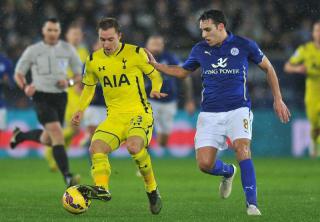
There are a pair of matchups between Premier League teams. Tottenham Hotspur and Leicester City will do battle at White Hart Lane. It could be a great momentum builder for either side, or an acceleration governor for the losing side. Each comes into this game in good league form, with Spurs looking to build on a pair of wins in the league, while Leicester has two in its last three.

Spurs has been tripped up at this point in each of the last two seasons, falling to Arsenal and Leeds in consecutive third rounds. Meanwhile, the Foxes have also not reached further than this point since 2012, when they made it to the sixth round before succumbing to eventual winners Chelsea. Spurs won the Premier League meeting between these two sides earlier this year by a 2-1 score at King Power Stadium.

Meanwhile, Southampton and Crystal Palace will face off at St. Mary’s. This season has seen a surprising surge from Southampton, and they will likely look to turn that into more than just a solid league table finish. The cup could be a good place to score some silverware if Southampton can make a run, but they’ll need to get by a scrappy Crystal Palace side that could be distracted, with saving its top flight status likely taking priority.

Manchester United drew the lowest remaining team in League Two side Cambridge United, and they will play the only Friday fixture this afternoon. Hopefully, for the people in this bar, Cambridge can put a few past the Premier League giants. Not too many, though.

Chelsea has League One’s sixth placed team Bradford City, who made it to the final of the League Cup in 2012, taking down Arsenal and Aston Villa on their way. Liverpool pulled mid-table Championship side Bolton, while Sunderland will welcome a much-improved Fulham team to the Stadium of Light. The Whites have climbed from the cellar of the Championship up to 14th since the departure of mercurial German manager Felix Magath.

West Brom face a tough draw with in-form Birmingham, in the middle of the Championship table but winners of four of their last six league games, losing just one over that span. Manchester City also have a tougher road ahead as they get Middlesbrough, in a promotion position of second in the Championship table. The Boro has conceded just a single goal across all competitions since Christmas.

On Sunday, a trio of Premier League teams will take on lower division foes. Arsenal travels to Brighton Hove & Albion, who sit 19th in the Championship table but have distanced themselves from the relegation zone with three wins in its last four. Aston Villa will host Championship leaders Bournemouth, a tall task for the Claret & Blue to be facing a team they very well may see in Premier League play next season. Finally West Ham will visit third tier Bristol City, who sit second in the League One table.

Other fixtures:

Cardiff City vs. Reading (Saturday)
Preston North End vs Sheffield United (Saturday)
Derby County vs Chesterfield (Saturday)

source:nbcsports.com

A guide to Greek elections

Greek voters go to the polls on Jan. 25 in a general election that will decide whether Europe’s most-indebted country sticks to the economic-overhaul program set out by its troika of official creditors or tries to chart its own course.

This is a guide to the rules governing the voting and the process of forming a government afterward.

— Voting begins at 7 a.m. on Sunday and finishes at 7 p.m. local time. A total of 9.8 million citizens are eligible to cast ballots, with more than a third of them concentrated in the Attica metropolitan region, which includes the city of Athens.

— Exit polls will be published at the close of voting. There will be an initial estimate of the result based on ballots counted at about 9:30 p.m and a more accurate estimate before midnight. The vote count will be available on the Interior Ministry’s website: http://ekloges.ypes.gr/.

— Twenty-two parties are standing for election. They need at least 3 percent of the vote to win seats in the next parliament and polls indicate that as many as seven will pass that threshold. Lawmakers are allocated proportionately among the parties that reach the cutoff and the group with most votes gets an extra 50 seats.

— Once sworn in, the new prime minister will have 15 days to win a confidence vote requiring 151 lawmakers in the 300-seat parliament. Recent polls suggest neither SYRIZA nor New Democracy will be able to do that on their own.

— If no single party has an absolute majority, the president of the republic gives the leader of the party with the most votes three days to form a government. If he fails, the three-day mandate is handed to the leader of the second-biggest party, and finally to the leader of the third party.

— If no one can form an administration, the president will ask party leaders to form a unity government. If that doesn’t work, as happened in 2012, all parliamentary groups will be asked to join an interim government to prepare fresh elections. And if that fails the job of organizing a new vote falls to either the head of the Council of State or the Supreme Court.

source:ekathimerini.com

Tsipras aims for deal with lenders by this summer

Alexis Tsipras speaking at Friday’s press conference.

 SYRIZA leader Alexis Tsipras will aim to conclude an agreement with Greece’s international lenders by the summer if his party is able to form a government after Sunday’s elections.

In a televised news conference Friday, Tsipras sketched out his plans for government and revealed that he had no specific plans for meeting German Chancellor Angela Merkel if he becomes prime minister.

The SYRIZA chief suggested that his government would enter negotiations with Greece’s eurozone partners after being elected and would aim to wrap up talks on the way forward in the relationship between the two sides by July or August, when Greece has a series of debt obligations to meet.

Tsipras said that he is aiming to achieve a “sustainable, mutually acceptable solution for Greece and for Europe.” However, he suggested that he would negotiate with representatives of European Union institutions, rather than troika officials.

“Austerity is not enshrined in European treaties,” said Tsipras, adding that his government would recognize Greece’s “institutional obligations” toward the EU but not the “political commitments”» made by the outgoing government.

When asked where he would make his first official trip to if elected prime minister, Tsipras said it would be Cyprus. He added that he would not seek direct talks with Merkel.

“I do not recognize Mrs Merkel as being any different from the other leaders,” he said. “She is one of 28 so I will not rush to meet her.”

source:ekathimerini.com

Samaras in last-ditch appeal to voters

Antonis Samaras addressing supporters on Friday.

 In a last-ditch attempt to rally supporters and attract additional support ahead of Sunday’s critical snap elections, Prime Minister Antonis Samaras on Friday underlined the risks of a leftist government coming to power in Greece, stressing that his party would keep the country solvent, on the path of reform and inside the Eurozone.

“We are leaving the memorandums… Greece no longer needs loans,” Samaras told a crowd of supporters at a sports stadium in Faliro.

“They will bring us to the point where we need to borrow again,” Samaras said, referring to leftist SYRIZA which is tipped to win the elections on Sunday.

“SYRIZA isn’t going to change Europe but will turn Europe against Greece,” Samaras said and accused leftist leader Alexis Tsipras of “serving the drachma lobby.”

The premier vowed that “the Tsipras accident is not going to happen,” warning that Greece could suffer a crisis similar to that experienced by Cyprus, where the European Central Bank cut off liquidity, if Tsipras comes to power.

Earlier in the day, New Democracy spokesperson Maria Spyraki struck a similar tone, describing Tsipras as “”determined to lead the country to isolation and bankruptcy” and accusing the leftist chief of “defrauding Greeks.”

At his rally, Samaras insisted that ND, which continued to trail SYRIZA in the final opinion polls Friday, was the only party that could steer Greece to economic and political stability. “The key question is this: Who do you want in the driving seat right now?” he said, reiterating pledges to cut property, income and corporate taxes if ND is re-elected.

The premier also slammed SYRIZA for its position on the ECB’s bond-buying program, indicating that the leftists’ resistance to resuming talks with Greece’s troika of international creditors essentially would block the country from the program. “It’s raining money, and they’re ordering umbrellas,” Samaras quipped.

The last round of opinion polls Friday pointed to SYRIZA maintaining a strong lead over the conservatives though it remained unclear whether the leftists would be able to secure an absolute majority and avoid talks with coalition allies. In any case, Samaras is almost certain to face upheaval within his party, with speculation about a leadership challenge intensifying Friday.

source:ekathimerini.com

Too much tax? Middle income Australians pay 11 cents in the dollar, says the Australian Council of Social Service

Mr 50 per cent: Joe Hockey says Australians spend six months of the year working to fill the government's coffers, a claim disputed by a new report.

Mr 50 per cent: Joe Hockey says Australians spend six months of the year working to fill the government’s coffers, a claim disputed by a new report. Photo: Christopher Pearce


Australians pay far less tax than they believe, a new report finds, and certainly far less tax than the Treasurer thinks they do.

Mr Hockey told Fairfax radio on Monday that Australians paid nearly half their income in tax.

“When Australians spend the first six months of the year working for the government with tax rates nearly 50 cents in the dollar it is a disincentive,” he said.

“You’re working July, August, September, October, November, December just for the government and then you start working for yourself and your own household income after that for another six months – it is a disincentive.”

A report released on Saturday by the Australian Council of Social Service finds that personal tax as a proportion of a middle-earning household’s income is just 11 per cent – a good deal less than other calculations and far less less than the Treasurer’s.

High-earning households pay 20 per cent of their household income.

ACOSS arrives at the figures by including all household income in its total, including untaxed or lightly taxed income washed through superannuation, family trusts and negatively geared properties.

“To get a true picture you need to look at total income rather than just taxable income,” ACOSS chief executive Cassandra Goldie said.

The personal tax scale prepared by ACOSS is quite progressive. The bottom one-fifth of households pay 3 per cent of their income in personal tax, the next group pays 7 per cent, middle group 11 per cent, the second-top group 15 per cent and the top group 20 per cent.

But the progressivity vanishes when other forms of tax are included. Including the goods and services tax and other consumption taxes such as petrol and tobacco excise, the lowest earning household pays 24 per cent of its income in tax and the highest earning household only a little more at 28 per cent.

Dr Goldie said the goods and services tax hit low earners far harder than high earners meaning they paid much more in consumption tax than income tax while high earners paid much more in income tax than consumption tax.

“It shows how skewed the tax debate is becoming. We seem to be only talking about the GST, yet our modelling shows that lifting the GST would hit hit the lowest earners far more than the highest earners,” she said.

Superannuation tax concessions and those for trusts, negative gearing and capital gains were far more likely to raise money from well off households than the GST

ACOSS has prepared the research paper as part of its contribution to the governments tax review which Mr Hockey will launched early next month.

“We are about to be embroiled in a very contested debate and we have the treasurer suggesting people are contributing half their income to tax which is simply not accurate,” she said.  “How can we possibly get responsible debate about reform when we don’t even have good transparency about the facts?”

“We are releasing this paper to demonstrate that based on the Bureau of Statistics data and appropriate modelling people on higher incomes are contributing around 28 per cent. They are able to pay more.”

source:smh.com.au


David Hicks: ‘US now admits’ Muslim convert was not guilty of terror charges, says lawyer

Australian’s lawyer says guilty plea was made under duress


The lawyer of a Muslim convert who was jailed at Guantanamo Bay has said the US has admitted his client was innocent of the terrorism charges he was convicted of.

Australian David Hicks was sent to the US prison camp on Cuba in 2001. In 2007 he pleaded guilty in 2007 to “providing material support for terrorism”. While in US military custody he was allegedly beaten and threatened with deadly violence.

But Mr Hicks and his lawyers have insisted the guilty plea was made under duress and that he was innocent of the allegations levelled at him

Lawyer Stephen Kenny, a veteran human rights activist, said the US military had now acknowledged his innocent and was preparing to formally do so in court. He said he expected to hear within a month whether or nor the Court of Military Commission Review in Washington would quash his conviction.

“We have no doubts that the Military Commission will make a ruling now that David Hicks’ conviction should be set aside,” Mr Kenny told the Australian Broadcasting Corporation.

David Hicks wrote about his treatment at the US military base at Guantanamo Bay

Mr Hicks, who is now 38 and lives in Australia, converted to Islam in 1999 and travelled to Afghanistan where he trained at paramilitary training camps. The US insists the camps were operated by al-Qaeda but Mr Hicks insisted he never saw evidence of terror related activities.

He was captured by US forces in the chaotic aftermath of the West’s invasion of Afghanistan and was among the first group of prisoners to be sent to Guantanamo Bay. In 2007, he signed a plea deal in which he agreed he would never appeal his conviction but which allowed him to return to Australia and complete nine months in jail.

While Mr Hicks, a former kangaroo skinner, agreed never to appeal his conviction, Reuters reported that civilian US courts had since ruled that providing material support for terror was not a legitimate war crime for actions that occurred before the adoption of new laws in 2006.

The Military Commission earlier this month overturned the terrorism conviction through plea bargain of a Sudanese man, Noor Mohammed, who was also at Guantanamo, citing those rulings.

The US military has refused to discuss the specifics of Mr Hicks’ case. A spokesman, Lt Col Myles Caggins, said in a statement on Friday that his case was now in an appeal process. He added: The government will make additional responses through court filings.”

source:independent.co.uk


Asian Cup 2015: UAE complete shock win over Japan to reach semi-final after penalty shootout dramatics

850472_heroa

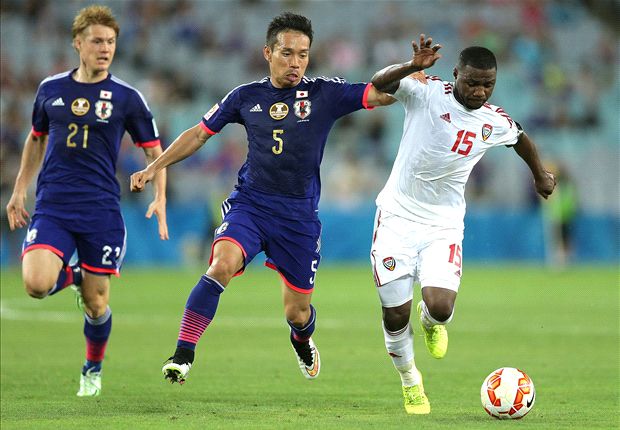
United Arab Emirates has set up an Asian Cup semi-final with Australia after a shock penalty shootout win over Japan at Sydney’s Olympic stadium.

Two of Japan’s biggest stars missed penalties as the defending Asian Cup champions were dumped out at the quarter-final stage by United Arab Emirates on Friday.

The Sydney fixture was forced into extra-time when the sides ended 90 minutes tied at 1-1 and, after the additional half-hour failed to produce another goal, Keisuke Honda and Shinji Kagawa missed their respective spot-kicks to cost Japan a place in the last four.

After Kagawa’s effort had struck the left-hand post, Ismail Ahmed stepped up to seal the win for UAE.

Ali Mabkhout had given UAE the lead after seven minutes with a stunning strike, with Japan struggling to shift out of first gear for much of the encounter.

Javier Aguirre’s side stepped up their game somewhat in the second half, and pulled level through Gaku Shibasaki nine minutes from time.

However, it was UAE who came out on top after the shootout went to sudden death.

The victory sees Mahdi Ali’s side progress to face hosts Australia for a place in the final, while Japan suffer their earliest elimination since 1996, when the tournament was held in UAE.

That tournament was also the last time UAE – eventual runners-up – reached the last four.

Mabkhout fired a warning signal when he carried the ball into the Japanese box only to get a heavy touch at the crucial moment, but the Al Jazira frontman did put his side ahead in the seventh minute.

The 24-year-old expertly brought down an inviting ball over the top, before rifling his fourth goal of the tournament across Eiji Kawashima into the bottom-left corner.

Inui looked to be Japan’s biggest threat early on and should have netted a leveller 11 minutes later, but headed straight at Majed Naser from a Gotoku Sakai cross.

With the winners of the fixture going on to face hosts Australia in the semi-finals, it was little surprise to hear the lower-ranked UAE enthusiastically supported in Sydney, and Ali’s men looked assured in preserving their unexpected lead.

Yasuhito Endo blasted over and Honda disturbed the side-netting before the half was out, but Japan looked a shadow of their usual selves.

Yoshinori Muto was introduced in place of Inui at the interval, but squandered two great opportunities to pull Japan level – drilling wide left before sending a header off target just short of the hour mark.

There was no questioning Japan’s improved attacking threat in the second half, and their persistence paid off when Shibasaki found the net with a sublime finish nine minutes from time.

The substitute was teed up by Honda just outside the box and found the net with a perfectly judged curling strike.

Only some desperate defending prevented Japan snatching the win in normal time, with Naser punching clear from a Kagawa effort late on before pushing over from a Honda free-kick.

Kagawa then put the ball agonisingly wide of the left-hand post from close range with the final kick of regulation time to force an extra 30 minutes.

The first period of additional time passed without incident – much to the relief of UAE, who came under immense pressure towards the end of the 90 – and the pace barely picked up in the second, with a late Honda free-kick sneaking just wide of the target to leave the sides to contest a shoot-out.

Honda ballooned the opening penalty to give UAE the advantage, before Khamis Esmaeel also cleared the crossbar to restore parity.

Kagawa’s strike against the base of the post at 4-4 opened the door for Ahmed to seal a famous victory, and the substitute made no mistake from 12 yards.

source:goal.com


Mutterings in unhappy Tony Abbott ranks – is mutiny on the horizon?

Backbenchers are so fed up with the PM’s backflips, they’re even talking about Malcolm Turnbull as the man who might save the government.

Luck’s been elusive in 2015. Abbott’s first talk-back caller on Neil Mitchell’s top-rating 3AW radio program was from a self-described “through-and-through” Liberal supporter named Andrew.

The danger for Abbott is that it is in the heartland where disillusionment with the government seems at its strongest.

“I’ve got to be honest and truthful with you, Mr Prime Minster, you’re on the nose with Liberal voters and that’s a real concern to me because I don’t want to see you give the keys to Bill Shorten at the Lodge … I have got to tell you, you are the world’s worst salesman, Prime Minister,” he said.

<i>Illustration: Simon Letch</i>Illustration: Simon Letch

“What is the specific problem, is there a policy thing you don’t agree with?”, Abbott inquired.

“Prime Minister, it’s the way you do things, like the Medicare thing, with the education, you’ve done so many backflips, people don’t know where you are going and business is saying there are roadblocks because there is no direction and no leadership … as a Liberal voter, I don’t particularly like you,” Andrew replied.

Ouch!

<i>Illustration: Simon Letch</i>Illustration: Simon Letch

“Yes it has been a messy start,” intoned one of Tony Abbott’s ministers wearily amid nascent leadership chatter. The year had barely started when a plan “B” slashing the Medicare payment to GPs by $20 for short consultations, had been summarily abandoned on the eve of its commencement.

And since then, a senior source wanted it known the idea of the cut had been the Prime Minister’s from the start. Health Minister Peter Dutton had argued forcefully against it  in Cabinet’s Expenditure Review Committee, and been backed by Joe Hockey, but they were overruled. The leak was telling.

Just like the friendless $7 per-patient co-payment barnacle it had partly replaced, the short-consult penalty was suddenly “off the table”. Once again, the government had sustained serious political damage for zero budgetary gain. Not for the first time, backbenchers were flummoxed.

What was going on? Had Abbott learnt the lessons of a woeful 2014 and replaced his legendary stubbornness with a new fleet-footed pragmatism? Perhaps, but a blunter interpretation saw only a triple defeat – a backflip from what had already been a backflip which had only been necessary in the first place because of a politically toxic broken promise, which was never sold to voters.

Abbott wanted more than anything to begin the game afresh having tied off the least productive fights as unwinnable. Last year had ended in desultory fashion characterised by a series of grudging half-retreats – the kind that left the government carrying both the humiliation of admitting its errors while still being lumbered with elements of the primary problem.

The Prime Minister had assured colleagues his pre-Christmas clean-up would facilitate a repositioning in the new year. Yet 2015 has commenced amid confusion at least as severe. Now, the “judgment” word is being muttered.

The horror for many Liberals, and the danger for Abbott is that it is in the heartland where disillusionment with the government seems at its strongest. MPs say they are picking up genuine anger within their own membership.

Abbott is well aware his leadership has entered its most fraught period, having already been forced to address the question before Christmas. “I think the one fundamental lesson of the last catastrophic government was that you don’t lightly change leaders,” he had told reporters. He was at it again on Thursday when asked on 3AW if he was aware of “increasing speculation” that he would consider stepping down if the problems continued?

“Yeah that’s nonsense, absolute nonsense,” he said. “… you do not change leaders; you rally behind someone and you stick to the plan.”

Yet the very fact that the PM is having to field such questions when he is trying to talk about other matters, speaks to his situation. Colleagues wonder anyway what the plan is given that it keeps changing.

A working assumption in Canberra has held that Abbott’s leadership is more secure than a Labor leader faced with the same problems. First, Liberals are culturally less inclined than Labor to embrace the percussive brutality needed to tear down a prime minister. In addition, the Coalition witnessed up-close in 2010 what voters thought about knifing a sitting PM and would simply not flirt with that. Yet another interpretation of the tumultuous events of 2010 is that they not so much reinforced the rules, as tossed them out. Hence forth, anything is possible in politics.

What is undeniable is that murmurings have started and that cracks are appearing in the government facade. On Tuesday, The Australian splashed with a story beginning “Joe Hockey has ruled out any backdown on government plans to deregulate university fees …”

The very next day, the Oz’s splash read: “The Abbott government is preparing to sacrifice up to $2 billion in budget savings in a bid to regain momentum and kick off the new year with a much-needed political victory on higher education reform”. Same government. Same subject. And yet completely contradictory positions.

For the first time since 2009 when he was bundled out of the leadership, Malcolm Turnbull’s name is being mentioned positively by influential figures on the party’s right – something that was inconceivable not so long ago.

Asked if conservatives really would consider lining up behind the moderate Turnbull now, one right-wing figure said events had already gone beyond left-right divisions.

In reality, Abbott probably has more time than his critics claim and plans to forge ahead using a National Press Club address on February 2 to chart the course for his political year.

But heavy weather externally is no longer his only existential threat. Now he must be alive to the threat of mutiny as well.

source:theage.com.au

Macedonian Makeover: Europe’s Flailing Capital of Kitsch

Skopje NEW NEW

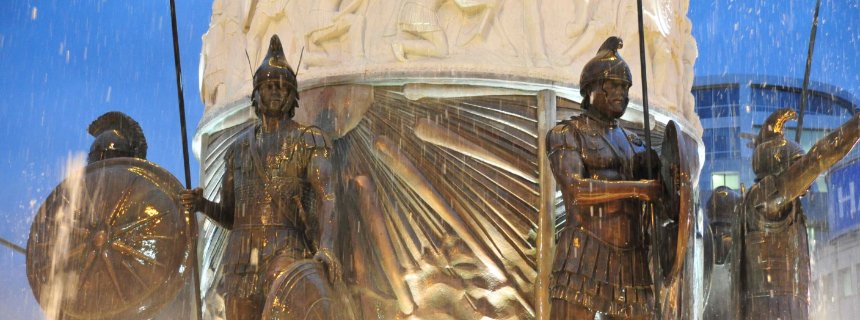
Jets of water spurt into the air in front of the warriors: red, yellow, blue, violet. The eight bronze men stare fiercely through the spray of the fountain, while far above their heads, Alexander the Great sits enthroned, raising one sword up at the sky. Wagner and Tchaikovsky blare out of the speakers and the water shoots more or less in time with the music.

Skopje has a new landmark: The Warrior on a Horse monument on the Plostad Makedonija, a square at the center of the city, is almost 30 meters (100 ft.) high, cost €10.5 million ($14 million) and is about as authentic as the imitation Grand Canal in Las Vegas. More heroes from Macedonia‘s colorful history pose nearby, sculpted on a large, if somewhat misshapen scale. The feet of the saber-rattling flag-bearer, for example, are disproportionally large.On the other side of the Vardar river, near the entry to the old town, a statue of Philip II of Macedon — Alexander’s father — shakes a colossal fist at the sky, while bronze horses jump out of a nearby fountain. New temple-like ministry buildings, a theater and a museum — with its own line-up of 19th- and 20th-century poets and revolutionaries — have been built between the monuments to the two kings.

‘Historical Kitsch’

And the construction project isn’t finished: Numerous facades are still obstructed by construction cranes. Buildings are being retrofitted with the dictated sugarcoated new style that the local media diplomatically calls “baroque” or “neo-classical,” and architects call “historical kitsch.”

The redevelopment is called Skopje2014 and is costing VMRO, the conservative and nationalist governing party, hundreds of millions of euros. The official budget is €207 million — which includes the renovated ministry buildings, the new national theater and triumphal arch.

Critics believe that’s an impossible figure, that it won’t buy half of what the plans call for. Even Skopje2014’s overall theme — a celebration of ancient and Slavic heroes — has been condemned by experts because it ignores many of Macedonia’s ethnic groups and favors a small section of the national fabric.

According to news reports, the contracts for the project were made illegally. But the Macedonian media have been restrained in their protest. “Too much criticism can quickly cost you your job. The VMRO has long had control over the media,” says one journalist, who does not want to be named. There’s a reason Skopje2014’s monumental style has an authoritarian feel.

The case of Tomislav Kezarovski is yet more evidence of this: The journalist recently received a four-and-a-half-year jail term for having allegedly revealed the identity of a witness in a murder trial in 2008 — an accusation independent observers claim is an attempt to muzzle a journalist critical of the government.

‘Strong Message of Censorship’

The Organization for Security and Cooperation in Europe has been sharply critical. The group’s press freedom appointee Dunja Mijatovic says she fears the court decision could become a “strong message of censorship directed at other journalists in the country.” The people in power have long made their threats known, and countless critical media organizations have shut down in the past few years.

The current economic situation offers little reason to build a triumphal arch. The financial crisis has hit Macedonia hard. Every second young person is unemployed, and the overall unemployment level is one of the highest in the world — almost 30 percent. Those who have jobs are relieved when their salary tides them over until the following month. The universities are underequipped, as are the hospitals. Renovations are necessary in many places, but the government apparently has other priorities.

The government and its construction project have provided people with some strange stories. Two young architects, Boro Gadjovski and Filip Dubrovski, stand in front of the recently erected Fallen Heroes of Macedonia monument. Behind them, a torch-bearing young man glistens in the autumn sun. “In the beginning you could only see his steeled muscles,” they say with a laugh, referring to its original nude state. There were waves of indignation: Such a nakedly “classical” statue wasn’t allowed, and so the torchbearer was fitted with a pair of pants.

Failed Opportunity

The two men don’t take any pleasure in the Skopje2014 prestige project — they’d rather remind people of another city construction project which had come about after the city was destroyed in a 1963 earthquake. After the catastrophe, “the reconstruction was a unique opportunity for modern city planning. Under the leadership of the United Nations a number of countries were involved. Skopje became a symbol for worldwide solidarity,” says Gadjoski. “They were going to build a humane yet utopian city,” adds Dubrovski.

The master plan for the post-earthquake reconstruction was designed by Japanese star architect Kenzo Tange, and resulted in angular cement structuralist icons and sleek skyscrapers that diverged from the normal apathetic prefab constructions of the time. Tange designed a train station that was never finished. “He wanted to put up footbridges for pedestrians to cross the streets going into the center. Pedestrians treated as more important than car traffic — where else did people think so progressively in the 1960s?” asks Dubrovski.

The Gradski Trgovski Centar shopping center is the square’s last remnant of that period. It won a national architecture prize in Tito’s Yugoslavia, and yet the Skopje2014 plan calls for it, too, to be “baroquized.”There is a group of architects in the city who oppose this transformation. They demonstrate on the edge of the shopping center in the evenings. Gadjovski and Dubrovski take part, along with another 30 allies. A woman sings lovely jazz in the cold autumn evening. Others distribute hand-decorated balloons. Only a small local TV station sends a team to cover the event. “In the summer we were still a thousand people,” says one of the demonstrators and shows the photos on his smartphone.

But it’s not just the protests giving the Skopje2014 planners a headache. “The new buildings are much too close to the river,” says Boro Gadjovski. “When there’s flooding there could be damage.”

source:spiegel.de