Monthly Archives: January 2015

Υποχωρεί το ευρώ στις αγορές Αυστραλίας – Ασίας μετά τα exit polls

Υποχωρεί το ευρώ στις αγορές Αυστραλίας - Ασίας μετά τα exit polls

Πτώση καταγράφει το ευρώ στις αγορές της Αυστραλίας και της Ασίας μετά τις δημοσκοπήσεις εξόδου που έδειξαν ότι ο ΣΥΡΙΖΑ οδεύει προς μια άνετη νίκη στις εθνικές εκλογές στην Ελλάδα, γεγονός το οποίο -όπως σχολιάζει το πρακτορείο ειδήσεων Reuters- εγείρει τον κίνδυνο μιας διένεξης με την Ε.Ε. σε ό,τι αφορά στην οικονομική πολιτική.

Το κοινό νόμισμα πέφτει έναντι των κυριότερων ξένων νομισμάτων κατά την έναρξη των συνεδριάσεων στις αυστραλασιανές χρηματαγορές τις πρώτες πρωινές ώρες της Δευτέρας (τοπική ώρα), υποχωρώντας σε μια ισοτιμία 1,1170:1 έναντι του αμερικανικού δολαρίου, η οποία είναι κοντά στο 1,115 που είχε καταγραφεί την περασμένη εβδομάδα κι ήταν η χαμηλότερη από τον Σεπτέμβριο του 2003.

Πηγή:zougla.gr

Exit polls suggest big margin of victory for SYRIZA

Greece’s anti-austerity leftist party Syriza is on course to win Sunday’s snap election by a large margin over Prime Minister Antonis Samaras’ conservatives, a joint exit poll showed.

Syriza received between 35.5 and 39.5 percent of the national vote, ahead of Samaras’ centre-right New Democracy party which took 23 to 27 percent, according to the poll by Metron Analysis, GPO, Alco, MRB, Marc.

Led by the 40-year-old Alexis Tsipras, Syriza wants to renegotiate a chunk of Greek debt and end austerity measures. That has spooked markets which fear a new financial crisis in Greece could push it out of the euro, though any broader repercussions for the bloc are expected to be limited.

The biggest party generally needs between 36 and 40 percent of the vote to win outright although the exact figure depends on the share of the vote taken by parties that fail to cross the 3 percent threshold to enter parliament. The exit poll indicated that seven or eight parties will make it into parliament.

Centrists To Potami and far-right Golden Dawn were tied for third spot with 6.4 to 8 percent of the vote, according to the exit poll.

source:ekathimerini.com

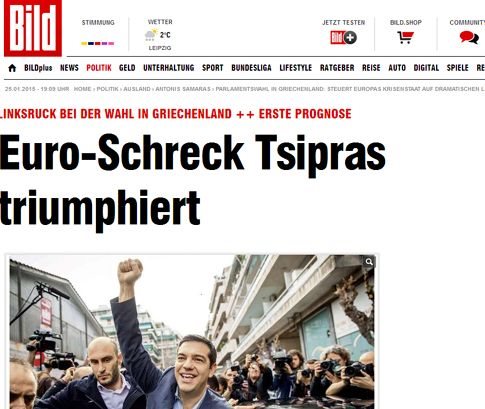
«Ευρω-τρόμος, θρίαμβος του Τσίπρα» αναφέρει προκλητικός τίτλος της Bild

D1F4BFFD599A2144DEA41AA6D5931CAE

Με τον προκλητικό τίτλο «ευρω-τρόμος, θρίαμβος του Τσίπρα» η Bild μεταδίδει τις εξελίξεις στην Ελλάδα και τα αποτελέσματα των exit polls.

Η γερμανική Bild αναφέρει ότι η μετατόπιση προς τα Αριστερά θα μπορούσε να σημάνει μια ριζική πολιτική αλλαγή πορείας στην Ευρώπη, να σηματοδοτήσει μία κρίση μεγάλου μεγέθους και να έχει δραματική επίδραση σε ολόκληρη τη ζώνη του ευρώ, επειδή ο Αλέξης Τσίπρας θέλει να βάλει τέλος στο σχέδιο λιτότητας και καλεί για την ελάφρυνση του χρέους.

Πηγή:in.gr

Γκρίνια στελεχών της ΝΔ – Έκτακτο συνέδριο εξετάζει ο Αντ. Σαμαράς

Γκρίνια στελεχών της ΝΔ - Έκτακτο συνέδριο εξετάζει ο Αντ. Σαμαράς

Βαρύ το κλίμα που επικρατεί στη ΝΔ μετά τη δημοσιοποίηση των exit polls. Ήδη, κορυφαία στελέχη θέτουν ζήτημα Συνεδρίου, προκειμένου να γίνει η αποτίμηση του εκλογικού αποτελέσματος. Το ενδεχόμενο αυτό εξετάζει, κατά πληροφορίες, κι ο ίδιος ο πρόεδρος του κόμματος, που πάντως δεν φαίνεται να είναι διατεθειμένος να δρομολογήσει εξελίξεις σχετικά με την ηγεσία της ΝΔ.

Μιλώντας στο Mega, ο Κυριάκος Μητσοτάκης συνεγχάρη τον ΣΥΡΙΖΑ για τη διαφαινόμενη νίκη του και μίλησε για δύσκολη βραδιά για τη ΝΔ. «Η ΝΔ παραμένει η μεγάλη φιλελεύθερη κεντροδεξιά παράταξη, ανεξαρτήτως αποτελέσματος» σημείωσε και παρατήρησε ότι «θα γίνει η αποτίμηση».

Ο κ. Μητσοτάκης έκανε λόγο για «βαριά ήττα» και επισήμανε πως τα αίτια θα αναζητηθούν και όλα θα συζητηθούν σύντομα. Ο ίδιος αρνήθηκε να σχολιάσει εάν θα τεθεί θέμα προέδρου, λέγοντας ότι «θα περιμένω να τοποθετηθεί ο πρόεδρος».

Επιπλέον, μιλώντας στο Mega, ο Μάκης Βορίδης σημείωσε ότι θα γίνει η αποτίμηση του αποτελέσματος στη ΝΔ και εξέφρασε την άποψη ότι το σημαντικό για τον ίδιο είναι πως «η ΝΔ διεκδικούσε την κυβέρνηση και τώρα είναι στην αντιπολίτευση». Τόνισε, δε: «Θα δρομολογήσει ο πρόεδρος τις διαδικασίες».

Την ίδια στιγμή άρχισαν τα καραμανλικά πυρά: Ο κ. Ευάγγελος Αντώναρος έγραψε στο twitter για συντριπτική ήττα και πλήρη αποδοκιμασία της στρατηγικής του φόβου και του αποκλεισμού της κεντροδεξιάς και όσων τα έκαναν σημαία της παράταξς της Νέας Δημοκρατίας. Επιστροφή στις ρίζες.

Σύμφωνα με Το Βήμα, στην ηγετική ομάδα της ΝΔ επικρατεί παγωμάρα, καθώς στις πιο κρίσιμες εκλογές των τελευταίων δεκαετιών, κατέρρευσε η πολιτική και επικοινωνιακή στρατηγική τους, ενώ αναδείχθηκαν τα πολλαπλά λάθη που έγιναν σε πολλά επίπεδα.

Το κρίσιμο ζήτημα από εδώ και πέρα, είναι πιο κεντρικό στέλεχος της ΝΔ θα θέσει και πότε θέμα ηγεσίας. Πάντως, σύμφωνα με τις πληροφορίες που υπάρχουν, ο κ. Σαμαράς δεν είναι διατεθειμένος να δρομολογήσει ο ίδιος εξελίξεις.

Στη σημερινή ηγετική ομάδα έχουν βγει τα μαχαίρια και το ένα στέλεχος ρίχνει τις ευθύνες στον άλλο για το πολύ άσχημο αποτέλεσμα. Ήδη γίνεται το «πολιτικό ταμείο» και σύμφωνα με πληροφορίες ο γραμματέας της ΝΔ Ανδρέας Παπαμιμίκος, φέρεται να λέει ότι το κόμμα κινήθηκε με οργανωτική επάρκεια και πόρτα-πόρτα και αναφέρει πως συγκρούστηκε με τον εξ απορρήτων πρωθυπουργικό σύμβουλο Χρύσανθο Λαζαρίδη που εισηγήθηκε και υπερασπιζόταν τη στρατηγική του φόβου.

Λίγο μετά τις 9:30 το βράδυ θα υπάρξει δήλωση του κ. Σαμαρά με την οποία θα εγγυάται την ενότητα της παράταξης.

Πηγή:in.gr

«Ξεκάθαρη νίκη για τον ΣΥΡΙΖΑ»

«Ξεκάθαρη νίκη για τον ΣΥΡΙΖΑ»

Για σαφή επικράτηση του ΣΥΡΙΖΑ κάνουν λόγο οι ηλεκτρονικές εκδόσεις των γερμανικών μέσων ενημέρωσης επικαλούμενες τα πρώτα στοιχεία που προκύπτουν από τα exit polls.

«Ξεκάθαρη νίκη για τον αριστερό συνασπισμό του ΣΥΡΙΖΑ», σημειώνει η Frankfurter Allgemeine Zeitung, επικαλούμενη τα προγνωστικά των exit polls που δημοσιεύτηκαν μετά το κλείσιμο της κάλπης των κοινοβουλευτικών εκλογών στην Ελλάδα.

Η Bild επιλέγει τον τίτλο «Αριστερή στροφή, ο τρόμος του ευρώ Τσίπρας θριαμβεύει», σχολιάζοντας έτσι το μεγάλο προβάδισμα που καταγράφει το κόμμα του προέδρου του ΣΥΡΙΖΑ Αλέξη Τσίπρα έναντι της Νέας Δημοκρατίας του Αντώνη Σαμαρά.

«Ο αριστερός συνασπισμός του ΣΥΡΙΖΑ έχει σαφές προβάδισμα», αναφέρει η ηλεκτρονική έκδοση του περιοδικού Der Spiegel που σχολιάζει: «Οι έλληνες ψηφοφόροι αποφάσισαν: Η χώρα βρίσκεται ενώπιον μιας αριστερής στροφής».

«Ο αριστερός συνασπισμός του ΣΥΡΙΖΑ ενώπιον ξεκάθαρης νίκης», γράφει η ιστοσελίδα της Süddeutsche Zeitung του Μονάχου, η οποία προσθέτει μεταξύ άλλων ότι «κόντρα στις προβλέψεις ο Τσίπρας θα μπορέσει μάλιστα πιθανόν να κυβερνήσει χωρίς κυβερνητικό εταίρο».

«Μπροστά οι αντίπαλοι του ευρώ. Ο αρχηγός του ΣΥΡΙΖΑ Τσίπρας κερδίζει τις εκλογές στην Ελλάδα», σημειώνει το περιοδικό Focus στην ηλεκτρονική του έκδοση.

Στην κούρσα της τρίτης θέσης Ποτάμι και Χρυσή Αυγή

«Η αριστερά κερδίζει τις εκλογές στην Ελλάδα», αναφέρει τηλεγράφημα του Γερμανικού Πρακτορείου Ειδήσεων (DPA). Επικαλούμενο τα στοιχεία του πανελλαδικού exit poll το DPA σημειώνει ότι «το αριστερό κόμμα του Αλέξη Τσίπρα συγκεντρώνει 35,5% έως 39,5% των ψήφων. Οι μέχρι σήμερα κυβερνώντες συντηρητικοί υπό τον Αντώνη Σαμαρά συγκεντρώνουν σύμφωνα με προγνωστικά περίπου 23% έως 27%».

Το Γερμανικό Πρακτορείο Ειδήσεων στέκεται και στη διαφαινόμενη «μάχη» που θα διεξαχθεί για την τρίτη θέση. «Στην κούρσα για την τρίτη θέση το φιλοευρωπαϊκό κεντρώο κόμμα Το Ποτάμι και η ακροδεξιά Χρυσή Αυγή βρίσκονται στα ίδια επίπεδα».

Αναφερόμενο τέλος στο ΠΑΣΟΚ, το DPA σημειώνει ότι «οι μέχρι σήμερα συγκυβερνώντες σοσιαλιστές φτάνουν (…) ηττημένοι στο 4,2% έως 5,2%».

Πηγή:in.gr

Socceroos Asian Cup star Tim Cahill on why he loves Australia

In need of a monument: What honour would befit the legend of Tim Cahill? Perhaps Premier Mike Baird will come up with a solution.

I LOVE Australia because of the people and the passion they represent for our flag.

Whether it’s in everyday life or in the sporting arena.

It has a very proud multicultural melting pot of ethnic communities from all around the world.

The fresh produce, iconic landmarks, beaches … every state is a holiday destination.

In sport we wear our hearts on our sleeve and we have the never-say-die attitude that has resonated around the world due to our work ethic and sportsmanship.

I love Australia for the simple things in life like throwing a fishing line out, lighting up the barbecue and chilling with the family. These things represent a taste of Australia Day for me.

I have been lucky enough to wear the green and gold 80 times, playing around the world, and every time I sing the national anthem it makes me very proud of our country.

I have had some great moments in my life but I’ll never forget where I came from and being Australian means everything to me.

TIM CAHILL AND THE SOCCEROOS PLAY UAE TOMORROW IN THE ASIAN CUP SEMI-FINALS

source:heraldsun.com.au

Greeks Vote in Election Seen as Referendum on Austerity

images

ATHENS — Greeks streamed to the polls on Sunday in a pivotal election that was expected to usher in the first anti-austerity government in Europe, reflecting years of economic hardship, raising questions about Greece’s place in the continent’s currency union and leaving financial markets on edge.

The left-wing Syriza party, led by a young firebrand, Alexis Tsipras, reached election day with small but consistent leads over the governing center-right New Democracy party of Prime Minister Antonis Samaras in pre-election opinion polls as people stood in lines to vote across the nation.

“Democracy will return to Greece,” Mr. Tsipras, 40, said as he cast his ballot at an Athens voting center mid-morning, surrounded by a phalanx of cameras. “The message is that our common future in Europe is not the future of austerity.”

After years of belt-tightening imposed by Greece’s creditors, led by Chancellor Angela Merkel of Germany, Mr. Tsipras has surged to popularity with pledges to repudiate many of the conditions attached to a 240 billion euro bailout that many Greeks blame for worsening their lives and deepening an already devastating five-year recession.

Mr. Tsipras has also demanded that creditors write down at least half of Greece’s 319 billion euro public debt in order to give the country more breathing room for spending stimulus that he says is needed to jump-start the economy and reduce Greece’s 25 percent unemployment rate.

Such talk has lifted leftist and populist parties elsewhere in Europe, especially in Spain, where the left-leaning anti-austerity Podemos party, which is less than a year old, has already reached 20 percent in opinion polls there. The leader of Podemos, Pablo Iglesias, joined Mr. Tsipras this week during Syriza’s campaign rally. Both have burst into the limelight with pledges to face down austerity and their nation’s creditors.

Those same pledges, however, have spooked finanical markets and other European governments, renewing doubts about Greece’s ability to exit a financial crisis that has weighed down the country as well as its neighbors, many of which have given Greece loans to help it get back on its feet. Mrs. Merkel and others have said they see Mr. Tsipras’s demands as unrealistic and rife with the potential to drive Greece toward the brink of a default or worse.

Similar concerns were on the minds of average Greeks, many of whom were still undecided Sunday morning on whom to choose. Even those who thought Mr. Tsipras would win power, either alone or in a coalition with one or more other opposition parties, worried about what he would do when he got it.

In the wealthy Athens suburb of Psychiko, Betty Kaleki, 45, and Polly Katsouli, 46, stood outside a crowded school trying to figure out which candidate they would pick. Both were leaning toward an upstart leftist party, Potami, or the River, started up less than a year ago by a former television journalist.

“I’m not happy, I’m afraid,” Ms. Kaleki said. “If Syriza comes to power, I don’t know what will happen tomorrow.”

Ms. Katsouli said she did not think a catastrophe would come. “I just heard Tsipras on the radio this morning — he is already speaking like he’s the prime minister,” she said. She added that her biggest fear was about the coterie of academic economic advisers with whom he has surrounded himself, many of whom are split on how to take the economy forward and deal with Greece’s creditors.

She was concerned that some of his advisers on the far left are too radical and unpredictable, said Ms. Katsouli, who was split on whether to vote for Potami or for Mr. Samaras, whom many Greeks blame for imposing austerity. The closer she got to the voting booth, the more she edged toward Potami.

Mr. Samaras, who oversaw the implementation of an austerity program demanded by Greece’s so-called Troika of lenders — the European Commission, the European Central Bank and the International Monetary Fund — has warned that a Syriza-led government could wind up driving Greece outside the eurozone. While few people think that will really happen, Mr. Samaras used a photo-op as he cast his ballot Sunday morning to drive home the point.

“Today we decide if we move ahead with power, safety and confidence or if we head into an adventure,” Mr. Samaras said. “I am optimistic because I believe no one will risk the European course of our country.”

Some people were not convinced. Wearing a blue suit, a tall silver-haired man who would only give his first name, Vassilis, said he felt angry at the current government and the two main parties, New Democracy and Pasok, which had led Greece for nearly 40 years. “I’m 80, and I’ve lived through the German occupation,” he said as he stood in a line to vote. The ruling parties “are traitors and should be ousted,” he said.

Vassilis said he used to vote New Democracy, but now planned to vote for the Independent Greeks, a fringe party, saying he did not agree with all of Mr. Tsipras’s positions. The austerity overseen by Mr. Samaras, including a reduction in Vassilis’s pension and new housing taxes, had driven him into dire financial straits, he said. “I need to work just for a plate of food.”

Christina Polychronidou, 39, came to the same place with her husband and young daughter to vote. She would not reveal her choice, but, she added, it wouldn’t matter much anyway. “Nothing will change,” she said. “Tsipras will stay on the same course that Samaras did. If you have Merkel against you it’s very tough to change.”

source:nytimes.com

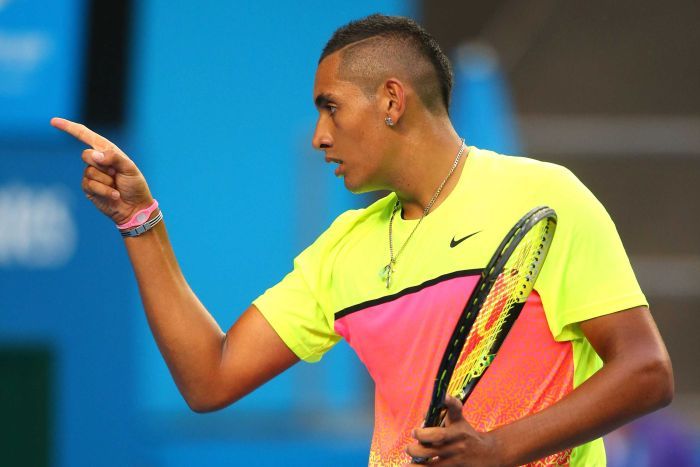
Australian Open: Nick Kyrgios beats Andreas Seppi in five dramatic sets to clinch place in quarter-finals

6045458-3x2-700x467

Nick Kyrgios, the last Australian remaining in singles competition, has thrilled the Melbourne Park crowd with a five-set win over Italy’s Andreas Seppi to make the last eight.

Kyrgios looked irritable and out of touch as he went down two sets to love, then fought back to win 5-7, 4-6, 6-3, 7-6 (7-5), 8-6 in his fourth-round match on Hisense Arena on Sunday night.

“It feels so good,” Kyrgios told Channel Seven.

“I knew he would have a lot of confidence, beating Roger [Federer], I just think drawing on my experiences, coming back against Richard Gasquet, I knew that I could do that. And the crowd was unbelievable.”

Games went on serve early in the match, but the Australian suddenly lost serve to love in the 11th game to hand Seppi the advantage.

The Italian, who caused the upset of the tournament when he beat Roger Federer in the third round, served out to win the opening set in 43 minutes – Kyrgios smashed his racket in frustration when he missed a chance to set up a break back.

Games again went on serve in the second set – although Kyrgios had Seppi at 15-40 in the fourth game before the Italian held.

The set looked likely to go to a tie-breaker before Kyrgios lost concentration to lose the 10th game, handing Seppi a two-set lead with a 6-4 scoreline.

With his Open hopes on the line, Kyrgios finally hit form, breaking in the second game and consolidating for 3-0 in the third set.

The Australian went on to win the set 6-3 to keep the match going.

The fourth set was a tense affair, and Kyrgios threw away a big opportunity when he challenged a Seppi groundstroke rather than play on at 0-30 on the Italian’s serve in the seventh game.

He lost the point, and Seppi went on to hold serve. Games then went with serve until 5-6 when Kyrgios – serving to stay in the match – double faulted when on game point to take the set to a tie-break.

He recovered with two straight aces to make it 6-6. Seppi netted a return on the opening point to go a mini-break down, but Kyrgios gave up the break two points later.

The Australian went ahead 3-2, then gave the break back the following point.

The next four points went on serve, Kyrgios then sent down an unplayable serve to go to set-point at 6-5, and the Australian followed up with a drilled backhand winner down the line to level the match after three minutes short of three hours.

Kyrgios rode the momentum, breaking his opponent in the second game of the final set.

He came under pressure on serve in the fifth game, before holding for a 4-1 lead.

However the Italian was not giving up, and he reeled off 12 straight points to seal the break and hold for 4-4.

The Australian appeared to be tiring, but he pulled two aces out in the ninth game to hold for 5-4.

For the first time Seppi had to serve to stay in the match, and the Italian was pressured into an error to go down 15-30 before holding for 5-5.

Kyrgios held to 15 to make it 6-5, then Seppi levelled it up again in the 12th game.

The Australian threw in a double fault at 30-15 in the following game, but he held in the end for 7-6.

Seppi netted a return off the opening point of the next game, and when he hit a forehand long, Kyrgios was two points from victory.

The Australian then found the corner with a cross-court backhand to set up three match points, and finally Seppi pushed an approach shot wide to give Kyrgios a dramatic win.

The win makes the 19-year-old Kyrgios the first teen since Roger Federer in 2001 to earn multiple quarter-final spots in grand slam tournaments.

He will play the winner of Britain’s Andy Murray and Bulgarian Grigor Dimitrov in the last eight.

source:abc.net.au

Anti-bailout party poised to win Greece election

greece-election-anti-bail

Greece voted Sunday in an early general election that could alter the course of the country’s struggle with crippling debts, with a radical left party poised to win by promising to rewrite the terms of its international bailout.

The Syriza party led by Alexis Tsipras has remained firmly ahead of conservative Prime Minister Antonis Samaras’ New Democracy party in opinion polls throughout the election campaign, which was called two years ahead of schedule.

But those polls also have shown that a significant portion of voters remained undecided until the last minute, and suggest that Syriza might struggle to win enough parliamentary seats to form a government on its own.

“These elections are crucial for our future and for the future of our children,” Samaras said after he cast his ballot in a southern Greek town. “Today we decide whether we will go forward with strength, with security, with assuredness, or whether we will head into adventures.”

Samaras said he was optimistic of victory given what he called the “unprecedented large number” of undecided voters. He said they would determine the outcome.

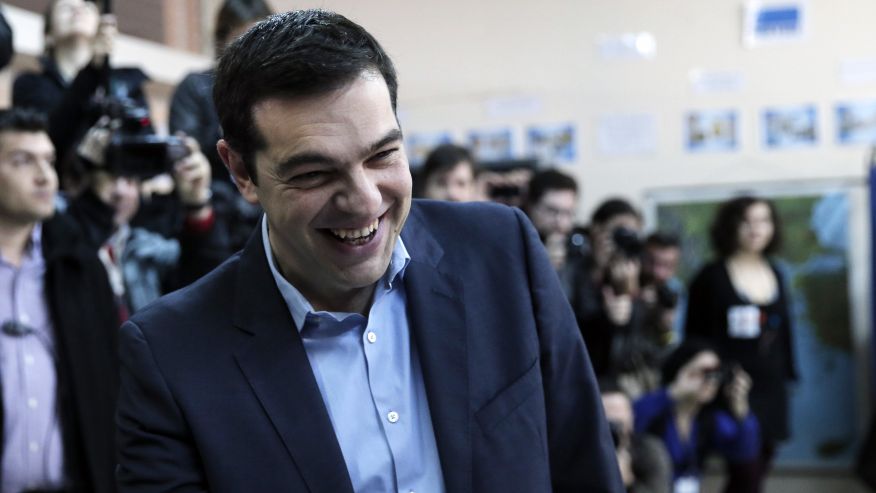
Tsipras was mobbed by a media throng as he voted in Athens. “The Left’s time has come!” chanted a nearby pack of his party’s youth activists.

A relaxed-looking Tsipras joked with journalists jostling for quotes and photos to calm down. “We’ve been waiting for this moment for five years. You can wait for another five minutes,” he said.

“Today, the Greek people are called to decisively make the remaining step toward the return of hope, the end of fear, the return of democracy and dignity in our country,” he said outside the polling station. He said a vote for Syriza would ensure that Greece negotiated “a tough bargain to rejoin Europe on an equal basis. I am optimistic this will be a historic day.”

Syriza has promised to renegotiate the country’s 240 billion euro ($270 billion) international bailout deal. It has pledged to reverse many of the reforms that international creditors demanded in exchange for keeping Greece financially afloat since 2010.

The anti-bailout rhetoric has renewed doubts over Greece’s ability to emerge from its financial crisis that has seen a quarter of its economy wiped out, sent unemployment soaring and undermined the euro, the currency shared by 19 European countries.

Greece’s creditors insist the country must abide by previous commitments to continue receiving support, and investors and markets alike have been spooked by the anti-bailout rhetoric. Greece could face bankruptcy if a solution is not found, although speculation of a “Grexit” — Greece leaving the euro — and a potential collapse of the currency has been far less fraught than during the last general election in 2012.

Samaras’ campaign focused on the improving economy, which grew for the first time in six years in the third quarter of 2014. He has promised to reduce taxes if re-elected and has warned of the potentially dire consequences of reneging on bailout conditions. Opponents accused him of using fear tactics.

Syriza’s promises to end Greece’s era of crushing austerity have attracted many voters infuriated by the deterioration in their standard of living and ever-increasing tax bills.

The big question is whether any party will win the required 151 seats in the 300-member parliament to form a government on its own. The Greek political scene has fractured during the financial crisis, with voters abandoning the two formerly dominant parties — the conservatives and the socialists — in favor of a smattering of smaller parties.

Mara Ramou, an official at one Athens polling center, said she hoped the vote would produce a stable government without the need for a second contest, as happened in 2012.

“I hope the votes will express what people truly want and believe, so that things change for us,” she said, adding her concern that social and financial pressures would not “get worse in Greece than what they already are, because austerity and the crisis touch all levels of society.”

Without the required 151 seats, whichever party wins the most seats will have to try forming a coalition government with at least one other party. The first three parties each have three days to try and form a coalition government to avoid a second election being called within a month.

Another option would be for the winner to seek support for a minority government. This would involve other parties agreeing to support the government in parliament without taking part in a formal coalition.

Opinion polls ahead of the vote showed the new centrist Potami, or River, party vying for third place with Nazi-inspired Golden Dawn, whose leader and several top lawmakers are in jail awaiting trial on charges of participating in a criminal organization.

Greece’s next government faces a series of formidable tasks, the most pressing of which is concluding negotiations with bailout inspectors to release a 7.2 billion euro ($8.1 billion) loan installment originally due late last year.

The inspectors “must come soon,” Finance Minister Gikas Hardouvelis said Saturday.

The new government also must negotiate some kind of relief for Greece’s 320 billion euro debt and bolster weak growth.

source:foxnews.com

Bill Shorten: move to a republic would reflect a modern and inclusive Australia

untitled

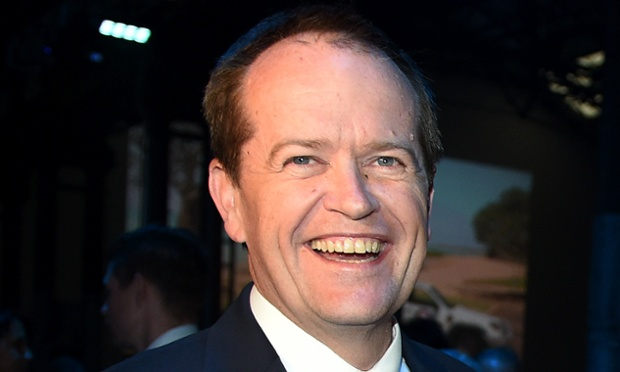
Becoming a republic would accurately reflect a modern and inclusive Australia, the opposition leader, Bill Shorten, said.

Shorten used a speech at the launch of a book on Australian identity to reiterate his support for Australia becoming a republic.

“Let us breathe new life into the dream of an Australian head of state,” he said. “114 years ago Australians found the courage and goodwill to transform this continent into a commonwealth. In the 21st century let us live up to their example. Let us declare that our head of state should be one of us.”

“Let us rally behind an Australian republic. A model that truly speaks for who we are: our modern identity, our place in our region and our world.”

Shorten launched the book, Mateship: A Very Australian History by Nick Dyrenfurth, in Melbourne on Sunday afternoon.

He said Australia should acknowledge the injustices of the past, including the stolen generations and inequality for women and first Australians.

“I believe Australians are smart enough and generous enough to know that our national story is not a choose-your-own adventure where we pick and mix the chapters that portray us in the best light,” Shorten said.

“It is wrong to imagine that we can only gain and grow from revelling in past glory.”

Shorten’s comments come more than a year after the federal government announced an independent review into Australia’s education system. Education minister Christopher Pyne said there were concerns that the history curriculum currently being taught in schools did not give enough weight to the legacy of western civilisation.

“I … want the curriculum to celebrate Australia, and for students when they have finished school to know where we’ve come from as a nation, because unless we know why we are the kind of country we are today we can’t possibly know where we want to go in the future,” Pyne said.

“There are two aspects to Australia’s history that are paramount. First of course is our Indigenous history, because for thousands of years Indigenous Australians have lived on this continent. The second aspect of our history is our beginnings as a colony and therefore our western civilisation, which is why we are the kind of country we are today,” he said.

Shorten said Australians were “tired of people claiming victory in the history wars”.

He shunned comments put forward by former prime minister John Howard that he had ended debate over the Australian identity, saying it is constantly evolving.

“No leader can end a conversation about our nation’s sense of self. No leader can settle the question of Australia’s global role and responsibilities. And no leader should take pride in trying,” Shorten said.

“Pulling up the drawbridge of our identity, of our place in the world, shuts out the contribution of the next generation, the evolution of self that every people has undergone with joy and trepidation, in every century, and in most decades of that century.”

“There is no last word in this conversation. And that is something we should celebrate, not shrink from. We are the product of our past, but never its prisoners,” he said.

source:theguardian.com