Monthly Archives: January 2015

A Christmas gift for the destitute children of Greece

A Christmas gift for the destitute children of Greece

Founder of Greek Ambassadors, Evy Yannas on her recent visit to the Doctors of the World headquarters in Athens.

Founder of Greek Ambassadors, Evy Yannas on her recent visit to the Doctors of the World headquarters in Athens.

Greek Ambassadors recently donated $2000 to Doctors of the World Greece.

In the spirit of Christmas, not-for-profit Greek Australian organisation Greek Ambassadors donated $2,000 to Doctors of the World for the destitute children in Greece.

Thanks to the hard work and dedication of volunteer doctors, nurses and therapists, the humanitarian organisation has been lending its services to those most affected by the crisis.

Thanks to the generosity of the Greek and wider Australian community who made a donation, the funds will help support 250 children through the European winter.

The money will fund the purchase of medicines and medical supplies such as antibiotics, inhalants, skin ointments, nasal sprays and anti-fever medications.

Doctors of the World will also be running their annual ‘A little milk for a lot of kids’ campaign, creating Christmas trees from donated cans of milk and distributing them to children in need.

For more information or to make a donation please email your enquiries to aid@greekambassadors.org

source: Neos Kosmos

To συγκινητικό «αντίο» του Βαγγέλη Παπαθανασίου στον Ντέμη Ρούσσο

To συγκινητικό «αντίο» του Βαγγέλη Παπαθανασίου στον Ντέμη Ρούσσο

Ο Ντέμης Ρούσσος το 1974

Τον γύρο του κόσμου κάνει η είδηση του θανάτου του Ντέμη Ρούσσου, με τον καλλιτεχνικό κόσμο να απευθύνει τον δικό του αποχαιρετισμό στον σπουδαίο τραγουδιστή και μουσικό.

Συγκινητικό το μήνυμα του φίλου και πρώην συνεργάτη του, Βαγγέλη Παπαθανασίου (Vangelis), ο οποίος έγραψε στην ιστοσελίδα του: «Ντέμη φίλε μου, μόλις έφτασα στο Λονδίνο και έμαθα ότι αποφάσισες να κάνεις το μακρύ ταξίδι. Είμαι σοκαρισμένος γιατί δεν πιστεύω ότι αυτό συνέβη τόσο σύντομα.

» Η φύση σου έδωσε αυτή τη μαγική φωνή που έκανε εκατομμύρια ανθρώπους σε ολόκληρο τον κόσμο πολύ ευτυχισμένους. Όσο για μένα, κρατώ αυτές τις πολύτιμες αναμνήσεις που μοιραστήκαμε μαζί εκείνες τις πρώτες ημέρες και ελπίζω να είσαι ευτυχισμένος όπου και αν βρίσκεσαι».

Η Νάνα Μούσχουρη δήλωσε στο γαλλικό ραδιόφωνο RTL: «Είχε μία υπέροχη φωνή, ταξίδευε στον κόσμο. Αγαπούσε αυτό που έκανε. Ήταν καλλιτέχνης, φίλος. Ελπίζω να βρίσκεται σε έναν καλύτερο κόσμο».

Τα συλλυπητήριά του εξέφρασε το Royal Albert Hall, επισημαίνοντας ότι ο Ντέμης Ρούσσος είχε εμφανιστεί εκεί δέκα φορές.

Την είδηση του θανάτου του Ντέμη Ρούσσου είχε ανακοινώσει αρχικά ο παρουσιαστής Νίκος Αλιάγας, ευχόμενος «καλό ταξίδι φίλε μας Έλληνα Ντέμη».

Πηγή:in.gr


Do the Greek elections spell a Grexit?

There is a possibility that Greece could be strong-armed by its creditors towards an exit.

There is a possibility that Greece could be strong-armed by its creditors towards an exit. Photo: Reuters

Greek voters delivered an emphatic message to their European Union neighbours at national elections on Sunday – they have had enough of austerity.

Far left anti-austerity party Syriza stormed to victory, securing 36 per cent of the vote and falling just two seats shy of the 151 seats it needed to govern alone. It has formed a coalition government with a right-wing fringe party, Independent Greeks, who won 13 seats.

At 40, Syriza’s outspoken and charismatic leader Alexis Tsipras is the country’s youngest prime minister in 150 years.

A bolstered tourism industry wouldn't be enough to stimulate Greece's economy.

A bolstered tourism industry wouldn’t be enough to stimulate Greece’s economy. Photo: Reuters

With the future of Greece’s international bailout agreement hanging precariously in the post-election balance, the prospect of Greece’s exit from the eurozone, or “Grexit” as it has come to be known, is a very live issue.

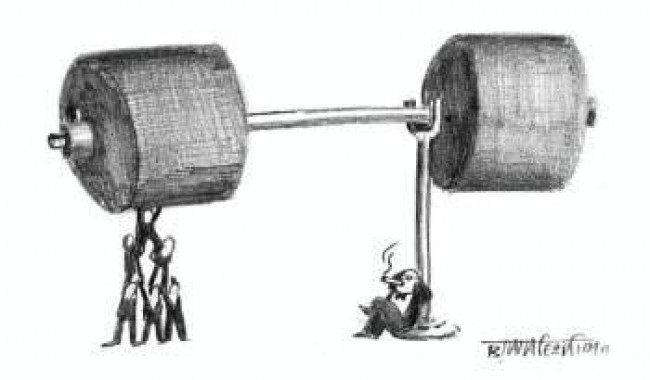
Among Tsipras’s first orders of business will be a round of tough negotiations with Greece’s creditors, who have bailed out the country to the tune of €240 billion on condition that Greece pursues a system of austerity.

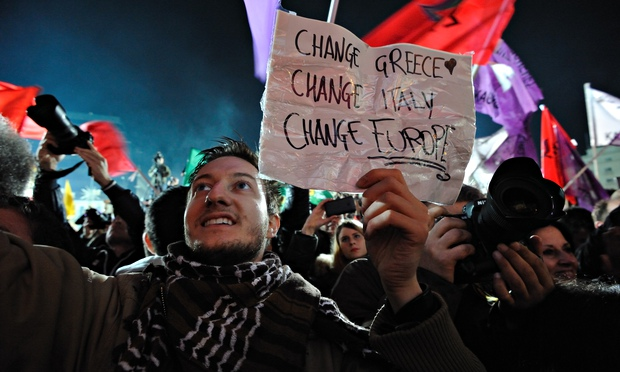
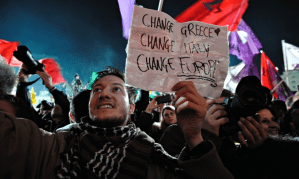
In his victory speech, Tsipras set the stage for a showdown, declaring “Europe is going to change.

In his victory speech, Alexis Tsipras set the stage for a showdown, declaring "Europe is going to change".In his victory speech, Alexis Tsipras set the stage for a showdown, declaring “Europe is going to change”. Photo: AP

“The sovereign Greek people today have given a clear, strong, indisputable mandate,” he said.

“Greece has turned a page. Greece is leaving behind the destructive austerity, fear and authoritarianism. It is leaving behind five years of humiliation and pain.”

Although Tsipras has formally said he does not want to leave the euro, his party’s hardline anti-austerity policies have not been looked on favourably by Greece’s creditors, namely Germany.

As both sides go to the trenches in the coming weeks, here are the most likely scenarios to come from the negotiations.

Successful re-negotiation on debt

Under an international bailout involving the International Monetary Fund, the European Central Bank and European Commission – the “troika” – Greece has borrowed nearly €240 billion ($343.8 billion).

On the table is a final bailout tranche of €7.2 billion ($10.3 billion), but the troika has made it clear this remaining aid is conditional on Greece implementing further austerity measures.

While Tsipras has made it clear he wants to end Greece’s austerity, the country is still battling astronomical debt – about 175.5 per cent of gross domestic product – as well as 26 per cent unemployment, including 50 per cent youth unemployment.

If Syriza don’t agree to more austerity conditions, Greece won’t get the loans it needs to avoid default by the summer, which would all but shore up a Grexit.

Tsipras will probably go to the negotiation table seeking the final bailout sum and a reduction in Greece’s debt or an easing of the terms of repayment. But for the troika to agree to refinance Greece’s loans, Tsipras will have to scale back some of Syriza’s more profligate policies, including his promise to increase public expenditure and expand the public sector payroll.

However, even with some concessions from Syriza, the key issue will remain: Greece won’t be able to pay off its debt any time soon.

Despite the friction, a negotiated outcome is most likely, because it suits neither side’s vested interests – Greece or its main creditor Germany – for Greece to leave the eurozone. This brings us to the two other potential scenarios, both of which contemplate a Grexit.

Greece defaults on debt

The attractiveness of a debt-free life outside the eurozone might lead Greece down the path of default. Abandoning its debt and leaving the eurozone would mean Greece would be instantly locked out of international markets, leaving it to fend for itself with a newly reintroduced drachma. It would then have to print drachma to fund its policies, leading to rampant inflation.

While a devalued drachma might entice more holidaymakers from around Europe, a bolstered tourism industry wouldn’t be enough to stimulate Greece’s economy to the extent it needs in the short term to fund its public service and welfare programs. With an ailing economy, and massive unemployment, there are few clear ways Greece could generate income without reliance on outside funds. In short, the consequences for Greece of leaving the euro are unpredictable, but at the extreme end it could result in internal economic catastrophe, with skyrocketing inflation, recession and the possibility of Greece’s banks collapsing.

For this reason, many commentators predict Syriza will be the first to blink in the debt negotiations.

Greece pushed towards exit

There is a possibility that Greece could be strong-armed by its creditors towards an exit by them refusing to consider Syriza’s debt-restructuring pleas. This theory is based on speculation that Germany is fed up with pumping money into Greece and that a cost-benefit analysis now favours Germany cutting its needy neighbour loose.

Other commentators have been quick to reject this. First, a Grexit would set an unsettling precedent that might trigger some of the other struggling countries in the eurozone, such as Spain or Italy, to follow.

It is also not in Germany’s interest for the zone to splinter – euro membership increases Germany’s annual economic growth by 0.5 per cent of GDP.

As Bloomberg contributor Leonid Bershidsky notes:

“Germany stands to gain €1.2 trillion from it between 2013 and 2025, much more than it would contribute to any Greek bailout. The amount Germany could lose if Greece reneged on troika debt – €70 billion in taxpayer funds – pales in comparison.”

Publicly, German Chancellor Angela Merkel has maintained her support for Greece remaining in the euro, affirming in January that she had “no doubt whatsoever” that a “successful conclusion” would be reached with Greece.

source:smh.com.au

Asian Cup runneth over: No excuses for Socceroos against UAE

images

The World Game continues with the column designed to get to the heart of the Asian Cup, or, failing that, any other part of its anatomy that we can reach. Throughout this festival of international football we’ll feature the good, the bad and the ugly – and the occasional interesting tweet.

Let’s be serious – there can be no excuse for the Socceroos not beating UAE in their AFC Cup semi-final on Tuesday night.

UAE shouldn’t even be there. Japan should be, but the defending champion blew it in its quarter-final against UAE and the opposition took advantage.

After the group stage of the tournament was completed, ACRO tipped Japan to go on and win it from there. It wasn’t rocket science – the Japanese looked the best team.

But, at the same time, ACRO pointed out Japan had an issue with its accuracy when shooting, saying: “That is the main thing that stands in the way of the Japanese team taking the title – it is not the greatest finisher.”

Japan got even worse in front of goal against UAE. Even as flat as Japan strangely looked in general play for much of the match, it still should have won it in normal time.

UAE took the lead in the seventh minute and Japan didn’t equalise until the 81st. Japan could have still easily won the game late in normal time, but wasted a couple of the best chances it had all night.

The 30 minutes of extra-time went scoreless and UAE advanced by winning a penalty shootout. It said it all about Japan that it was finally eliminated as a result of not being good enough in that most basic of one-on-one situations.

Statistics taken from the official AFC Asian Cup website show Japan had 35 shots at goal in the match, eight of which were on target and 12 were blocked. UAE had three shots – two on target and one blocked. Yet the two teams came up with the same number of goals.

Japan had a shot accuracy percentage (excluding blocked shots) of 34.8 per cent, as opposed to UAE’s 100 per cent.
That’s football. It’s all about taking chances and if you don’t take your chances you’ve got no-one to blame but yourself for the result.

The Socceroos are the hot favourites now – not just to win this match, but the tournament.

They are a better team than UAE. They will create more chances and take more shots at goal than the opposition. It’s whether they can capitalise on opportunities and take control of the game that is the question.

If they don’t, they risk going the same way as Japan.

sound:theworldgame.sbs.com.au

Greek leftist Tsipras sworn in as PM to fight bailout terms

untitled

ATHENS, Jan 26 (Reuters) – Greek left-wing leader Alexis Tsipras was sworn in on Monday as the prime minister of a new hardline, anti-bailout government determined to face down international lenders and end nearly five years of tough economic measures.

The decisive victory by Tsipras’ Syriza in Sunday’s snap election reignites fears of new financial troubles in the country that set off the regional crisis in 2009. It is also the first time a member of the 19-nation euro zone will be led by parties rejecting German-backed austerity.

Tsipras’ success is likely to empower Europe’s fringe parties, including other anti-austerity movements across the region’s economically-depressed south. The trouncing of the conservatives represents a defeat of Europe’s middle-ground political guard, which has dallied on a growth-versus-budget discipline debate for five years while voters suffered.

Sporting his trademark no-tie look, the 40-year old former student Communist Tsipras became the first prime minister in Greek history to be sworn in without the traditional oath on a Bible and blessing of basil and water from the Greek Archbishop.

At a brief secular ceremony where he pledged to uphold the constitution, Tsipras told President Karolos Papoulias: “We have an uphill road ahead.” In a symbolic move, his first action as prime minister was to commemorate Greek resistance fighters with red roses at a memorial in Athens to those executed by Nazis.

Defying predictions that he would turn from populist to pragmatist after taking power, Tsipras quickly sealed a coalition deal with the small Independent Greeks party which also opposes Greece’s EU/IMF aid programme.

Syriza won 149 seats in the 300-seat parliament with its campaign of “Hope is coming!”, leaving it just two seats short of an outright majority and in need of a coalition partner. The Independent Greeks, at odds with Syriza on many social issues like illegal immigration, won 13 seats.

The alliance is an unusual one. The parties, at the opposite end of the political spectrum, share only a mutual hatred of the 240-billion-euro bailout programme keeping Greece afloat at the price of budget cuts.

Stavros Theodorakis, leader of To Potami, a new centrist party once seen as a potential Syriza coalition partner, said he could not join a government that included the Independent Greeks, whom he called “far right” and “anti-European”. But he said he would wait to see the government’s programme before deciding whether to support a vote of confidence in parliament.

The tie-up suggests Tsipras will keep up his confrontational stance against Greece’s creditors, who have dismissed his demands for a debt write-off and insisted the country needs reforms and austerity to get its finances back on track.

“At first sight this looks like a very strange marriage, but both parties share a strong opposition to austerity,” said Diego Iscaro, an analyst at IHS Global Insight.

“SELF-REINFORCING CRISIS”

Yanis Varoufakis, an economist and outspoken blogger crusading against austerity, was expected to become finance minister when the cabinet is unveiled on Tuesday, senior party officials said.

He wrote on Monday that Greeks had “put an end to a self-reinforcing crisis that produces indignity in Greece and feeds Europe’s darkest forces”.

Reaction from financial markets to Syriza’s victory was largely muted, with the euro recovering from a tumble to an 11-year low against the dollar on initial results. Greek stocks fell 3 percent, led lower by bank stocks including Piraeus Bank which fell 17.6 percent. Greek 10-year bond yields rose but stayed below the levels seen in the run-up to the vote.

For the first time in more than 40 years, neither the New Democracy party nor the centre-left PASOK, the two forces that had dominated Greek politics since the fall of a military junta in 1974, will be in power, beaten by a party that has until recently always been at the fringe.

Together with last week’s decision by the ECB to pump billions of euros into the euro zone’s flagging economy, Syriza’s victory marks a turning point in the long euro zone crisis.

It signals a move away from the budget rigour championed by Germany as the accepted approach to dealing with troubled economies, though it is unclear what concessions Syriza will be able to wring from creditors.

Both IMF head Christine Lagarde, who said the Fund would continue supporting Greece, and the chairman of the eurogroup of euro zone finance ministers, Jeroen Dijsselbloem, said they wanted to work with the new government.

Irish Finance Minister Michael Noonan said there could be some room for a deal to adjust debt maturities and cut interest rates rather than writing the debt off.

But Tsipras can expect strong resistance to his demands from Germany in particular and a series of European policymakers urged Syriza not to renege on previous governments’ commitments.

“There is no room for unilateral action in Europe,” ECB Executive Board member Benoit Coeure told Europe 1 radio, saying it was important to play by the “European rules of the game”.

Tsipras has drawn the ire of lenders with his pledge to end budget cuts and heavy tax rises that have helped send the jobless rate over 25 percent and pushed millions into poverty.

But with Greece unable to tap the markets because of sky-high borrowing costs and facing about 10 billion euros of debt payments this summer, he may find himself with limited room to fight creditors. The new prime minister will also need a deal to unlock more than 7 billion euros of outstanding aid to make debt payments in the summer.

Standard and Poor’s sent an early warning shot to Greece’s new government, saying it could downgrade its credit rating even before its next planned review in mid-March if things go badly. (Additional reporting by Angeliki Koutantou, Lefteris Papadimas and George Georgiopoulos, Tim Ahmann in Washington, Padraic Halpin in Dublin; Writing by James Mackenzie and Deepa Babington; editing by Anna Willard, Sophie Walker and Pravin Char)

source:reuters.com

Ten killed in Greek fighter plane crash in Spain

NATO authorities say a Greek F-16 crashed after losing power on take-off at a training centre in Albacete, Spain. This file photo shows a Taiwan Air Force F-16 fighter jet.

NATO authorities say a Greek F-16 crashed after losing power on take-off at a training centre in Albacete, Spain. This file photo shows a Taiwan Air Force F-16 fighter jet. Photo: AP


Madrid: Ten people were killed and another 13 people were injured after a Greek fighter plane crashed during NATO training in Spain on Monday, a spokesman for the defence ministry said.

The F-16 plane crashed shortly after taking off at the training centre in Albacete, 262 kilometres south-east of the Spanish capital of Madrid.

“The plane, part of the Tactical Leadership Programme of NATO was carrying out a (training) exercise when during the take-off the plane lost power, crashing into the parking area for planes, crashing into various planes that were parked there,” said the defence ministry in a statement.

The defence ministry said firefighters were working to put out a fire at the base and the area had been cordoned off.

source: smh.com.au

Πέθανε ο «παγκόσμιος Ελληνας» Ντέμης Ρούσσος

Ο σπουδαίος καλλιτέχνης άφησε την τελευταία του πνοή, σε ηλικία 69 ετών, τα ξημερώματα της Κυριακής στην Αθήνα

Μέσω Twitter ανακοίνωσε πριν λίγο ο Νίκος Αλιάγας τον θάνατο του Ντέμη Ρούσσου. «Μόλις έμαθα για το θάνατο του φίλου μου Ντέμη Ρούσου, το βράδυ του Σαββάτου, ξημερώματα Κυριακής στην Αθήνα. Βαθύτατη λύπη για έναν μεγάλο καλλιτέχνη» έγραψε συγκεκριμένα.

Ο μεγάλος καλλιτέχνης πέθανε τα ξημερώματα της Κυριακής στην Αθήνα. Νοσηλευόταν στο νοσοκομείο Υγεία. Ήταν μόλις 69 ετών. Σύμφωνα με το ιατρικό ανακοινωθέν του νοσοκομείου : «Μετά από μακρόχρονη νοσηλεία στο Νοσοκομείο ΥΓΕΙΑ, απεβίωσε ο διεθνούς φήμης καλλιτέχνης Ντέμης Ρούσσος». Οι πρώτες πληροφορίες λένε, ότι ο Ντέμης Ρούσσος παρακολουθείτο τους τελευταίους 12 μήνες, από ομάδα γιατρών της ογκολογικής κλινικής του νοσοκομείου Υγεία. Εισήχθη για τελευταία φορά, σε σοβαρή κατάσταση, την περασμένη Τετάρτη.

Οι γονείς του Γεώργιος και Όλγα ήταν Έλληνες της Αιγύπτου. Γεννήθηκε στις 15 Ιουνίου του 1946 και μεγάλωσε στην Αλεξάνδρεια.  Ο Ντέμης Ρούσσος είχε μεγάλη αγάπη για την Αλεξάνδρεια. Ο ίδιος είχε πει για την γενέτειρα του: «Η Αλεξάνδρεια είναι μία πόλη, πολύ ελληνική. Αν πάμε πίσω, χτίστηκε από τον Μέγα Αλέξανδρο.Ήταν δυνατή η ελληνική κοινότητα της Αιγύπτου. Και το Πατριαρχείο μας εκεί, είναι πολύ γερό. Καμιά φορά άμα σκέπτομαι όλες αυτές τις εικόνες των παιδικών μου χρόνων, είναι σαν να βλέπεις ένα φιλμ της Αγκάθα Κρίστι…Από την Αλεξάνδρεια έφερα μαζί μου μία όρεξη για να είμαι πάνω σε μία σκηνή. Η αγάπη μου για τη σκηνή είναι οικογενειακό μας. Το είχε ο πατέρας μου, το είχε η μητέρα μου. Θέλαμε να διασκεδάζουμε τον κόσμο».

Έχασαν τα πάντα και ήρθαν στην Ελλάδα με τις αναταραχές του Σουέζ. Η μητέρα του, Όλγα, ήταν γνωστή καλλιτέχνης με το ψευδώνυμο Νέλλη Μασλούμ.

Μετά από την εγκατάστασή του στην Ελλάδα, συμμετείχε σε διάφορα μουσικά συγκροτήματα αρχίζοντας με τους The Idols σε ηλικία 17 χρόνων. Αργότερα πήγε με τους We Five χωρίς ιδιαίτερη επιτυχία.

Στο ευρύτερο ακροατήριο έγινε γνωστός το 1968 με το συγκρότημα Aphrodite’s Child, αρχικά στα φωνητικά και αργότερα ως μπασίστας. Το διακριτικό φωνητικό του ύφος προώθησε το συγκρότημα σε διεθνή επιτυχία, ιδιαίτερα με τη συμμετοχή του στον δίσκο 666, ο οποίος έγινε κλασική επιτυχία. Για την επιτυχία που είχε γνωρίσει το συγκρότημα, είχε δηλώσει ο Ντέμης Ρούσσος σε συνέντευξη του στην ΕΡΤ: «Στη δουλειά τη δική μας, η επιτυχία σχηματίζεται από διάφορους παράγοντες. Το ταλέντο είναι πολύ σημαντικό. Έτσι δεν είναι; Το άλλο είναι το timing. Εμείς ήμασταν τυχεροί γιατί εκείνη την εποχή γινόντουσαν οι μεγάλες απεργίες και οι μεγάλες μάχες στους δρόμους του Παρισιού. Ο Μάης του ’68. Εμείς τότε γράψαμε το “Rain and Tears” που πάει να πει βροχή και δάρκυα. Τότε έπεφταν τα δακρυγόνα και τα ραδιόφωνα το έπαιζαν συνεχώς και εμείς κάναμε επιτυχία και πουλήσαμε ένα εκατομμύριο δίσκους. Συμπωματικά είχαμε γράψει αυτό το τραγούδι!».

Μετά από τη διάλυση των Aphrodite’s Child, συνέχισε διάφορες σποραδικές ηχογραφήσεις. Από τη συνεργασία του με τον άλλο διάσημο φίλο του, τον Βαγγέλη Παπαθανασίου, κυκλοφόρησαν το 1970 τον δίσκο Sex Power, και το 1977 το Magic. Η επιτυχέστερη συνεργασία τους ήταν το Race to the End, μια φωνητική προσαρμογή του μουσικού θέματος από το βραβευμένο με Oscar Οι Δρόμοι της Φωτιάς, που κυκλοφόρησε και στα ισπανικά με τον τίτλο Tu Libertad. Το 1982 ο Ρούσσος πήρε μέρος με έκτακτη συμμετοχή στο soundtrack της κινηματογραφικής ταινίας Blade Runner.

Ο Ρούσσος άρχισε σόλο καριέρα μετά από τη διάλυση των Aphrodite’s Child, αρχίζοντας με το τραγούδι “We Shall Dance”. Αρχικά χωρίς ανταπόκριση, περιόδευσε στη νότια Ευρώπη και έγινε σύντομα ευρύτερα γνωστός ως κορυφαίος τραγουδιστής. Η σταδιοδρομία του έφτασε στο ζενίθ τη δεκαετία του ’70 με πολλούς δίσκους που έγιναν επιτυχίες. Το “Forever and Ever” ανέβηκε σε πολλά ευρωπαϊκά charts το 1973. Σε ερώτηση για το αν αισθάνθηκε ότι δόξασε την Ελλάδα, ο Ντέμης Ρούσσος είχε πει: «Δεν ξέρω αν δόξασα την χώρα μας. Αλλά έκανα ό,τι μπορούσα!». Σε άλλη συνέντευξη που είχε παραχωρήσει στην εκπομπή «Προσωπικά» είχε δηλώσει χαρακτηριστικά: «Άμα είσαι Έλληνας δεν χρειάζεται να έχεις στοιχεία για να είσαι υπερήφανος. Είσαι υπερήφανος. Είμαστε μία ευλογημένη ράτσα».

Το 1974 κυκλοφορεί το “White Sails”, μια αγγλική διασκευή του τραγουδιού “Άσπρα, Κόκκινα, Κίτρινα, Μπλε” από τον δίσκο “Συνοικισμός Α΄” του 1972, σηματοδοτώντας μια σύντομη περίοδο συνεργασίας του τραγουδιστή με τον συνθέτη Δήμο Μούτση, ο οποίος θα ακολουθήσει στη συνέχεια ένα μοναχικό μουσικό σταυροδρόμι με έντονες επιρροές από βετεράνους της rock και της folk, όπως ο Eric Clapton, η Joni Mitchell και ο Paul Simon.

Ακολούθησαν τα “My Friend the Wind”, “My Reason”, “Velvet Mornings”, “Goodbye My Love, Goodbye”, “Someday Somewhere” και “Lovely Lady of Arcadia”. Το 1980 είχε επιτυχία με το “Lost in Love” των Air Supply που το τραγούδησε ντουέτο μαζί με την Florence Warner και με τον Dick Morrissey στο σαξόφωνο.

Επανακυκλοφόρησε τα τραγούδια του σε διάφορες γλώσσες και είχε επιτυχία στις χώρες της Ευρώπης και της Λατινικής Αμερικής. Στην Αμερική το LP Demis έγινε χρυσός δίσκος.

Το 1982 εξέδωσε το βιβλίο ‘A Question of Weight’ (“Είναι θέμα βάρους”), μαζί με την Veronique Skawinska, στο οποίο ασχολήθηκε αμερόληπτα με το θέμα της παχυσαρκίας.

Μετά από μια περίοδο σιωπής και κλινικής κατάθλιψης τη δεκαετία του ’80, επανήλθε το 1993 με το Insight (γνωστό και ως Morning has Broken) και συνεργάστηκε με την ολλανδική εταιρεία BR Music για την παραγωγή των δίσκων Immortel, Serenade και In Holland, χρησιμοποιώντας ποικίλα εθνικά και ηλεκτρονικά στυλ.

Συνεχίζοντας τις ηχογραφήσεις και τις περιοδείες, την άνοιξη του 2002 έκανε μια επιτυχημένη περιοδεία στην Αγγλία.

Κατά τη διάρκεια της πτήσης 847 της TWA, στις 14 Ιουνίου 1985, ο Ντέμης Ρούσσος, όντας επιβάτης, έπεσε θύμα αεροπειρατείας. Οι αεροπειρατές γιόρτασαν ακόμη και τα γενέθλιά του όταν τον αντιλήφθηκαν ανάμεσα στους ομήρους.

Τον Σεπτέμβριο του 2013, παρασημοφορήθηκε από την Γαλλική Δημοκρατία με τον τίτλο του Ιππότη της Λεγεώνας της Τιμής, σε τελετή που παρατέθηκε στην πρεσβεία της Γαλλίας στην Αθήνα.

Δημόσιο χρέος της Ελλάδας:Στο 176% του ΑΕΠ & Στα 315,5 δισ. το χρέος το γ” τρίμηνο

timthumb.php

Στο 176% του ΑΕΠ έφτασε το δημόσιο χρέος της Ελλάδας το τρίτο τρίμηνο του 2014, έναντι 171% του ΑΕΠ ένα χρόνο πριν, σύμφωνα με τα στοιχεία της Eurostat που δόθηκαν σήμερα στη δημοσιότητα. Το δημόσιο χρέος στην ευρωζώνη διαμορφώθηκε, κατά μέσο όρο, στο 92,1% του ΑΕΠ το τρίτο τρίμηνο του 2014, έναντι 91,1% του ΑΕΠ το τρίτο τρίμηνο του 2013.

Στην «ΕΕ των 28» το δημόσιο χρέος έφτασε το 86,6% του ΑΕΠ, ενώ ένα χρόνο πριν ήταν στο 85,3% του ΑΕΠ. Ειδικότερα, σε ό,τι αφορά την Ελλάδα, το δημόσιο χρέος το τρίτο τρίμηνο του 2014 έφτασε το 176% του ΑΕΠ (315,5 δισ. ευρώ), έναντι 177,5% του ΑΕΠ (317,5 δισ. ευρώ) το δεύτερο τρίμηνο του 2014 και 171% του ΑΕΠ (317,7 δισ. ευρώ) το τρίτο τρίμηνο του 2013.

Το υψηλότερο δημόσιο χρέος στην ΕΕ κατέγραψε, το τρίτο τρίμηνο του 2014, η Ελλάδα (176%) και ακολουθούν η Ιταλία (131,8%), η Πορτογαλία (131,4%) και η Ιρλανδία (114,8%). Το χαμηλότερο χρέος κατέγραψε η Εσθονία (10,5%), το Λουξεμβούργο (22,9%) και η Βουλγαρία (23,6%).

Σε σχέση με το τρίτο τρίμηνο του 2013, το δημόσιο χρέος αυξήθηκε σε 18 κράτη-μέλη της ΕΕ και μειώθηκε σε δέκα. Οι μεγαλύτερες αυξήσεις σημειώθηκαν στη Σλοβενία (+16,8%), στην Κροατία (+7,3%) και στη Βουλγαρία (+6,6%). Τη μεγαλύτερη μείωση δημόσιου χρέους κατέγραψε η Ιρλανδία (-9,4%), η Πολωνία (-8%) και το Λουξεμβούργο (-5%).

Πηγή:mynima-hellas.com

South Korea 2-0 Iraq: Stieleke’s men stroll into Asian Cup final


862812_heroa

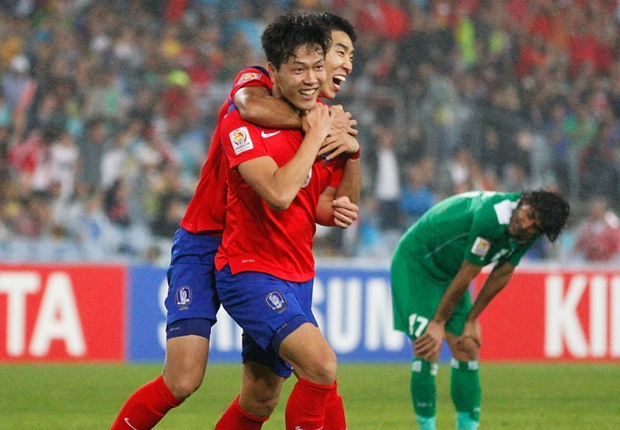
The East Asian nation took the lead 20 minutes into the match through Lee Jung-hyub before Kim Young-gwon doubled the total shortly after half-time.

Goals from Lee Jung-hyub and Kim Young-gwon secured South Korea’s first Asian Cup final appearance since 1988 with a 2-0 victory against Iraq.

Uli Stielike’s side were comfortable in Sydney on Monday, with a goal in each half wrapping up a deserved win.

After a dominant opening Lee was on hand to break the deadlock in the 20th minute with his second goal of the tournament.

Kim Young-gwon extended South Korea’s lead early in the second half as a deflected strike beat Jalal Hassan Hachim and Iraq needed their goalkeeper to keep them in the game with saves from Ki Sung-yong and Son Heung-min.

Iraq slowly began to force their way back into the game as South Korea’s nervous defending presented openings, but they were unable to convert, with Younis Mahmood guilty of missing the best of the chances.

The victory exacts some revenge for South Korea having lost the 2007 semi-final to Iraq on penalties and they will now wait to see whether it will be host nation Australia or United Arab Emirates who they face in Saturday’s final.

South Korea made a positive start to the match in a rain-sodden Sydney and could have taken the lead inside five minutes as Han Gyo-won peeled away from Dhurgham Ismail, but failed to connect with Ki’s lofted pass.

Iraq’s early openings were restricted to fruitless counter-attacks, but they nearly got caught out after 19 minutes as the dangerous Son broke forward.

With the defenders backing off he unleashed a powerful effort from 20 yards that Hachim was able to tip over the crossbar.

A minute later he was beaten, though, as Kim Jin-su delivered an inviting free kick into the penalty area that Lee glanced past Hachim from close range.

As half-time approached Iraq began to find their footing in the game while South Korea appeared to lose their way and Amjad Kalaf nearly punished them with a 20-yard drive.

The midfielder found space on the edge of the penalty area, but Kim Jin-hyeon was able to get down well and push his effort wide.

Refreshed from the break South Korea resumed their attacking football and five minutes into the second half Kim Young-gwon doubled their advantage. Lee superbly chested a high ball into the defender’s path and he produced a controlled volley that deflected off Salam Shakir on its way past Hachim.

The Iraq goal was leading a charmed life as South Korea began to pepper it with chances, both Ki and Son unable to beat Hachim with efforts from outside the penalty area.

They did not have it all their own way, though, as Iraq – whose place in the semi-final was only confirmed after an appeal from Iran over an ineligible player in the quarters was rejected – finally began to threaten.

Kalaf took too long when presented with their first opening, before Mahmood had two efforts to halve the deficit blocked by resolute South Korean defending.

In the closing minutes chances continued to fall Iraq’s way, but, try as they might, a goal did not arrive and South Korea moved a step closer to ending their 55-year wait for an Asian Cup triumph.

source:goal.com

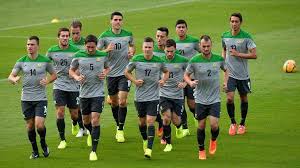
Postecoglou steering Socceroos in ‘right direction’

Oman v Australia - 2015 Asian Cup

Ange Postecoglou reckons the Socceroos were running on empty when he took over as coach.

But after 14 months of refuelling, Postecoglou now says he can take them for “a decent drive” – regardless of whether the trip includes an Asian Cup final.

“We can safely say we can go for a decent drive now. There’s plenty of fuel there,” Postecoglou said.

“How far? I’m not really sure. But we’re definitely heading in the right direction.”

Postecoglou’s 14-month journey as Australian coach continues on Tuesday with an Asian Cup semi-final against the United Arab Emirates in Newcastle.

He hit bumps along the way – critics circled after two wins from his initial dozen games – but Postecoglou never deviated.

“That is what annoys me more than anything else, that people actually think that I feel under pressure or my job is on the line,” he said.

“If it was job security I was after, I wouldn’t have taken the job.

“I was pretty settled at (Melbourne) Victory, I was pretty settled at Brisbane Roar and could have had a contract for life.”

Postecoglou’s map had no short-cuts. He was steadfastly on a road to regenerate, create deeper playing depth, and implement an attacking style.

He gets annoyed when pundits couldn’t realise some short-term pain was needed for long-term gain.

“I can’t understand the misunderstanding because everyone has been pretty clear on what we have been trying to achieve,” he said.

“I think it has been outstanding, what we’ve achieved over the past 14 months from where we were.

“The timing of what we did 14 months ago wasn’t great because, yes, we wanted to regenerate and rejuvenate and play a different style of football – but we had two of the biggest tournaments on our calendar inside 12 months.

“That is a little bit unfair on the players coming in, knowing who they had to replace, as a group.

“People want to say that everything we have done over the last 14 months hinged on 90 minutes. I think they would be ignoring the fact that some of our players are growing enormously through this period.”

Postecoglou also admitted “shaking my head” at talk the Socceroos needed to avoid favourite and defending champion Japan until the Asian Cup final.

The Blue Samurai were shock quarter-final losers to the UAE, while Asia’s top-ranked nation Iran also stumbled at the quarter-final hurdle.

“I haven’t seen a major tournament where the tournament goes to script,” Postecoglou said.

“I knew that there was no chance in hell that the four semi-finalists were going to be the four World Cup teams (from Asia), not a chance in hell, because that is not how tournament football works.

“We haven’t looked past our next opponent. If people were assuming we were preparing to meet a certain team in the final, they have missed the point of what we have been doing.

“We didn’t want to be the ones who missed out on a semi-final because we were thinking so far ahead.”

source:sbs.com.au