
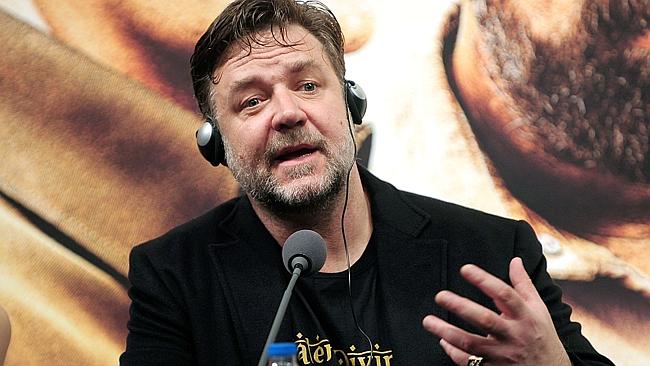
RUSSELL CROWE plays an Aussie farmer, a water diviner, in search of his three missing sons in his upcoming film.
The story grew from a single sentence footnote in historian Charles Bean’s book, Gallipoli Mission.
It’s a grand starting point and it’s ripe for comparison — another short Bean passage inspired the 1981 masterpiece, Gallipoli.
Crowe’s fictional character sprang from a real-life water diviner, renowned in parts of Victoria and NSW, who once found the precious stuff on Mel Gibson’s property. Keith Liston was the grandfather of the movie’s co-writer, Andrew Anastasios. Liston sounds worthy of his own movie, a weary soul condemned by his almost-mystical reputation to be constantly caked in mud.
The film sounds easy to embrace, a touching notion borrowed from history and conjured from the imagination, about an odyssey doomed to despair and yet bathed in hope.
Yet perhaps the story alone was not appealing enough for the publicity people.
Crowe has flogged The Water Diviner for a few weeks now.
He has stomped a path almost as worn as the sort of mindless sentimentalism he has identified as being in need of challenge. Crowe has questioned the Gallipoli mythology and wondered at the tone of its commemoration.
In that, he has unwittingly tapped a fad in academic circles right now. In doing so, and not for the first time, Crowe has cast himself as a dill.
He has demanded that the “the other side” be heard, apparently unaware that the Turkish perspective has been thoroughly (and rightly) explored. He has queried the “invasion” of Turkey in April 1915, ignoring previous Turkish attacks on Allied (and, by extension, Australian) interests in the Suez Canal and the Black Sea. Crowe has confused the naval battle of Canakkale with the land battle of Gallipoli (or Gelibolu).
He has seemed to suggest that a permission slip ought to have been sought from the enemy before the attack. It was a war, after all. One can apply a modern lens to misunderstand Australia’s motives for being there, yet Crowe seems unaware that the Ottoman Empire chose to be on the other side.
He has declared that Gallipoli folklore should not be “celebrated”. His appreciation of the post-war grief that hobbled Australia for generations seems muddled if not absent. One can only guess that he has not felt the silent reverence that envelopes any modern-day dawn service.
If Crowe has discovered that war is an awful waste, he ought to be congratulated for catching up. Yet he should also acknowledge what such new-found wisdom implies. It seems he had never watched a great war movie or read a fallen soldier’s diary until now. He mistakes his ignorance for our ignorance. If he is moved to apologise to Turkey on our behalf, which seems eminently possible, may I apologise to Turkey for the celebrity chameleon who does not grasp his country’s heritage or mood.
This isn’t to say that Crowe cannot act (or direct, as he has for this movie). He can act. Yet Crowe jars in the self-appointed role of Crowe the commentator.
HE IS one of many celebrities who volunteers for extra-curricular duties out of what might be mistaken for grandiosity. U2’s Bono has been “fixing” the world’s ills since the 1980s.
He’s humanity’s equivalent of the IT guy, all answers and no solutions.
He introduces new metaphors to old problems and the distraction of his presence stops systems dead. When he finally wanders off, there is blessed relief, because everything can go return to being just plain broken again.
Arnold Schwarzenegger went further than Bono and got elected to politics. Once there, he declared that gay marriage should be between a man and a woman and that marijuana was a plant and not a drug.
Cate Blanchett can act better than the Terminator. To be fair, at least Schwarzenegger committed to the vagaries of the political system. Blanchett instead offers airy pronouncements on societal priorities. Like Crowe, inconvenient truths aren’t her thing. Last week, former Prime Minister John Howard described her rendering in her free education eulogy to Gough Whitlam as “outrageous”.
Perhaps Crowe sees himself as an artist, much as Blanchett once described it: “We change people’s lives, at the risk of our own. We change countries, governments, history, gravity. After gravity, culture is the thing that holds humanity in place, in an otherwise constantly shifting and, let’s face it, tiny outcrop in the middle of an infinity of nowhere.”
Those are just a few examples. The important shift lies in the long overdue reaction to such celebrity hubris. Where once such flagrant misspeak was politely dismissed, it now receives shrill shoutdowns (for which Twitter was surely designed). Only now, in 2014, has a magazine finally outed Bono as among the “Least Influential People” on the planet.
Crowe has been openly attacked. Historians and advocates and media commentators lined up. One or two suggested that his views were conflated to promote the movie.
The Water Diviner’s cinematic place after its December 26 release will be determined by the audience. Yet Crowe’s comments on its historical groundings should assume their place, too.
As a historian, Crowe stands alongside Alan Bond, another big character who also beat a patriotic drum. Their perspectives differ, but the pair share a mutual disdain for facts. During the 1983 America’s Cup, Bond reached for the Gallipoli campaign for perspective.
“We had our backs to the wall there and we won that one,” Bond said of the military disaster.
source:heraldsun.com.au








 STUDIO 3 NEWCASTLE AUSTRALIA