Monthly Archives: August 2014

Greece: Botched steroid deal led to Mani murders

mani_victims

Two bodybuilding fanatics were found dead in the outskirts of Kalamata.

A deal to sell steroids gone wrong appears to have been the reason for the murder of two bodybuilding fanatics, aged 25 and 26, whose bodies were found in a ravine on the outskirts of Kalamata in the Peloponnese, Kathimerini understands.

According to police sources, a 19-year-old local man who was arrested shortly after the bodies were found has allegedly admitted to being at the scene of the shooting but claimed that another man, also aged 19, shot the two victims in the back with a hunting rifle.

Police investigators found the gun and the car which the two suspected perpetrators are believed to have used to dump the bodies of their victims in the ravine.

According to the police probe, the two men – 26-year-old Constantinos Sgouros and 25-year-old Yiannis Kommatis – had been drinking in a bar outside Kalamata with friends on Monday night. They told their friends they were going to meet someone but gave no further details.

It appears that they failed to procure some 800 euros’ worth of steroids that the two 19-year-olds are alleged to have ordered, prompting an argument that led to the shootings.

The bodies of Kommatis and Sgouros bore several bullet wounds in their backs, according to police sources who said the injuries indicated that the shots were fired at very close range.

Kommatis, a professional soldier who had been serving on the island of Samos, practised bodybuilding as a hobby and, according to sources, had indicated on his Facebook page his intention to open a store selling vitamin supplements and gym equipment.

Sgouros had won bodybuilding competitions. Photographs showed that he had a tattoo of a swastika.

Source: Kathimerini.

Aussie toursits flock to Greece

549543_10151005619362551_1669002454_n


Industry figures see a 10 per cent increase in Australian tourists flying to Greece.

According to travel company and ticket wholesaler, Consolidated World Travel, Australians are flocking to Greece.

Owner and general manager of the company, Greek Australian Spiros Alysandratos has seen a 10 per cent increase in the number of Australian tourists holidaying in Greece last year, and the trend is continuing this year.

Almost 130,000 Australians travelled to Greece in 2013, a rise of 9.6 per cent of tourists. The numbers are also buoyed by increased direct flights from major Australian cities.

According to industry figures, Australians are proving the most generous tourists and spend 12 or more days in Greece more than any other visitor and spend approximately 1,420 euros, with Canadians just behind with 1,207 euros, Americans who spend 1,098 euros, and the Russians with 1,005 euros.

source: Neos Kosmos

Aυστραλία: «Εφιάλτης» το πατρικό χωραφάκι από την Ελλάδα

xorafia

Το φορολογεί σκληρά η Ελλάδα, το «ψάχνει» και η Αυστραλία.

Τα «χωραφάκια» που κληρονόμησαν χιλιάδες συμπάροικοι στην Ελλάδα εξελίσσονται γι’ αυτούς σε εφιάλτη, εξαιτίας των υπερβολικών και, σε πάρα πολλές περιπτώσεις, εξωπραγματικών χρεώσεων, του Ενιαίου Φόρου Ιδιοκτησίας Ακινήτων (ΕΝΦΙΑ) που επέβαλε η ελληνική κυβέρνηση.

Την ίδια στιγμή, οι συμπάροικοι που έχουν την όποια περιουσία στην Ελλάδα θα πρέπει να τη δηλώνουν στην Aυστραλιανή Eφορία αν θέλουν να αποφύγουν άλλες ταλαιπωρίες (και πρόστιμα) όπως επισημαίνει στο «Νέο Κόσμο» το γνωστό λογιστικό γραφείο Ernst&Young Australia. (Διαβάστε σχετικό άρθρο στη σελίδα 2).
Εάν κερδίζετε κάποιο εισόδημα στην Ελλάδα ή κατέχετε περιουσιακά στοιχεία εκεί, ίσως αυτή να είναι η καλύτερη στιγμή για να βάλετε σε τάξη τα οικονομικά σας χωρίς να έρχεστε σε σύγκρουση συμφερόντων με την Aυστραλιανή Eφορία που δίνει σχετική «αμνηστία».

Η Φορολογική Υπηρεσία της Αυστραλίας (Australian Taxation Office – ATO) εντείνει τις δραστηριότητες οικονομικού ελέγχου. Εξετάζει τα στοιχεία Αυστραλών με επενδύσεις και τραπεζικούς λογαριασμούς στο εξωτερικό. Ελέγχει, επίσης, τις πληροφορίες αυστραλιανών και ξένων τραπεζών σχετικά με τις ροές κεφαλαίων, τα εισοδήματα από κεφαλαιουχικές υπηρεσίες και τα υπόλοιπα λογαριασμών, και συλλέγει πληροφορίες πληροφοριοδοτών για εξωχώριους λογαριασμούς, όπως και εμβάσματα από και προς εξωχώριους τραπεζικούς λογαριασμούς αλλά και για ακίνητη περιουσία.

Την ίδια στιγμή και μετά τις αντιδράσεις που προκλήθηκαν (εντός και εκτός Ελλάδας) για τον Ενιαίο Φόρο Ιδιοκτησίας Ακινήτων (ΕΝΦΙΑ), η κυβέρνηση Σαμαρά έδωσε παράταση ενός μήνα «για να εξετάζει κάποιες αδικίες» αλλά η κατάσταση δεν αναμένεται να βελτιωθεί θεαματικά.
Ενδεικτικά, αναφέρουμε (όπως σημειώνει και αναγνώστης μας με επιστολή του που δημοσιεύεται στη σελίδα 10 του «Νέου Κόσμου») ότι σε οικόπεδο στα Μεγάλα Καλύβια Τρικάλων, αντικειμενικής αξίας 98.670 ευρώ το 2013, υπολογίστηκε ο ΕΝΦΙΑ το 2014, με νέα αντικειμενική αξία 815.568 ευρώ!
Κάτοικος ορεινού χωριού της βόρειας Κεφαλλονιάς κλήθηκε να πληρώσει 10πλάσιο φόρο για το ακίνητο που διαθέτει. Συγκεκριμένα, για οίκημα 75 τ.μ. ο φόρος είναι 3.636 ευρώ από 323 ευρώ που πλήρωσε το 2013.

Η κατάσταση είναι ακόμα χειρότερη για δεκάδες χιλιάδες άλλους που έχουν κληρονομήσει κάποια χωράφια, τα οποία δεν καλλιεργούνται εδώ και χρόνια και σήμερα καλούνται να πληρώσουν σημαντικούς φόρους καθώς, όπως καταγγέλλεται οι αντικειμενικές αξίες πάνω στις οποίες γίνεται ο υπολογισμός του ΕΝΦΙΑ είναι εξωπραγματικές.

Πηγή: Νέος Κόσμος

Athens museums a haven in a holiday heat wave

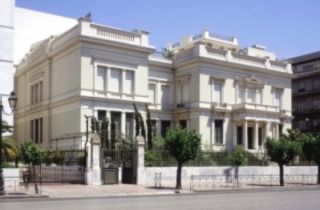
benaki_museum_0

On the August 15 public holiday, a major feast day in the Greek Orthodox calendar marking the Dormition of the Theotokos, Athens’ streets might have been a bit empty.

With many restaurants and cafes closed, locals and tourists alike flocked to the museums. Those that braved the heat were treated to almost private tours of a number of musuems that opened their doors on the holiday.

The Byzantine Museum often described as an underappreciated treasure had it’s doors open, where tourists were able to see the current exhibition by outdoor installation by artist Kalliopi Lemos focusing on the human struggle through life.

The Numismatic Museum also bucked the trend and remained open, showcasing one of the greatest collections of coins, ancient and modern, in the world.

The month of August might be one of the quietest in Athens thanks to many locals taking their holidays, but for the museums, the time is perfect to welcome interested tourists with lower crowd numbers.

Great exhibitions on this month include the Museum of Cycladic Art’s “History Zero,” a video by Stefanos Tsivopoulos which represented Greece at the 2013 Venice Biennale to the end of September; the Benaki Museum’s “Notes on Oriental Tobacco,” a fascinating exhibition about the history of the multifaceted commercial product in Greece, running to August 31.

Source: Ekathimerini.

Living in the blood stained country

gaza_0

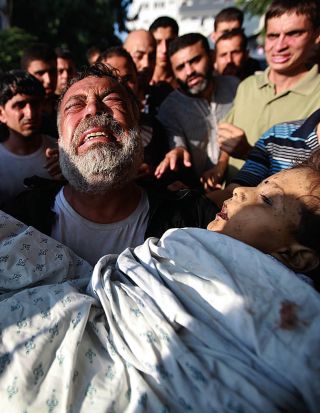
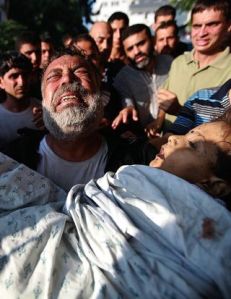
Akram Miqdad, father of Bara-a, 6, cries as he carries his body outside the morgue of Shifa hospital in Gaza City. This is the current face of the bloodstained country. Photo: EPA/MOHAMMED SABER.

Gabriel Haritos, a researcher of International, Political and Economic Relations in the Mediterranean who currently lives in Israel, talks to Neos Kosmos about the harsh reality of the never-ending war in Gaza.

It was almost a year ago when Gabriel Haritos, a doctoral candidate and researcher, decided for the purposes of his work to leave Rhodes and settle in Jerusalem. The Mediterranean, and more specifically, its fascinating history, always enthralled Gabriel, to the extent that it became the main point of his scientific research.

When he took the decision to move to Jerusalem, he knew very well that peace has always been the most fragile entity in the country. But his experience during this last year made him, momentarily at least, forget this millennia proved harsh reality.

All he would live and experience was a multicultural city where everything “was mingling nicely”, as he says. Religions, languages, different cultures were mixing with a Western-style reality creating a vibrant society. Jerusalem did not let Gabriel down.

Yes religion was and remains a very important element that defines the fault lines of this city, but Jerusalem remained in essence a cosmopolitan city.

“The truth is that there is an invisible boundary that those who come here to Jerusalem, even for a day or two, can see. The west side is the West and the east side is the East. But this invisible boundary does not impede the normal flow of life. For example, I would go out in the evening to a bar and this might be a Jewish bar but then the taxi driver who’ll take me home might be Arab. The waiter might be an Arab even in a Jewish bar and vice versa for an Arab place. I have Arab friends who are lawyers and their clients are ultra orthodox Jews.”

And that was the reality that Gabriel lived up until two months ago. Not anymore.

IN the PRESENT TENSE

The first signs of unrest hit Jerusalem in June, when the bodies of three Jewish teenagers were discovered and it became clear they were murdered.

“For 18 days the army was looking at the West Bank to find the perpetrators. The Israeli press was coming out with headlines promoting hatred against the Arabs on a daily basis. Things became worse when a phone call that had been made by one of these children to the Israeli police became public. The teenager was heard saying that he’d been kidnapped, a man speaking in Arabic was heard telling him ‘put your heads down’ and then shots. This recording created an explosive environment in Jerusalem. For those 18 days that followed you could hear screams, laments and public prayers coming from the Wailing Wall. The society was at a boiling point,” says Gabriel.

At that time, the city that he knew changed dramatically. Things got out of hand when the body of a Palestinian teenager was found brutally murdered shortly after. In Israel, many reacted with horror at the deed, while others started calling for revenge over the deaths of the three Israeli teens.

Gabriel lives on the Arab side and within walking distance from the Mosque of Omar. The day the body of the Palestinian teenager was found marked the day that peace proved its fragility in Jerusalem. The city descended into chaos.

Street fighting started outside his house. Rocks and flash crackers were exchanged day and night amidst screams and anti-Jewish or anti-Arab slogans.
And this was the reality Gabriel had to face daily and, as he says, to adapt to, too.

“Humans are very adaptive. After all, even chaos has its rules. When they started I was wondering how it would be possible for me to do simple things, like going to the grocery store. I had to change the way I was doing things, to learn the small but important secrets of survival.”

He figured out that the best time to go out and do the simple, everyday things was while the prayer in the Mosque of Omar was on. He could hear it very clearly from his home. “All the Arabs were there and the Jews did not have anyone to fight with. The end of prayers was the warning sign to start to slowly get back home.”

It did cross his mind to return to Greece but… “when something comes so suddenly you believe that it can stop suddenly too. So you do not take the decision to give up everything easily. I have a research project to complete”.

And the above was not the sole reason that Gabriel stayed in Jerusalem. The war came as another sudden development to stop any thoughts he might have entertained of returning to Greece.

The process of counting hours, observing the situation and making a balanced assessment of it started. He knew that rockets from Gaza had targeted almost 80 per cent of Israel’s territory. The prime target was Tel Aviv and the wider area of the city where the Israeli airport is. And the airport was not a safe place anymore.

“During previous military operations that had happened in Gaza the airport was taboo, it was never hit before. This time, however, the airport proved to be a target. For five hours I would be exposed in an area where I would potentially be a target.”

The other option he had was to go east and fly from Jordan. But the limited information available for the area he had to cross in order to get to Jordan made the trip to that part of the country even more dangerous. “So I decided to stay where I am. No I don’t feel trapped. Not a hundred per cent safe, but secure,” he says.

THE ABSURDITY OF FULL BLOWN WAR…

Gabriel cannot only offer us an on-the-ground account of the societal realities after the break of the recent war in Israel. His scientific expertise, due to his current research subject and the fact that he also served as visiting scholar at the Israeli think-tank Moshe Dayan Centre for Middle Eastern and African
Studies at the University of Tel Aviv, in conjunction with the fact that he is an outsider in terms of religion and ethnicity to those involved in the conflict, puts him in the best position to give us a critical account of the situation.

He declines to enter into the ‘horrors of war’, as he calls the images of death and destruction that we’ve all seen lately.

“This is a very abnormal situation,” he says. “From a scientific point of view, before a war starts all parties look and judge accordingly what they want and what they can achieve. The ‘why you do it’ and the ‘what you are trying to achieve’. Hamas began to cast its rockets to 80 per cent of a neighbouring country, which it does not recognise has the right to exist, after the murder of the Palestinian boy. In essence this was a way for Hamas’ military wing to express its solidarity to the Palestinians who live in Israel. That was their claim back then but this in reality was a superficial rationale.”

The actual reason, as Gabriel says, is the fact that the agreement signed between the Palestinian Authority and Hamas’ political leadership, an agreement for reconciliation and cooperation, last April, did not satisfy and was opposed by Hamas’ military wing.

“The military arm of Hamas began to thirst for resources as Egypt closed the passage in Sinai. After the Arab Spring, Hamas is regarded by Egypt as ideologically aligned to the Muslim Brotherhood, which is currently outlawed in Egypt. The military arm of Hamas had two objectives when it started firing rockets. Initially it was to show its strength to the political wing of Hamas.

But then as they began firing rockets to the major urban centres the thing got out of control. It was the first time that Hamas’ rockets exceeded even Tel Aviv. The first time they hit Haifa near the border with Lebanon they even got up to Mitzmpe Ramon in the middle of the Negev desert. Hamas even fired three amphibious assault drones. All this is very impressive for an organisation. On the other side Israel had to cope with the internal outcry and it retaliated. In other words, it was drawn into what the military wing of Hamas wanted.

According to Gabriel the second objective of Hamas’ military wing was to cancel the Fatah – Hamas agreement. It wants for Gaza to remain as it is and for the passage from Gaza to Sinai to reopen. Fatah is the organisation that runs the West Bank while Hamas runs Gaza.

“If you follow the media statements made from Hamas to the Palestinians, the alleged objective it puts forward is the liberation of Palestine. And I’m asking as an independent observer … is it possible to free a country by throwing rockets here and there? No matter how powerful they are you need an army, you need the boots to touch the ground. So this objective is beyond its capacity. An unattainable one for that matter,” adds Gabriel.

As he says the same applies for Israel too. “When Hamas started bombing Israel, the main objective for Israel was to bomb the points from which the rockets were fired in Gaza. Let’s be realists on this one. No country will stay idle, when it is attacked left, right and centre. No country will tolerate one third of its population to live in a shelter. For this reason the international community initially did not object. Gaza is the most densely populated area in the world and it is impossible not to have many victims when bombs fall. Indeed, Israel sent messages to the population of Gaza to leave their homes before bombing.

But the big question which remained and still remains unanswered is where these people will go. However, with regard to Israel’s objective, there was no other way to do it. But when the Israelis began their military operation on the ground a second objective was developed. They argued that the purpose of the ground operations was to destroy all the tunnels. These tunnels started from Gaza and they were used for the movement of weapons but not only that. They are leading close to Jewish settlements located close to the Strip. And again as an observer I pose this question, ‘how can you destroy all the tunnels without at the same time destroying what is above them’. So it is absolutely clear that we have two warring sides which have set objectives above their capacity to achieve them and this is the big problem. Who will give in first?”

THE UNKNOWN ‘X’

The absurdity of this war is not only verified by the fact that both parties set unattainable objectives, according to Gabriel Haritos. It extends to the fact that at the moment and despite the horrific consequences for Palestine and the global outcry against Israel, both sides show no sign of waiving their hostilities. As for the innocent victims from both sides, unfortunately they are cynically regarded as ‘collateral damage’.

“Definitely the ceasefire is a development that brings some hope. It gives time for a compromise to be found. But the question is what this compromise will be. What the starting point will be for the solution will be determined by what Hamas will do. Does Hamas, and I mean the military wing of the organisation, want to remain isolated? Will the Sinai passage open and who will control it? Israel asks for the complete disarmament of the Gaza strip and Israel is the more powerful player in this conflict. Will Hamas give in to this demand?”.

This is not, however, the only ‘unknown X’ of the situation. Gabriel looks beyond the current absurdity of war. He focuses on the future that this war constructs in the societies of Israel and Gaza, which he describes as “bleak”.

“The Israeli leadership should be very alarmed about the events that occurred in the country between the Jewish and the Palestinian population, even before the start of the operations in Gaza. I mean the hatred and polarisation on behalf of both sides. For 18 days groups of 15 and 16-year-olds, Jews and Arabs, were throwing rocks at each other. What we see is two generations that haven’t learned to live together. These generations of Jews and Arabs were born and raised shortly after 2000 when we had the second Intifada. They grew a mutual distrust against each other. This trauma accumulates and one thing is certain, one day it will erupt. In 20 years these teenagers will be the politicians of the country. They are the people who will be responsible of this society.
That’s why I feel the implications of these recent developments are far more serious and damaging for the community.”

And Gabriel is so right. This war might come to an end but the divisions that it created have scarred the multicultural community of Jerusalem and beyond for many years to come. These scars will be carried into the future by those who are seen as the hopeful future, the children and the teenagers of today.
And it comes as a grim realisation of the ‘immortal’ words of Franklin Roosevelt that “wars are not paid for in wartime; the bill comes later”.

source: neos kosmos

 

Guangzhou Evergrande coach Marcello Lippi erupts following ACL defeat to Western Sydney Wanderers

1408564389803_jpg-620x349

Marcello Lippi has to be held back after his side received their second red card. Photo: Brendan Esposito

Guangzhou Evergrande coach Marcello Lippi sensationally stormed out of a media conference following their shock 1-0 loss to Western Sydney Wanderers but not before unleashing a heated attack towards the referee and Wanderers’ midfielder Vitor Saba.

The first-leg quarter-final defeat to the Wanderers at Pirtek Stadium will go down as an historic moment for the 66-year-old World Cup and Serie A winning coach who ran on to the field to protest the dismissal of two of his players in the late stages of the game before erupting in the post-match press conference, attacking Emirati referee Mohammed Abdulla Hassan Mohamed.

The Italian coach did not hide his anger as he ranted to the media about his dismay at the officiating of the match and the behaviour of some of the Wanderers’ players before walking out of the press conference without fielding a single question, leaving his two translators to relay his tirade.

Lippi criticised the referee for missing an alleged hand-ball in the box in the first half that would’ve given the reigning champions an early penalty as well as another foul by Daniel Mullen that he believes should have warranted a second yellow-card. Mohamed awarded Evergrande the foul but gave Mullen a talking-to rather than a dismissal.

“To be honest the first was a little bit far away but the second [red card] was really close to me so I saw it. I also saw that in the during of the match number 33 [Mullen] had to go for a second yellow card…. But I don’t know why the referee didn’t see this. Also in the first half we had a good chance to score and there was a handball in the opening and also the referee didn’t see it,” Lippi said.

Disbelief: Guangzhou Evergrande react to one of the red cards.

Disbelief: Guangzhou Evergrande react to one of the red cards. Photo: Brendan Esposito


“I’ve been in every competition in the world – the World Cup, European Champions League, Club World Championships – everything. I know it’s wrong to go on the field, but at the first moment I just wanted to ask the referee why  – But he talked to me like a child – I also tried to apologised to the ref, I knocked on the door [after the game] and I tried to say it wasn’t in protest, I wanted information on this.”

Lippi was critical of the Wanderers new Brazilian playmaker, Vitor Saba, who he accused of diving. Lippi was seen to have grabbed hold of Saba during a chaotic on-field protest involving the entire Guangzhou Evergrande bench.

“Number 10 with the beard, he played in Italy. It’s not good in football to be falling down and to be so fake, not in the champions league,” Lippi said.

Wanderers coach Tony Popovic was puzzled when he heard of Lippi’s tirade, saying his opponent had nothing to complain about.

“I don’t know what he’s upset about,” he said. “That’s his interpretation but the referee has made a decision. Their coaches can not go on the pitch, I’m sure if I went on the pitch I would’ve been sent off so I can’t condone their coaches going on the pitch. We all disagree with decisions that referees make, we voice our opinion from the sideline but we don’t go on the pitch and man-handle a player.”

Meanwhile, the Wanderers are expected to announce their fifth and final visa-player for next year with the signing of Nigerian left-back Seyi Adeleke set to be confirmed on Thursday.

The signing of the 22-year-old defender effectively ends any chances of the club signing a high-profile foreign marquee to replace Shinji Ono.

Adeleke arrives from Serie A club Lazio where he spent three seasons but did not make a senior appearance as he spent the bulk of his career loaned out to smaller clubs. He spent two seasons in the lower leagues of Italy with Salernitana and Pergolettese as well as a season in Switzerland with FC Biel-Bienne.

source: smh.com.au

Paul Hogan divorces Linda Kozlowski but keeps ‘Crocodile Dundee’

1406168148734_jpg-620x349

Paul Hogan can now say, “that’s not a settlement. That’s a settlement” after successfully finalising his divorce while managing to hold on to the love of his life

The now ex-Mrs Hogan, Linda Kozlowski, will receive a one-off payment of $6.25 million while Hoges will keep the rights to his Crocodile Dundee character and the film company that produced the classic films.

Kozlowski, 56, will remain living in their Venice Beach home until 2018, or until she remarries, which ever happens first according to TMZ.

Actress Linda Kozlowski with Paul Hogan in happier times in 1988.

Actress Linda Kozlowski with Paul Hogan in happier times in 1988.


The pair will share legal custody of their 15-year-old son Chance and neither will pay child or spousal support.

Hogan, now  74, and Kozlowski were the original Brad and Angelina after falling in love on set in 1986 after the Australian actor cast Kozlowski to play his love interest Sue Charlton in the first Crocodile Dundee film. Hoges split with his then wife Noelene soon after before marrying his American co-star in 1990.

The couple were married for 23-years before separating in September last year citing irreconcilable differences.

Prior to splitting with Kozlowski, Hogan was at the centre of a long running ATO investigation for tax evasion. After returning home to attend his mother’s funeral in 2010, he was prohibited from leaving the country, which resulted in a public stand-off with the taxation department. No charges were ever laid and he settled for an undisclosed sum in 2012.

source: smh.com.au

Socceroos coach Ange Postecoglou names squad to play Belgium and Saudi Arabia

1408583411436_jpg-620x349

Socceroos Head Coach Ange Postecoglou has moved to broaden the base of international players ahead of the 2015 AFC Asian Cup by selecting a group of new faces for the matches against Belgium and Saudi Arabia in September.

The 20-man squad contains four uncapped players in Brad Smith, Chris Herd, Trent Sainsbury and Bailey Wright as well as Hyundai A-League young guns Terry Antonis and Tomi Juric.

Robbie Kruse, Carl Valeri and Josh Brillante have been recalled to the Socceroos squad along with 12 members of the 2014 FIFA World Cup final squad, including captain Mile Jedinak and talisman Tim Cahill.

After naming the squad, Postecoglou declared Socceroos selections would continue to be bold as he builds a broader base of international players in Australia’s pursuit of becoming the best team in Asia.

“The next series of games for us are really important to broaden the base and depth so we’re going to be pretty bold in the way we select our squads and give some people an opportunity,” Postecoglou said.

“After the World Cup campaign we had a break and I had a bit of a chance to think about everything that transpired over the last six to eight months, culminating in the World Cup.

Leading the way: Mile Jedinak.

Leading the way: Mile Jedinak. Photo: Sahlan Hayes


“One thing that came out, that was evident to me, is that we need to broaden our base and get some depth in various positions in our squad.

“From our perspective these games are a chance to expose some young players to international football and hopefully create some depth in areas we’re light on.

“We want a really strong squad for the Asian Cup and we are only going to get that if we have a look at some more players.”

One player that fits Postecoglou’s blueprint to broaden the base is left-sided player Brad Smith, who has been called into the Socceroos squad for the first time after making his English Premier League debut last year for Liverpool.

“Brad’s a player we have been monitoring since I’ve been in the job and he plays in a position where we don’t have a great deal of depth. He plays left back and left side and he’s quick,” Postecoglou said.

“Brad’s a young player who is making his way in the football world. He’s contracted to Liverpool Football Club and obviously been loaned out to Swindon to get some games under his belt.

“Brad’s played for the England U21s as recently as a couple of months ago but he’s very committed to playing for Australia and after having a chat to him we are really keen to get him in the green and gold and give him an opportunity.”

Postecoglou acknowledged injuries ruled out Rhys Williams, Curtis Good, Tom Rogic, Matthew Spiranovic, Matt McKay and Ivan Franjic with experienced campaigners Mark Bresciano and Josh Kennedy still in line for matches in October and November ahead of the 2015 AFC Asian Cup.”

The 20-man Socceroos squad:

Terry Antonis

Joshua Brillante

Tim Cahill

Jason Davidson

Ben Halloran

Chris Herd

Mile Jedinak

Tomi Juric

Robbie Kruse

Mitchell Langerak

Matthew Leckie

Massimo Luongo

Mark Milligan

Tommy Oar

Mat Ryan

Trent Sainsbury

Brad Smith

Carl Valeri

Alex Wilkinson

Bailey Wright

source: smh.com.au


Bondi local Cyril Baldock, 70, sets record for oldest swimmer of English Channel

5669946-3x2-340x227

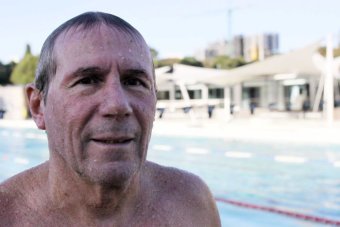
Bondi man Cyril Baldock has set the record for the oldest person to swim the English Channel.

The 70-year-old Bondi Surf Life Saving Club member completed the swim between England and France in 12 hours and 45 minutes on Wednesday (local time).

It was his second Channel swim, after first completing the test – considered the ‘Everest of swimming’ – in 1985, when he became the fifth Australian to do so.

After finishing his swim overnight he posted on Twitter: “Support from home has been overwhelming – thanks to everyone for following our journey”.

Mr Baldock told the ABC his dream to break the world record began when his mentor and coach, Des Renford, had a heart attack.

Described as “the king of the channel”, Renford had wanted to be the oldest person to achieve the record.

“Des wanted to have a crack at that but obviously it was never going to be,” Mr Baldock said.

“I told Des that when I got to that age I’d have a go at it. But little did I know over that 30-year period the oldest went up 10 years, so I had to wait a while.”

Mr Baldock said he would not have done the swim again if it was not for the record.

“There’s no way that I’d attempt the English Channel just to swim it a second time. I’ve done it, I was only the fifth Australian to do it back then, but to be the oldest it’s an enormous challenge. It’s something that very few people can ever achieve,” he said.

However Mr Baldock’s record may be short-lived, because 73-year-old Brisbane woman Irene Keel is also attempting the swim this week.

Mr Baldock’s training consisted of around 40 kilometres of swimming each week, including five pool sessions and a long open water swim on a Saturday.

The English Channel is 34km straight across but it is very rare for a swimmer to cover it in under 40km.

Mr Baldock’s coach Vladimir Mravec specialises in preparing people for marathon swims like the English Channel.

This year, 12 of his squad members are attempting the feat.

So far seven have been successful, including Sydney’s Stuart Johnson, who was attempting to be only the fourth person to swim three laps of the Channel continuously.

Johnson managed two-and-a-half laps but decided to retire after 30 hours in the water, tired and close to hypothermia.

“My role as coach is take his momentum and make the momentum live,” Mravec said.

It is this momentum that not only helped Mr Baldock be best prepared for the Channel swim but also in other areas of his life.

“It’s helped my fitness, I’ve got five grandkids and I’m able to do things with them that a lot of 70-year-olds couldn’t do,” Mr Baldock said in the lead-up to the swim.

“Swimming is the ultimate sport for fitness because you’re under pressure all the time, you’re breathing all the time.”

Mr Baldock has lost a number of friends to skin cancer and is raising money for the Melanoma Institute of Australia.

source: abc.com.au

Τι συνέβη με το εξαφανισμένο Boeing 777; Σοκάρει η νέα θεωρία

____370_929059919

Έχουν γραφτεί πολλά και έχουν ακουστεί ακόμα περισσότερα για το τι πραγματικά συνέβη με το μοιραίο Boeing 777 που ακόμα δεν έχουν βρεθεί συντρίμμια του, ούτε και τα πτώματα των 239 επιβατών, καίτοι έχουν ερευνηθεί ακόμα και αχαρτογράφητες περιοχές του πλανήτη.

Ο Νεοζηλανδός ερευνητής Ewan Wilson, πιλότος και ο ίδιος και ιδρυτής της Kiwi Airlines, διατυπώνει μια καινούργια θεωρία στην οποία κατέληξε, όπως επισημαίνει, σταθμίζοντας όλα τα δεδομένα και όλα τα εναλλακτικά σενάρια που έχουν δει μέχρι τώρα το φως της δημοσιότητας.

Το βιβλίο των Ewan Wilson και Geoff Taylor

Σύμφωνα με τη δική του θεωρία (γράφει σχετικά η βρετανική Mirror), ο πιλότος του Boeing 777 της Malaysia Airlines Zaharie Ahmad Shah, έκλεισε εσκεμμένα την παροχή οξυγόνου στην καμπίνα των επιβατών. Όσοι εκείνη την ώρα κοιμόντουσαν πέθαναν από ασφυξία, όσοι ήταν ξύπνιοι φόρεσαν τις μάσκες οξυγόνου, αλλά αυτές δεν κατάφεραν να λειτουργήσουν πέραν του 20λεπτου. Στη συνέχεια και αυτοί οι επιβάτες είχαν την ίδια μοιραία κατάληξη: πέθαναν από ασφυξία.

Οι θεωρίες γύρω από την μοιραία πτήση

Ο ίδιος ο πιλότος, κλειδωμένος στην καμπίνα του, ο συγκυβερνήτης του είχε μείνει απέξω, φαίνεται πως είχε προμηθευτεί έξτρα φιάλη οξυγόνου για να αντέξει περισσότερη ώρα. Σε αυτό το διάστημα προσθαλάσσωσε το αεροσκάφος στα βάθη του Ινδικού Ωκεανού και τότε -εντελώς ακυβέρνητο- άρχισε να βυθίζεται σιγά σιγά. Ιδού και μια εξήγηση γιατί όλα τα σωστικά συνεργεία δεν έχουν βρει ακόμα ίχνος συντριμμιών.

Ο χάρτης από την περιοχή των νέων ερευνών

Κατά τον Wilson δεν υπήρξε ούτε έκρηξη, ούτε πτώση, ο Zaharie Ahmad Shah θα πρέπει να το προσθαλάσσωσε όσο πιο ήρεμα μπορούσε και στη συνέχεια το άφησε στη μοίρα του.

Ο Wilson συνέγραψε ένα βιβλίο, μαζί με τον Geoff Taylor, για την τραγωδία του Boeing με τίτλο «Η αλήθεια πίσω από τον χαμό της πτήσης 370 -Καληνύχτα Malaysian 370». Σε αυτό σημειώνουν πως ο Zaharie Ahmad Shah, έπασχε από κάποια ψυχική ασθένεια. Έτσι κατάφερε να ξεγελάσει τον συγκυβερνήτη του, 40 λεπτά μετά την αναχώρηση, και να τον κλειδώσει εκτός της καμπίνας.

Ο κυβερνήτης Zaharie Ahmad Shah

Είχε, δε, μπροστά του τρεις ώρες για να αναπτύξει το πλάνο του, ενώ ήταν γνωστός για την μεθοδικότητά του και για τη λατρεία που είχε σε παντός είδους τεχνικά ζητήματα.

Πηγή: iefimerida