
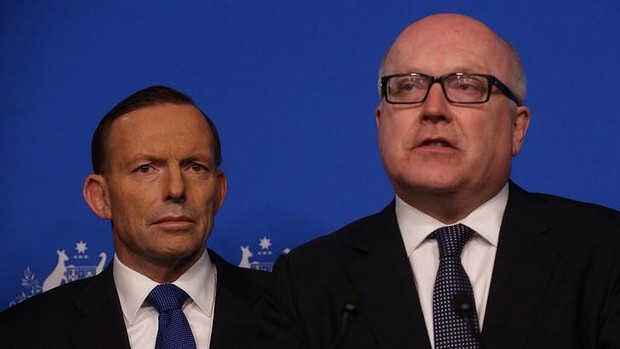
Prime Minister Tony Abbott and Attorney-General Senator George Brandis on section 18C of the Racial Discrimination Act. Photo: Andrew Meares
GEORGE Brandis and Malcolm Turnbull will move today to put the government’s counter-terrorism plans for computer and phone records back on track after a blow-up in cabinet over a lack of consultation and responsibility for the sweeping changes.
Tony Abbott and the Attorney-General have been forced on to the back foot in explaining and justifying plans to force internet providers and phone companies to keep every record of a customer’s phone and web use for at least two years.
An angry and frustrated Communications Minister forcefully warned the Prime Minister and his cabinet colleagues yesterday that they risked being embarrassed over the new terror provisions because they had taken a decision without full knowledge of the repercussions for internet service providers and the public.
Last night, Senator Brandis, ahead of a meeting today with Mr Turnbull to begin work on a strategy for metadata retention, deepened confusion over whether web histories of private computers would be targeted in the new laws.
Concerns about privacy breaches by keeping browsing histories and fears of extra costs for data retention are emerging as the two most contentious issues of the sweeping new anti-terror measures.
Mr Abbott tried to reassure the public about web browsing histories, saying yesterday: “We’re not asking for anything that isn’t already being done.
“This idea that we are asking the telecommunications providers to store material that isn’t already kept and stored is just wrong.
“We are not seeking content, we are seeking metadata. What you generate is content, what the service providers generate is metadata.
“We do think the metadata should be kept because all of the best security advice is that, without this, counter-terrorism work becomes very difficult, crime-fighting work becomes very difficult.
“But I stress, we’re not asking for new information.”
However, government MPs, officials and telecommunications companies are confused and concerned about the prospect of web-browsing histories being collected and are convinced that some companies will face higher costs, to be passed on to clients, to keep the metadata on record, contrary to Mr Abbott’s claims.
Senator Brandis said on Sky News last night in answer to a question on web histories: “What you’re viewing on the internet is not what we’re interested in. What the security agencies want to know, to be retained, is the electronic address of the website.
“It tells you the address of the website. When you visit a website, people browse from one thing to the next and that browsing history won’t be retained and there won’t be any capacity to access that.”
On Tuesday, Mr Turnbull bluntly complained to cabinet he found it “strange” that as the Minister for Communications he had not been invited to the National Security Committee of cabinet discussions, which agreed in principle to data-retention plans.
He further complained that the first he knew of the decision was a report on the front page of Sydney’s The Daily Telegraph, which said the cabinet committee had signed off on mandatory data-retention laws.
Cabinet sources told The Australian last night it would have been better to have Mr Turnbull, an original investor in pioneering internet service provider Ozemail, involved because of his technical understanding of communications. When Mr Abbott appointed Mr Turnbull as Communications Minister he praised his deep understanding of modern communications and joked that he had “virtually invented the internet’’.
Some cabinet ministers sympathised with Mr Turnbull’s claim that he had been left out of the loop on the new laws and that there was insufficient consultation with the full cabinet.
But Mr Abbott made clear to his colleagues at the cabinet meeting on Tuesday that the NSC — which includes the Prime Minister, the Deputy Prime Minister, the Foreign Minister, the Defence Minister, the Treasurer, Attorney-General and intelligence and defence chiefs — made the decision in principle and the legislation would be finalised with Mr Turnbull.
At the end of the cabinet meeting, Mr Abbott said Mr Turnbull and Senator Brandis would now work together on the “third tranche” of the counter-terrorism legislation. Their first meeting is today.
Senator Brandis was at the NSC meetings, as the minister responsible for ASIO and the Telecommunications Interception Act. Social Services Minister Kevin Andrews was also included in the meetings because the other counter-terrorism changes, which Mr Abbott announced on Tuesday, directly affected his responsibility.
During the Howard government years, then communications minister Helen Coonan was called into the NSC when legislation was being prepared to restrict some internet activities.
source: theaustralian.com.au








 STUDIO 3 NEWCASTLE AUSTRALIA