
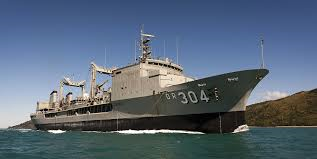
HMAS SUCCESS
The HMAS Success is due to arrive in the search area for missing Malaysia Airlines Flight MH370 today, joining the increasingly international effort to find the missing jet.
Australian, New Zealand and American air searches found no trace of wreckage or debris in their sweeps of the search area southern Indian Ocean yesterday, despite deploying Self Locating Data Marker Buoys in the zone.
Two aircraft from China are also expected to be part of the search effort today, joining a Norwegian cargo vessel and one other merchant ship that are already in the search area, approximately 2500 kilometres southwest of Perth.
The search will be further bolstered on Sunday by two P-3 Orions from Japan.
Five Chinese ships and the British HMS Echo are also heading towards the southern Indian Ocean to assist.
PREVIOUSLY: How yesterday’s search unfolded
“We are doing all that we can, devoting all the resources we can and we will not give up until all of the options have been exhausted,’’ said acting Prime Minister Warren Truss.
However he also tamped down expectations.
“Something that was floating on the sea that long ago may no longer be floating — it may have slipped to the bottom,’’ he said.
“It’s also certain that any debris or other material would have moved a significant distance over that time, potentially hundreds of kilometres.’’
Speaking from Papua New Guinea, where he is on an official visit, Prime Minister Tony Abbott told reporters he spoke with Chinese President Xi Jinping, who he described as “devastated.’’
“It’s about the most inaccessible spot that you could imagine on the face of the Earth, but if there is anything down there we will find it,’’ Mr Abbott said.
“We owe it to the families and the friends and the loved ones of the almost 240 people on Flight MH370 to do everything we can to try to resolve what is as yet an extraordinary riddle.’’
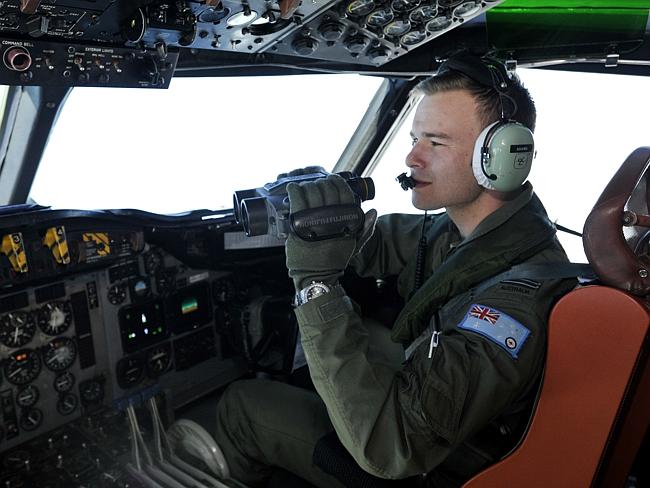
On the hunt … pilot Russell Adams searches from a Royal Australian Airforce AP-3C Orion during the search mission yesterday. Picture: Justin Benson-Cooper Source: Getty Images
Experts say it is impossible to tell if the grainy satellite images of the two objects — one 24 meters long and the other measuring 5 meters — were debris from the plane. But officials have called this the best lead so far in the search that began on March 8 — two weeks ago today — after the plane vanished over the Gulf of Thailand on an overnight flight to Beijing.
Searchers relied mostly on trained spotters aboard the planes rather than radar because radar found nothing in the first day of the search Thursday, Australian officials said.
The search will focus more on visual sightings because civilian aircraft are being brought in. The military planes will continue to use both radar and spotters.
“Noting that we got no radar detections yesterday, we have replanned the search to be visual. So aircraft flying relatively low, very highly skilled and trained observers looking out of the aircraft windows and looking to see objects,’’ said John Young, manager of the maritime safety authority’s emergency response division.
A spokesman for the Norwegian cargo vessel Hoegh St. Petersburg said the ship, which has been in the area since Thursday, searched a strip of ocean stretching about 100 nautical miles (185 kilometres) yesterday using binoculars and unaided eyes.
“The visual observations are the most important. The fact that they are there and have the capacity to move in a specific pattern is the most important contribution,’’ he said.
Aircraft pieces have been found floating for days after a sea crash.
Peter Marosszeky, an aviation expert at the University of New South Wales, said the wing could remain buoyant for weeks if the fuel tanks inside were empty and had not filled with water.
Other experts said that if the aircraft breaks into pieces, normally only items such as seats and luggage would remain floating.
“We seldom see big metal (pieces) floating. You need a lot of (buoyant) material underneath the metal to keep it up,’’ said Lau Kin-tak, an expert in aircraft maintenance and accidents at Hong Kong Polytechnic University.
source: news.com.au







 STUDIO 3 NEWCASTLE AUSTRALIA