
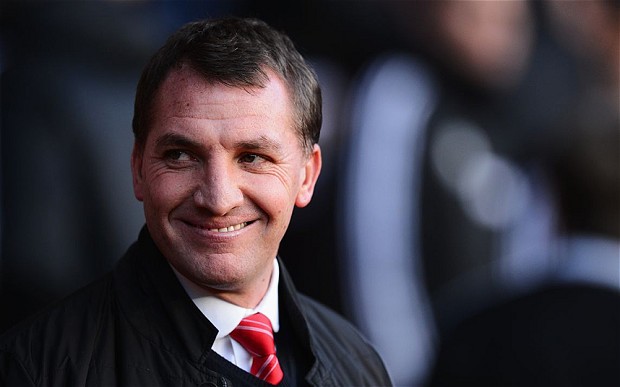
Liverpool arrive at Old Trafford with a double-digit lead over Manchester United for the first time since 1991.
Brendan Rodgers has the facts. “If you look at the last 38 games – from the last 10 of last season and the 28 this season – we would be 12 points ahead of Manchester United with 91 goals opposed to 64,” the Liverpool manager says. “Over the period of time, including Fergie’s time as well, we’ve shown progress.”
Rodgers volunteers those stats from memory – “I knew you were coming,” he jokes – and while he quickly dismisses the suggestion that United are the “yardstick for us” he knows the importance of what he is saying for both clubs.
The comparison is at the forefront of his mind even if he is careful not to bite on whether knocking United “off the perch” – to borrow Sir Alex Ferguson’s memorable phrase – is what he wants to achieve as Liverpool manager. “Our measurement is not Manchester United,” Rodgers states. “It’s about trying to recreate the great history of this club in the modern times. That is obviously difficult but we’re trying to do it in a different way.”
The phrase “in a different way” peppers Rodgers’s conversation as he prepares for the visit to Old Trafford today in the knowledge that something momentous can be achieved. Already Liverpool have gone from finishing 28 points behind United, the champions last season, to 11 points ahead of them. That is some swing, whatever the circumstances.
Liverpool arrive with a double-digit lead over United for the first time since 1991 – when they drew 1-1 and Kenny Dalglish resigned a few weeks later – while only once in the intervening 23 years have they travelled for the same fixture ahead of United. That was in 1996 when they were a point in front after nine games and the so-called Liverpool “Spice Boys”, all style and less substance, held sway. United finished as champions.
“This is a very different Liverpool,” Rodgers says. “I don’t think people see us as that. People talked about us after the Swansea game [the recent 4-3 home win] about the openness of it – I hated that, by the way, because we do so much work on our pressing and getting the ball back.
“We conceded poor goals that day. This is not a cavalier, go out and win 4-3 team. We started the season with three 1-0s and that was great. I’d always want to have that charisma and aggression in the team – both with and without the ball. That comparison is different to where we are at.”
The “mental resilience” he now feels that Liverpool is embodied not just in Steven Gerrard – “a remarkable man,” Rodgers says – but in Luis Suárez. Once more, the strength shown by the manager and Liverpool’s owners, the Fenway Sports Group, in refusing to sell the striker last summer appears to be the key factor in what is happening at the club.
“Over the years people are called hard men,” Rodgers says. “They’re usually centre-halves or midfield players. But Suárez is a hard man. Don’t underestimate him. I know he’s a striker, but he gets battered, he gets kicked. He’s the toughest player mentally I’ve ever come across in my life and I’ve worked with some big players. The boy is relentless in his desires. We’ve seen it in all his time here and he’s maturing as well, which is great. There’s not much rattles him.”
So where, then, are Liverpool ‘at’ in Rodgers’s mind as they strive to finish ahead of United for the first time since 2002 – the year Ferguson derailed his club’s campaign by first announcing he was retiring? Certainly ahead of schedule, with the manager revealing that ‘Year Three’ of this plan was to be the one when they competed for the Premier League title.
“Everyone is talking about us and the objective being to finish fourth but that has never been the case,” Rodgers says. “A club like this is about trying to win.”
To do that Liverpool adopted the Rodgers ‘way’ and he is emphatic about the need to clean up the club’s finances, make them competitive not just with United, but with Chelsea, Manchester City and Arsenal – who also all have bigger budgets. And to coach, of course.
“What I’ve had to do is coach people,” he says, cheekily claiming Liverpool are now everyone’s second favourite team: “I think that’s why people enjoy watching us.
“We took a bit of stick in the beginning because we were still trying to find our way. Now we are very focused. We have a way of playing and a way of working that the players now understand.
“We’ve had to move a lot of players out in order to generate the funds to bring people in. There was always a financial element we had to look at, we had to take care of.
“We may not have the financial clout of the others, but we are trying to coach our way, to develop young players and bring them through. Of course the pressure is always to win, especially at a club like this.
“Hopefully once we have a philosophy embedded at the club that should save us a bit of time and money.” Liverpool will still spend. “If there is a top player out there then the club will do everything they can [to get him]. But we are trying to get away from just throwing money at any player at whatever age. If we think we can get the right player, the owners will back that.”
Rodgers is full in his praise of the owners and even says they were “apologising to me” during the first six months of his time as manager because “they could see it wasn’t quite coming off and obviously the results weren’t there. I suppose we were suffering a wee bit”.
Now there is undoubted suffering at United with David Moyes dealing with the – perhaps inevitable – downward curve of some of his players following Ferguson’s retirement. There is qualified sympathy from Rodgers.
“They have obviously had a difficult season which you can understand – they’ve lost one of the greatest managers in the history of football,” he says.
“So there is always going to be that transition. But I just don’t think it’s good to compare because David took over the champions and a club that was winning titles. I took over a team that was eighth. So it’s incomparable in terms of where both of us are at.
“If I came into here and we were winning titles then maybe it is a different comparison. [But] it’s a different job.”
source: telegraph.co.uk








 STUDIO 3 NEWCASTLE AUSTRALIA