
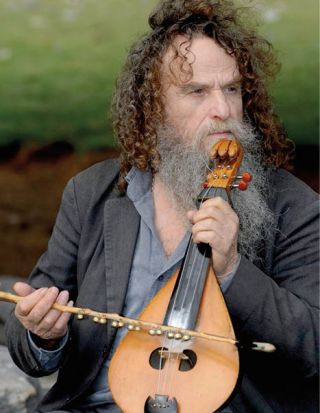
In a tavern in Heraklion, Psarantonis opens up about his life, his loves, and his unwaning passion for the Cretan lyra.
The interview was held in a tavern in Heraklion. We spoke for two hours. Initially Psarantonis was withdrawn, but later he opened up – we were also drinking raki. A friend who admires him had advised me: “Direct the conversation to the archetypes: life, love, death. Psarantonis is primitive, innocent.”
Why are you called Psarantonis? It’s a nickname. At Anogeia [a mountainous region within the prefecture of Rethymno, Crete] we all have nicknames. My grandfather was called this [‘Psarantonis’]. He was part of a group of 5-6 people who would go and steal from the Turks. He was the quickest. If they came across any Turks, he would move like a bullet and would catch them all, from the first to the last, ‘like fish’ [ψάρια]. So he got the name ‘Psarotourkos’ [Ψαρότουρκος] and from that came ‘Psarantonis’ [Ψαραντώνης]. It then stuck to the whole family: Psaronikos, Psarogiorgis…
How old are you? Tell them I’m 100! (laughs)
Did you go to school? Yes, I went to primary school. I learned to read and count.
When did you start playing music? From very young. At 10 I was playing the lyra and at 12-13 I was performing my own music.
At that age? How is that possible? It comes on its own. As you are walking it comes to your head and you take up the instrument. Is it something you produce immediately or slowly? It’s produced better slowly… Listen, I never play a piece the same way twice. Even if I were to play it immediately again it will not be the same. You dress it up one way the first time, a different way the next. You embroider it, you push it forward, you take it far. Music, my child, is miles long. Don’t listen to those who put dots on paper or those who read them.
Isn’t that music also? No, it’s not! The feelings of the artist can’t be put on paper. They can’t be sold, and they can’t be bought. Music is character. Can all the sheets of paper and all the pen markings go to make up a Nikos? [meaning his brother, Nikos Xylouris] Let these scholars take Nikos’ songs and learn them and sing them… These songs that are manly will be turned by them into…songs fit for a pansy! (laughs)
Do you know how to read music? Yes, I do. And so what? I don’t need them. Notes are what Karagiozis speaks of when he says, “Do re mi fasolada!” (bursts out in laughter) [φασολάδα: beans, a play on the solmization system of do re mi fa sol la ti]. I saw this as a little kid and I’ve never laughed as much.
What do you think of musicologists? They are full of hangups. Words, theories, slavishness to foreign trends, that which is good they don’t want.
Why don’t they want it? Because they can’t handle it. They are jealous of it because they can’t create it themselves. Before you go up on stage to play, do you do any preparations? I only tune the instruments. We then come out all together and we go wherever the stream leads us. I never say: “Lads, we will now play this piece.” They look to me to see what I’ve begun playing and then they come on board.
Have you ever done rehearsals? (laughs) No, they know what to do.
Wait on now, Psarantoni! How do they know? Well, we’ve been playing so long together. Sometimes I play a new piece and they don’t know it at all.
During a concert? Yes. I play the piece and they follow the rhythm.
Do you take notice of the audience below? Yes, I do take notice of the audience, because they play along with me. The way they listen, the way they applaud changes my performance.
Do you think of anything as you are playing? Of course I do! I notice that you close your eyes. Yes, I have my landscapes. I go to landscapes I like so that the music might turn out well. How can I explain it? We human beings have nothing, nature has it all. She is God. She gives birth to you, devours you, punishes you. She also gives us music. I stand opposite Psiloriti [Mount Ida, the highest mountain in Crete] for hours. And I come out with the lines: “On Psiloriti’s peak / the snow never ends / as soon as the old melts / it is buried with new.” I look at him and he would impart the music to me.
Where were you looking at him from? I was opposite, in Idaio Antro [a cavern, known as the Cave of Zeus, on Mount Ida], near my village. And you were sitting with your lyra and playing? Is it possible now to behold Psiloritis and play some trashy song? [Psarantonis uses the term ‘σκυλάδικο’, which refers to a genre of Greek folk music sometimes associated with disreputable nightclubs, and popularized by such artists as Vasilis Karras and Lefteris Pantazis.] He rebukes! He wants rizitika [ριζίτικα]: a type of song with a long history in Crete], he wants tragedy, he wants… …passion! Passion! You got it, lad!
In your sleep, in your dreams, do you ever hear music? Yes, of course. A melody once came to me in a dream and I got up and I put it together. And it’s a nice piece, called Air [Αιθέρας]… Does music ever frighten you? It certainly does. There are times when I wake up in a sweat. Music is a wild beast which cannot be tamed. Tell me 2 or 3 songs by others which you like. I like many songs by my brother, Nikos: Weaver [Ανυφαντού], Augusta [Αυγούστα], The Brave Man in Sfakia [Παλικάρι στα Σφακιά]…
source: Neos Kosmos





 STUDIO 3 NEWCASTLE AUSTRALIA