Category Archives: Uncategorized

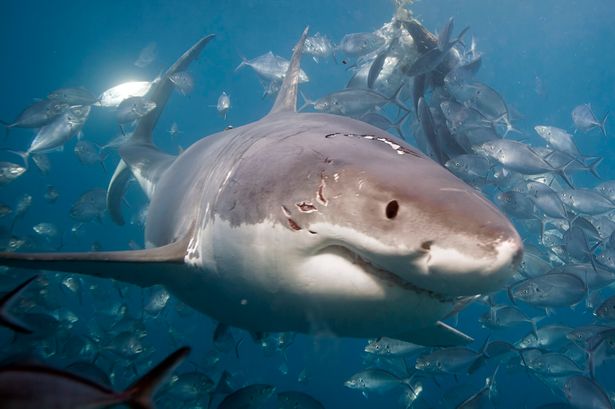
Jaws meets Scarface as shark feeding frenzy becomes a shocking underwater battle

A-great-white-shark-seen-with-wound-marks-of-jaws-near-the-Neptune-Islands-Australia

This battle-weary great white shark was dubbed “Scarface” after these dramatic pictures were taken off Australia.

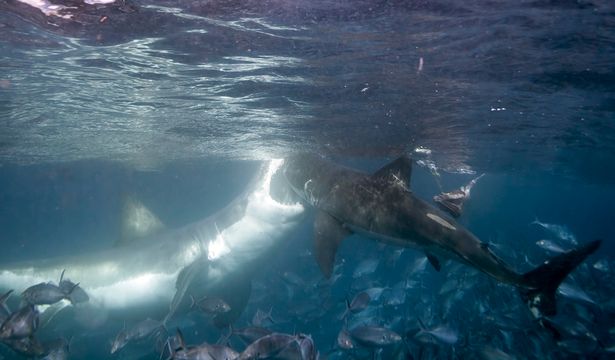
Two great whites clashed with each other to try and get the most food.

The younger shark had been attempting to “jump the queue” and feed on fish when a five metre female charged in at the same time.

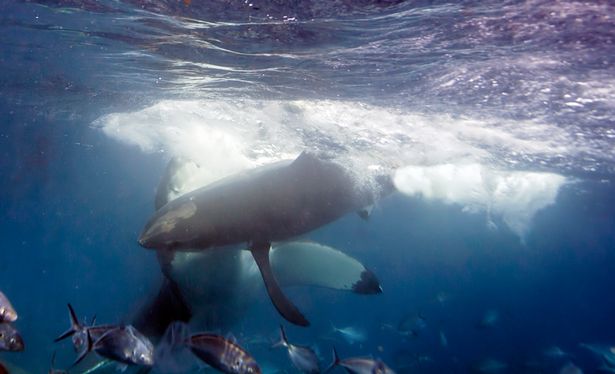
The older shark snatched the juvenile in her jaws – but instead of taking a chunk out of him, she simply spat him out before continuing her meal.

The underwater shots were captured by photographer Jason Whittle off the Neptune Islands.

He said: “It was definitely a warning not to jump the line and respect the elder, queen of the territory.

Two-great-white-sharks-collide-to-attack-each-other-in-the-Neptune-Islands-Australia

Terrifying clash: The older shark catches the juvenile in her jaws

Two-great-white-sharks-collide-to-attack-each-other-in-the-Neptune-Islands-Australia

Pecking order: The older, larger shark reminds the smaller one who’s boss

Two-great-white-sharks-collide-to-attack-each-other-in-the-Neptune-Islands-Australia

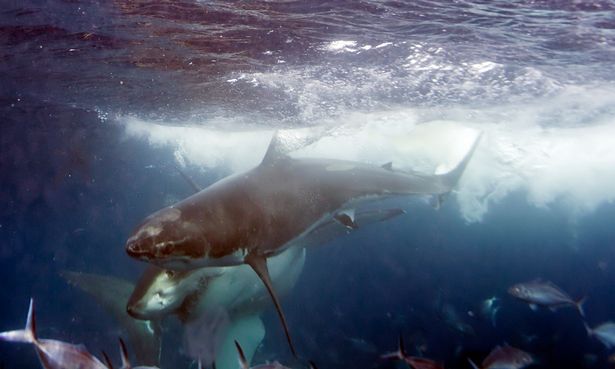
Beaten: The younger shark moves away from the confrontation

“With that much power she could have ended that smaller shark without any problems.

“But sharks don’t have hands to say ‘get out of the way’ so the next best thing is for them to open their jaws to show how big they are.”

Jason managed to capture the frames despite issues with his underwater camera housing and rough conditions inside the shark cage.

“It felt like I had waited three or four hours to get a shot,” he said, “but it was well worth the whole trip just for that one.”

source:mirror.co.uk

Greece debt crisis: Athens narrowly passes 2016 austerity budget

untitled

Greece’s parliament has narrowly approved a 2016 budget that includes more spending cuts and tax rises.

The new measures are required to unlock further funds from a third bailout deal worth €86bn the country agreed with its international creditors in July.

The budget was approved by 153 to 145 votes following a heated debate, with the opposition contesting that it was “socially unfair”. The centre-right New Democracy party’s interim leader Yiannis Plakiotakis described the budget as “anti-growth”. “They are getting ready to turn the pensions into tips,” he was quoted as saying by German broadcaster DW.

Prime Minister Alexis Tsipras, whose coalition majority shrank last month after two lawmakers rebelled against austerity, described the budget’s passage as a “difficult exercise”. “Behind the numbers anybody can see the agonising effort to support the working classes,” he said, pointing out that spending on hospitals, social welfare and job creation was being modestly increased for the first time in five years.

Painful austerity

The 2016 budget sets out €5.7bn in public spending cuts, with €1.8bn of that amount coming from pensions, and brings in some €2bn through tax hikes. It foresees Greece’s economy shrinking 0.7% in 2016. Public debt is expected to hit 188% of gross domestic product from 180% this year, while the unemployment rate is expected to remain steady at 25%.

Last month, Greek workers staged their first general strike since Tsipras’s far-left Syriza party came to power on an anti-austerity platform at the start of the year.

The prime minister called for snap elections in August after he faced down a revolt from his own party members, who saw the terms of the latest bailout deal as a betrayal of Syriza’s anti-austerity roots. He went on to win September’s general election, securing 35% of the vote.

Representatives from the European Union, the European Central Bank and the International Monetary Fund are due in Athens on 7 December to hold talks over implementing additional reforms to the country’s pension and tax systems.

source:ibtimes.co.uk

Cronulla rioters 10 years later speak of pride, regret, death: ‘I’m not ashamed’

1449386383796

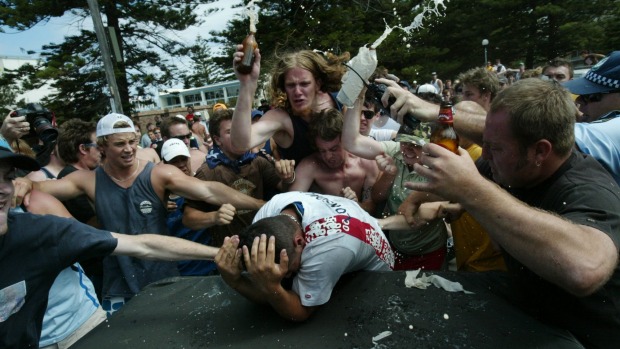
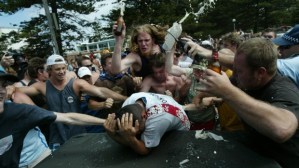
Geoffrey Atkinson, wearing a green shirt and camouflage cap, joins the mob of men attacking Safi Merhi during the Cronulla riots. Photo: Andrew Meares

It was the day that shamed a nation.

Photos now etched into history show beer and sweat flying as angry young men swing fists and bottles at a lone Middle Eastern man who cowers on the back of a ute.

A shirtless man jumps up and down on the bonnet of a police car. Others storm a train, draped in Australian flags as they attack a passenger before cheering with joy.

Ten years after the Cronulla riots, some of the men captured in the most defining images of the event have spoken for the first time.

“I was a drunk moron who attacked someone with a beer bottle. I’m 100 per cent ashamed of what I did but I’m not ashamed of the stance I took,” said Geoffrey Atkinson, now 28, a father-of-two who runs his own trucking business near Camden.

“I’m not ashamed of being there and if I could have just been one of the people standing on the fence, waving my little Australian flag, holding my can of VB, I would have been 100 per cent proud to talk about the Cronulla riots and tell my kids about it,” he said.

In recounting his memories for the first time Mr Atkinson, who was convicted for his role in the mob attack on Safi Merhi, said he believed the real story behind the events of that day were quickly lost to the enduring narrative of violence, racism and ugly patriotism.

After a morning surf at Cronulla, Mr Atkinson and his mates watched “waves and waves of cars” roll in, ready to “take back the beach”.

They bought 15 slabs of beer, filled the back of his ute with ice and were content playing football with the police and singing Waltzing Matilda until the alcohol set in and the crowd fired up.

“How do you not get caught up in it? I’m not blaming the drink but maybe if I was sober that day, maybe if I didn’t have 50 mates down there, it could have been different.”

Mr Atkinson said he was not racist. He was arrested on January 11, 2006 at his workplace, Habib Brothers Truck and Smash Repairs, and his Lebanese boss stood by him during his court case.

He had best friends who were Muslim, his then-girlfriend was Maltese, he grew up in Kemps Creek and went to school in Cecil Hills with students representing a virtual league of nations.

But, he said, problems with young Lebanese men at Cronulla, where he would surf every week, had been building for months. He said some of the men had claimed parts of South Cronulla rock pools as their own; others would talk rudely or spit at surfers as they passed.

Two weeks before a lifeguard was bashed by a group of young Middle Eastern men, Mr Atkinson and a friend were also bashed as they returned to their car from a morning surf.

When he received a text message about coming to “defend” Cronulla on December 11, 2005 he didn’t hesitate to forward the message on.

“There was no respect. They had a chip on their shoulder and they needed to be brought back down to reality,” he said.

“And for 5500 people to turn up, with no social media back then and no planning, this had brewed and brewed to the point where people were sick of it. They were like, ‘This has gotta stop’.”

He said the violence ended up becoming the story, rather than the grievances shared by 5500 people who, he recalls, came from across the state and from all backgrounds.

Mr Atkinson pleaded guilty straight away, keen to get his life back. He spent 29 days in a protective cell in jail, with a further eight months on parole. He had friends disown him, a $30,000 legal bill and a premier, Morris Iemma, who wanted to see him and other rioters rot in jail.

Today, he believes racial tensions are just as high, but he prefers to keep his head down.

“I don’t want to say I wish it didn’t happen because it needed to happen, I just wish I didn’t take the actions that I did,” he said.

Fairfax Media tracked down another 40 men who were arrested after the riot and subsequent reprisal attacks. Most were too ashamed to talk, having moved on and established businesses, families and steady lives.

One man, convicted of attacking three people when rioters stormed a train at Cronulla station, is now engaged to a Lebanese woman.

“I don’t need past skeletons destroying my own family’s future,” said another, now a fly-in fly-out miner.

For well-known Cronulla surfer Troy Dennehy, the shame was too much. He suicided two years after the riots, in which he was pictured jumping on a police car, an act for which he was given 350 hours of community service.

Dennehy, 35, had battled depression and could be unpredictable, especially when drinking, his friends said.

Despite publicly apologising to the Lebanese community for his role, he never got over the shame and the attention that his actions attracted, his friend Cameron Johnson told the St George and Sutherland Shire Leader in 2007.

He became bogged down in debt from legal fees and fines and his marriage to his Japanese wife fell apart.

Brent Lohman, captured in widely-run images of the train incident, still shares the photos on his Facebook page, alongside news from Reclaim Australia and groups such as “deport all illegal boat people” and “extremely pissed off Aussie infidels”.

When a protest against an anti-Muslim film turned violent in Hyde Park in 2011, he posted on his public page: “line em up and shoot em all… a beer per kill and a snitty at the barr [sic]”.

He told Fairfax Media he would only talk for a large sum of money because “what I have to say will upset a lot of people”.

Now living in Queensland, he claimed the train incident was set up by the media, although he still blamed it on “the wogs”.

“Ten years on and we’ve got a better chance of being blown to bits now than if people listened back then,” he said.

Of the 53 people arrested during reprisal attacks, at least one is in prison again. Mahmoud Eid, a 29-year-old Punchbowl plumber, spent 15 months behind bars for an unprovoked attack a day after the Cronulla riots.

He was again jailed in 2013 for kicking a police dog and punching a policewoman to the ground during the 2011 Hyde Park protest. He was a man who clearly struggled to “control his emotions [and] express his feeling passively”, his lawyer told a court at the time.

One of his co-accused, Mahmoud Omar, was embroiled in drama again when his brother, Mohammed “Tiger” Omar, was fatally stabbed in front of him during a fight on the dance floor at Homebush’s Beirut By Night restaurant in 2010.

Ali Ammar, who served seven months in jail as a 16-year-old for stealing an Australian flag from the Brighton-Le-Sands RSL and burning it, publicly apologised when he was released. He walked the Kokoda Track as a form of rehabilitation. .

Yahya Jamal Serhan, who served nine months in jail for being an accessory to a stabbing outside Woolooware Golf Club in the days after the riot, told Four Corners in 2008 that it was like “guerilla warfare” after years of “us versus them”.

“Like every time you go somewhere, you know, you think people are looking at you or think, you know, someone is going to spit in your food,” he told the program.

He declined to speak when contacted by Fairfax, except to say there should be limits to freedom of speech and “freedom to attack”.

Mr Atkinson said he believed the riot started to settle racial tensions in Cronulla.

One of the men swept up in revenge attacks in Maroubra agreed, although only because 200 Middle Eastern men fought back.

“They wanted the reply from us, they were goading it. Plus, if we didn’t reply, it would have been, like, a step down against our community,” he said. “We don’t take insults and we made that clear. That’s why I reckon it hasn’t happened again.” ​

source:smh.com.au

Children drive 35km for help after mother falls into well trying to save father overwhelmed by gas

imagesISQL0Y7Y

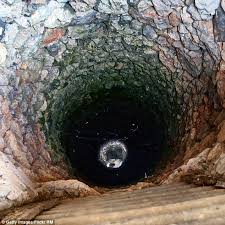
Two children drove 35 kilometres for help in remote New South Wales after their father inhaled gas while working in a well and their mother fell in trying to help him.

Police said the 29-year-old man was installing a water pump at the bottom of the well near Weilmoringle — about 225 kilometres north west of Lightning Ridge in north-western NSW — when he was overwhelmed by fumes, about 5:30pm on Saturday.

He died at the scene.

The man’s 28-year-old partner started climbing down the well to help, but fell about 30 metres after the rope ladder broke.

Police said the couple’s two children, aged 12 and 13, drove 35 kilometres to a nearby road, where they flagged down a passing driver, who phoned emergency services.

Superintendent Jim Stewart from the Castlereagh Local Area Command said the incident demonstrated the skills of people in the bush and their ability to survive.

“It’s a large property, the kids obviously have the skills and the knowledge to be able to drive a vehicle 35 or so kilometres to get help,” Superintendent Stewart said.

“But also to take people back to where they were too in such a panicked state, I can only imagine the panic the poor kids were in.

“If [the woman] had not been found, and certainly over time there could have been a very real chance that lady could have lost her life.

“Thanks to the response of those young boys, her children, I can only say how proud their mother would be of them and her family.”

NSW State Emergency Service, Fire and Rescue NSW, police and paramedics arrived and started a rescue operation.

The woman was rescued from the well about 1:00am on Sunday, eight hours after the ordeal began.

She was suffering shock and suspected carbon monoxide poisoning.

The mother was flown to Orange Base Hospital in a serious condition.

Police said they were not treating the incident as suspicious.

A report will be prepared for the coroner.

source:abc.net.au

Ολοκληρώθηκαν οι εκδηλώσεις Αδελφοποίησης μεταξύ Μελβούρνης και Θεσσαλονίκης

shsister3

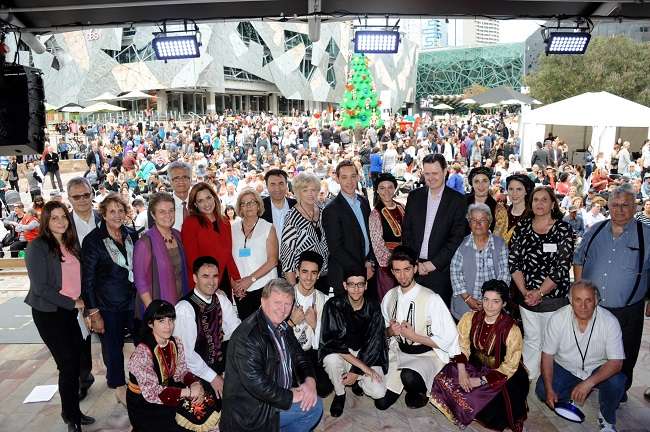
Οι επίσημοι μαζί με μέλη χορευτικών συγκροτημάτων. Φώτο: Κώστας Ντεβές

Στο Φεστιβάλ παρευρέθηκαν χιλιάδες κόσμου

Συνεχίζοντας το θεσμό τον οποίο θέσπισε η Ένωση Θεσσαλονικέων «Ο Λευκός Πύργος» για κάθε Νοέμβριο, ολοκληρώθηκε το Φεστιβάλ Αδελφοποίησης μεταξύ Μελβούρνης και Θεσσαλονίκης στις 29 Νοεμβρίου 2015 και το ετήσιο γεύμα στις 28 Νοεμβρίου.

Στο Φεστιβάλ παρευρέθηκαν χιλιάδες κόσμου, συμμετέχοντας έτσι στη διατήρηση και προώθηση της ελληνικής παράδοσης, καθιστώντας την 31η επέτειο επιτυχία.

Ο παραδοσιακός χορός, για μια ακόμη φορά, ξεκίνησε από το κτίριο του Δήμου της Μελβούρνης στις 1.30μμ. την Κυριακή με ζωντανή μουσική και περίπου 15 νέους και νέες ντυμένους με παραδοσιακές φορεσιές να ζωντανεύουν το Swanston Street της πόλης προχωρώντας προς την πλατεία του Federation Square.

Όταν στις 2.00μμ. περίπου έφτασαν στην πλατεία, ο χορός συνεχίστηκε για κάμποση ώρα, με τους παρευρισκόμενους να συμμετέχουν πιάνοντας χέρι-χέρι και γεμίζοντας χαρά τις ψυχές, εφόσον στο κέντρο μιας πόλης τόσο μακριά από την Ελλάδα διαδραματίζονται παρόμοιες σκηνές.

Ο επισκέπτης, εκτός από την κοσμοσυρροή, θα παρατηρούσε επίσης και τις ελληνικές σημαίες στημένες κατά μήκος του St. Kilda Road, απέναντι από τον φημισμένο σταθμό της Μελβούρνης Flinders Street.

Φέτος στην πλατεία αναρτήθηκε και ένα Χριστουγεννιάτικο δέντρο με κομμάτια Lego, το οποίο φαινόταν σαν να συμμετείχε κι αυτό στην αδελφοποίηση.

Η μεγάλη πίστα του Federation Square, η μεγάλη οθόνη, τα παραδοσιακά φαγητά κατά μήκος του ποταμού Yarra ολοκλήρωναν την ατμόσφαιρα.

Το Φεστιβάλ παρακολούθησαν η πρόεδρος της Επιτροπής Πολυπολιτισμού Βικτωρίας (Victorian Multicultural Commission), Ελένη Κάπαλου, και ο αντιπρόεδρος, Σπύρος Αλατσάς, ο υπουργός Πολυπολιτισμού, Robin Scott, η δημοτική σύμβουλος Μελβούρνης, Susan Reily, και άλλοι επίσημοι, όπως και το Δ.Σ. της Ένωσης Θεσσαλονικέων με επικεφαλής τον Παύλο Μαυρουδή, που εργάστηκε σκληρά για να ολοκληρωθούν με επιτυχία οι εκδηλώσεις.

Το πρόγραμμα, που παρουσίασε η Δρ Φύλια Γαριβάλδη, περιλάμβανε εκτός από τους χαιρετισμούς των επισήμων, παραδοσιακούς χορούς από τους Πόντιους, τους Λάκωνες, τους Μακεδόνες, τους Κρήτες κ.ά. αναγκάζοντας τον κόσμο να συμμετέχει με ζητωκραυγές και χειροκροτήματα.

Στην παραδοσιακή χοροεσπερίδα του Σαββάτου, 28 Νοεμβρίου, παρευρέθηκαν η Γενική Πρόξενος της Ελλάδας στη Μελβούρνη κ. Χ. Σημαντιράκη, η πρόεδρος του Γραφείου Πολυπολιτισμού Μελβούρνης Ελένη Κάπαλου και ο αντιπρόεδρος Σπύρος Αλατσάς, ο πρόεδρος της Ελληνικής Κοινότητας, κ. Βασίλης Παπαστεργιάδης, με την οικογένειά του και άλλοι.

Η χοροεσπερίδα έγινε στο χώρο του Normandy House, στο Thornbury, όπου η ορχήστρα «Unique Celebrations» έδωσε μια υπέροχη παράσταση ελληνικών τραγουδιών.

Προς το τέλος της βραδιάς συμμετείχαν στο τραγούδι, ο πρόεδρος της Ένωσης, Παύλος Μαυρουδής, και ο διευθυντής του Greek Media Group, Σπύρος Αλατσάς, ολοκληρώνοντας έτσι την επιτυχία της εκδήλωσης.

Πηγή:neos kosmos

Turkish PM denies expanding military operations in Iraq

2015-635849321565803679-580

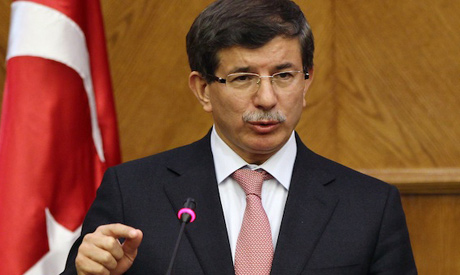
Turkey on Saturday denied that it has expanded its military activities in northern Iraq after it deployed troops close to an area controlled by the Islamic State group, a move blasted by Baghdad as illegal.

“The camp in Bashiqa, 30 kilometres (19 miles) northeast of Mosul, is a training facility established to support local volunteer forces’ fight against terrorism,” Prime Minister Ahmet Davutoglu said in a televised speech, denying reports that the deployment was in preparation for a ground operation against ISIS.

Turkish media reported that 600 Turkish soldiers backed by 25 tanks had been sent to the Bashiqa area near the city of Mosul, the Islamist group’s main hub in Iraq.

Iraq has called on Turkey to “immediately” withdraw forces, including tanks and artillery, deployed without Baghdad’s consent.

But Davutoglu said Saturday that the camp was not new and that training of Iraqis there had begun after a demand from the Mosul governor’s office and in coordination with the Iraqi defence ministry.

The Turkish prime minister added that more than 2,000 Iraqis had been trained at the camp for almost a year.

“We are ready to give any kind of support in line with Iraq’s national army and Iraqi police department’s demand,” the prime minister said.

Davutoglu described the military activity in the camp as a “routine rotation activity” and as “reinforcement against security risks” there, labelling any misinterpretation as a “provocation”.

“We have trained and will continue to train our Iraqi brothers in Basiqa and other camps in northern Iraq who are fighting against Daesh,” he said, using an Arabic acronym for IS.

Davutoglu said the two countries’ defence ministers spoke on the phone on Saturday, adding that the Iraqi minister would visit Turkey soon and that he would visit Baghdad himself in the near future.

“Turkey does not have an eye on any country’s soil. Turkey’s fight is against terrorist organisations,” he said, referring to ISIS and the outlawed Kurdistan Workers’ Party (PKK).

“The two friendly countries should be cleared from terrorist organisations in particular Daesh and the PKK,” he said, referring to Iraq and Syria.

source:ahram.org.eg

Newcastle:Elton John kicks off Australia tour in the Hunter Valley

untitled

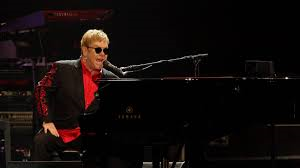
MUSIC legend Sir Elton John performed the first show of his Australian tour in the Hunter Valley last night.

Billed as the All The Hits Tour, the 68-year-old delivered exactly that during the two-and-a-half hour set at Hope Estate which featured classic songs including Bennie and The Jets, I’m Still Standing, I Guess That’s Why They Call It The Blues and Candle In The Wind.

Backed by a five-piece band which included Nigel Olsson (drums) and Davey Johnstone (guitar), who have both played alongside John for much of his 47-year long career, the show also featured heavily on the British star’s 1973 album, Goodbye Yellow Brick Road.

“We just celebrated the 40th anniversary of Goodbye Yellow Brick Road a couple of years ago and that makes me feel extremely old,” John told the crowd.

Performing under a dazzling 12 metre wide chandelier prop, John chatted with his audience throughout the set, speaking about his love of Australia and reflecting on his career, including a tribute to long-time collaborator Bernie Taupin who wrote the lyrics for many of his biggest hits, including Your Song which delivered one of the set’s highlight moments.

The audience sang along with John to anthems Rocket Man, Tiny Dancer and Don’t Let The Sun Go Down On Me, the latter of which he dedicated to Newcastle country music star and personal friend of John’s, Catherine Britt.

The hits kept coming as the show came to a close as John encouraged the audience to get on its feet to dance along to Saturday Night’s Alright (For Fighting), The Bitch Is Back and Crocodile Rock, proving that even after nearly 50 years in the game, Sir Elton still knows how to rock.

source:theherald.com.au

Rebetiko legend brought back to life on the silver screen

tsitsanis_1-thumb-large

It all started about five years ago, when a production company gave Manousos Manousakis a screenplay based on the novel “Ouzeri Tsitsanis” by Giorgos Skabardonis. The successful screenwriter, director and producer was not impressed. He did, however, discern a glimmer of potential and returned to the source, the book.

“Other than a good piece of literature, it’s a gold mine for a screenwriter,” says Manousakis. “It offered the possibility – by adding some things or shifting the narrative’s focus here and there – to take a simple love story and make it reflect today’s reality, to condemn racism, to reveal Nazism for what it is to those who don’t know and remind those who have forgotten.”

And so the journey began, with Manousakis and screenwriters Vassilis Spiliopoulos and Ada Gourbali working together with historians and people who experienced some of the more dramatic events from the period. Each added his or her own precious contributions to the wonderful mosaic that hit cinemas across the country on Thursday, December 3.

The story

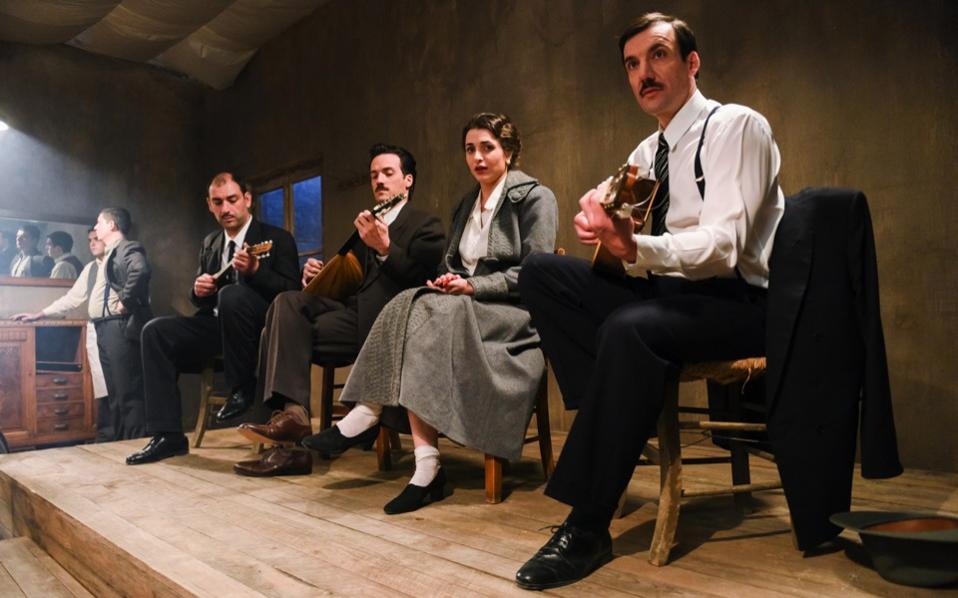
The story begins in Thessaloniki in 1943, shrouded in the heavy mantle of the Nazi occupation, with security battalions, hunger, arrests, execution and, of course, resistance, as the first trains start leaving for the death camps carrying the city’s Jews. Against this tragic backdrop, a forbidden love blossoms between Estrea, a Jew, and Giorgos, a Christian, accompanied by the sounds of Ouzeri Tsitsanis, a live music venue and taverna where rebetika master Vassilis Tsitsanis, then 28 years old, was in his creative prime, penning some of his most emblematic and lasting songs – including “Synnefiasmeni Kyriaki” (Cloudy Sunday). The song came to him at dawn as he left the taverna and saw traces of blood in the snow. He followed the trail and came upon the body of a young man. This scene is in the film: a powerful bond between the fiction of film and the real story.

“The protagonists are young people who are not much different from those today. Back then they were trying to build a life under the extreme conditions of the occupation, while today the situation is similar with the harsh conditions of the economic crisis,” says Manousakis.

The writer did not have any particular knowledge of the singer when he started the screenplay. “Of course I knew his songs but I hadn’t delved any deeper. Through the process of making the film I had the opportunity to get to know more about him and, more importantly, to understand the torment of the creative process he was defined by, just like any great artist.”

The cast

The director had no problem whatsoever in picking a cast for the film. He found his perfect Tsitsanis, Andreas Konstantinou, while watching Pantelis Voulgaris’s “Little England.”

“He didn’t even have to audition,” says Manousakis. “Andreas is creative, inquisitive and full of suggestions. And if you’re clever as a director and wring him dry, you can make miracles happen.”

Konstantinou worked hard on the part. He did a lot of reading, took bouzouki lessons, listened to all of Tsitsanis’s songs again and again, memorized his mannerisms from photographs and videos, and took in the details of the man.

“I don’t know if I identified with Tsitsanis. I tried to understand what it is like to be gifted with such a talent under those circumstances. What I saw was a man who was low-key, a man of action instead of words, a modest man and a perfectionist,” says Konstantinou.

Vassiliki Troufakou stars in the role of Lela, a young woman from a working-class background with an exceptional voice and beauty. Her desperate love for the unavailable Tsitsanis leads her into the arms of another man, a powerful and controversial character.

“Without calling her a saint, she’s a person who fights to the end. And the most charming thing about her is that she fights all her battles alone. I tried to put myself in her shoes and imagine what it meant for a woman at that time to be responsible for her ailing mother, without a male presence at her side, walking into a place that was all-male,” says the actress.

On the other side of the story, Dimitris Horn Award-winning actor Haris Frangoulis plays Giorgos, an active member of the resistance who leaves a secure future to open an ouzo joint with Tsitsanis at a time when the rebetika scene was very much the underbelly of society.

What the actor admires most about his character is his “immediacy, his sincerity and strength.”

Giorgos is in love with Estrea, played by first-timer Christina Hilla Fameli. What did she learn from the story told in the film? “That you can survive even the most tragic events, fear and prejudice, without closing your eyes, without losing your courage.”

The production

The numbers alone indicate the challenge of the endeavor: 60 actors, 2,500 extras, 6,000 period costumes, three months of shooting. What’s it like doing this kind of cinema, huge for Greek standards, and especially during the crisis?

Manousakis smiles. “Bliss! Especially when a problem was overcome,” he says. “You can’t imagine how much trouble we had with locations. We’ve demolished everything in this country, erased every trace of our historical memory. We built walls, we painted them and at night the kids would come by and scribble them with graffiti. We had to have a security guard on watch all night. In Thessaloniki alone we used 1,200 extras. In the train scene we had 700 and most were volunteers. Thessaloniki residents of all ages would come forward and offer to help. They would come and watch the shoots, take it in, cry. The film was a trigger for them to remember things from the past, the stories of their families.”

What are his predictions about the film’s fate?

“As a people we’ve started to appreciate our products, the cultural ones too. You saw what happened with ‘Little England’ and ‘Lobster,’” he says of two recent Greek film success. “So, yes, I’m optimistic!”

The film’s music is by composer Themis Karamouratidis and it was no easy feat because he had to write new material that would also evoke the era of the film, without it sounding “old” to the ears of younger audiences. He penned 27 original melodies, adaptations and new renditions of Tsitsanis songs that form a parallel yet equally fascinating narrative without overshadowing the story and action.

How close to Tsitsanis did he feel through this process?

“I can’t answer that,” says Karamouratidis. “I think it’s disrespectful to say that I feel I’ve come close to him. I would love to, of course, to come to a point where I can approach his elegant simplicity, the purity of his melodies, his sincerity.”

The CD with the “Ouzeri Tsitsanis” soundtrack, released by Feelgood Records, will be included in Kathimerini’s special Sunday edition on December 13. The special collectible CD will also include a rare recording to “Synefiasmeni Kyriaki” from the personal archive of the Tsitsanis family, performed by the great man himself, together with Eleni Gerani.
source:ekathimerini.com

Selling an American Dream: Australia’s Greek Cafe

comm_cafe%20lecture

A public lecture will be presented by documentary photographer Effy Alexakis and social historian Leonard Janiszewski

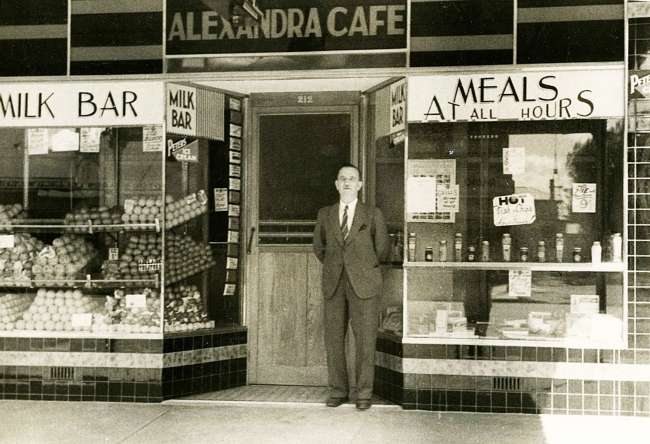
‘Selling an American Dream: Australia’s Greek Café’, will be supported by the Royal Australian Historical Society and the Australian Society for History, Engineering and Technology, is an opportunity to learn about Australia’s Greek cafés and milk bars as a significant global phenomenon in the modern era.

Greek-run cafés and milk bars populated Australian country towns and cities, merging local fare with new American food-catering ideas.

They subsequently contributed to a major change in not only eating habits, but cinema, music and architecture with the introduction of American sodas, ice cream sundaes, milkshakes, hamburgers, milk chocolate and hard sugar candies.

The two researchers will bring together 30 years of research from travels over four continents, and selected from more than 1,800 interviews and innumerable contemporary and historical photographs.

Cost of attendance is $10 per person.

Fore more information, visit http://www.rahs.org.au/evnt/rahsashet-lecture-selling-an-american-dreamaustrali… or contact Leonard Janiszewski on 0448 876 626 or (02) 9850 6886/7437.

When: Tuesday 8 December from 5.30 pm-7.00 pm

Where: History House, Royal Australian Historical Society, 133 Macquarie Street, Sydney, NSW

source:Neos Kosmos

Greek Australian woman racially attacked

racial%20attack%2001

Caucasian man tells Australian-born Greek to ‘get out of Australia’

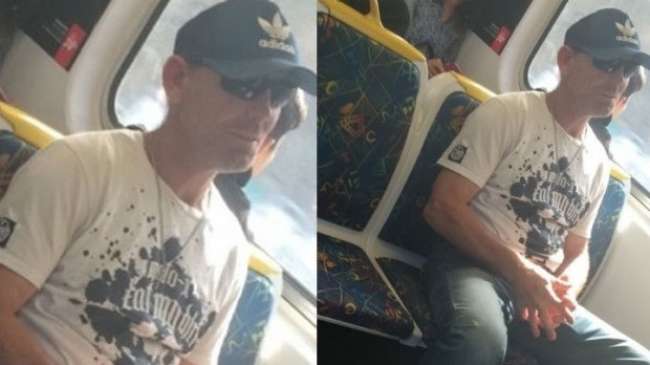
A Greek Australian woman was the subject of a racial attack on a Melbourne train this week.

Arna Dionysopoulos, 26, was on her way home from work on Wednesday afternoon, when a man described to be Caucasian, noticed her nametag.

The Age reported that the man then proceeded to tell her that she should “get out of Australia”, adding that he would love to put a gun to her and her father’s heads and pull the trigger.

The IT consultant, who was born in Australia to a Greek father and German mother, says that she initially didn’t realise the abusive comments were directed at her, as she considers herself to be as Australian as anyone else.

“It’s quite shocking that that’s what some people believe,” she told The Age.

“If you live here, you’re Australian.”

Ms Dionysopoulos’ attempts to ignore the abusive comments by reading her book however, were unsuccessful.

The man, who she says could have possibly been under the influence of drugs, continued to hurl abuse, and upon being told to calm down by a fellow commuter, claimed to have four knives on him.

The 26-year-old then disembarked the train at Footscray station ahead of her destination. Thankfully another commuter accompanied her, as they soon discovered the abuser had followed them.

Shaken by the incident, Ms Dionysopoulos quickly contact the police and reported the matter.

*The man is believed to be between 173cm to 183cm tall with a thin build, and unshaven. If you have any information regarding the incident, contact Crime Stoppers on 1800 333 000 or submit a confidential report via http://www.crimestoppersvic.com.au

source:Neos Kosmos