
AUSTRALIAN houses will remain some of the most expensive in the world, despite facing a decade of muted growth as wages struggle to keep pace with more subtle gains in property values.
“The combination of high house-price-to-income ratios and prices that are above the long-term average ratio relative to rents suggests that the potential for further increases in real terms is limited over the next decade,” said Ben Newey, director of ratings agency Fitch, adding that nations such as Britain and Canada faced the same outlook.
“Fitch expects affordability in Australia to deteriorate in the near term, with house prices continuing to rise more than income levels.”
In a global housing and mortgage report, Fitch said homeowners would this year experience gains of 4 per cent – less than half last year’s 9.8 per cent appreciation. Wages are growing at an annual rate of 2.7 per cent, the weakest in 16 years, according to the Australian Bureau of Statistics.
Economists said separate data yesterday showing declining consumer confidence revealed that soft income growth was starting to “overwhelm” the rally in assets such as stocks and property.
“Households are starved of income growth,” said Evans and Partners chief investment officer Michael Hawkins, pointing to weak job creation and low interest rates.
Amid record low demand, Fitch predicted first-home buyers would continue to get squeezed out of the market after the surge in buying from investors benefiting from “preferential tax treatment”.
Economist Saul Eslake recently lashed government grants and negative gearing for exacerbating a rising affordability problem after population growth outgrew new housing stock in the past decade.
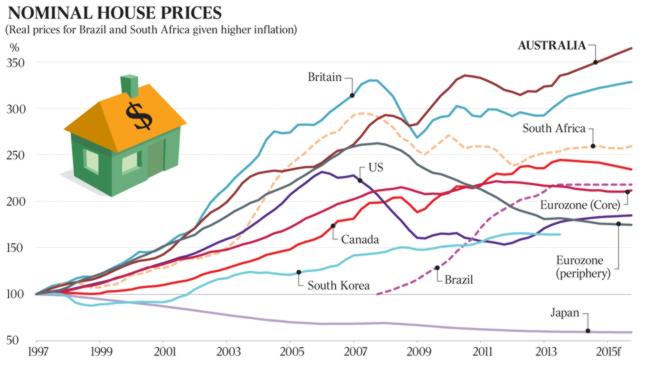
In nominal terms – not including inflation – Fitch found Australian house prices were the highest in the world, above Britain and Canada, and would retain the spot at least through to 2015.
Australian homes were second most expensive as judged by house prices to income, as they have been for the past decade.
Despite slower growth than before the global financial crisis, Fitch said property would be supported by continued, albeit slowing, economic growth, better affordability following the Reserve Bank’s rate cuts since 2011, and undersupply in some regions.
Sydney, Melbourne and Perth home values would likely rise further this year, while other cities “may remain flat”, Fitch said.
The rise in house prices was yesterday noted in the faster-than-expected pick-up in inflation in the final months of last year, reducing the chances of further rate cuts.
Analysts have expressed concerns of a brewing property bubble, particularly in cities such as Sydney, amid already record low interest rates.
Fitch said larger cities were not immune from the “consequences” of cyclical house price movements, despite typically experiencing above-average GDP, income, population and house price growth. “Longer-term average annual house price growth cannot excessively disconnect from incomes,” Fitch warned.
The global agency last week put the banks’ world-class credit ratings on notice, saying house price rises combined with a loosening of lending standards could prompt “negative” action.
source: theaustralian.com.au







 STUDIO 3 NEWCASTLE AUSTRALIA