Daily Archives: May 8, 2015

Mother of murdered child held in custody after facing magistrate

The mother of a 4-year-old girl allegedly killed by her biological father was remanded in custody on Thursday after telling an investigating magistrate that she had no involvement in the murder of her daughter, whom she had reported missing last month.

Authorities believe that while the 25-year-old was not directly involved in the murder of Ani Borisova, she had subsequently contributed to efforts made by her partner, the alleged killer, to avoid arrest.

The mother is facing charges of perjury and putting an infant at risk.

The child’s 27-year-old Bulgarian father, who has been in solitary confinement at a Corfu prison since Wednesday, on Thursday claimed in comments to a senior prison guard that he did not kill his daughter or mutilate and boil the pieces of her body.

“He told me he didn’t do it,” the prison guard, Manolis Koulouris, told the Athens-Macedonian News Agency.

“He said a friend of his did it in front of him, using the method that we’ve heard,” the guard said.

source:ekathimerini.com

Tsipras and Putin signal step forward on pipeline

Prime Minister Alexis Tsipras and Russian President Vladimir Putin discussed energy cooperation in a telephone conversation on Thursday during which the Russian leader expressed his readiness to finance a Greek company that will participate in the construction of a Russian pipeline that would carry natural gas to Europe, Tsipras’s office said.

The timing of the conversation was significant. It came as Gazprom announced that its Turkish Stream project, supplying Russian gas to Turkey, will start operating in December next year. It also came ahead of a scheduled visit to Athens on Friday by the US State Department’s envoy for international energy affairs Amos Hochstein who is expected to present Greek officials with American positions on energy strategy in the region.

According to a statement from Tsipras’s office, the premier confirmed Greece’s readiness to participate in the construction of a Greek pipeline to transfer Russian natural gas from the Greek-Turkish border to other European countries.

As for Putin, he “expressed his intention to support a plan to finance the Greek company that will build the pipeline which could attract energy and growth investments and whose cost could be covered by the company’s profits from operating [the pipeline].”

Tsipras’s office also announced that the premier will travel to Saint Petersburg on June 18-20 to participate in an international business forum and will meet again with Putin.

source: ekathimerini.com

Greece and Britain test the Union

Two very different countries are challenging the European Union’s cohesion and the outcome of this test will determine the future of the greatest experiment in democracy that the world has known. Britain, a former superpower, once said that the sun never set on its imperial domain, and it is still the EU’s second-largest economy; Greece, which has been plagued by bankruptcies since its independence, is the Union’s most troubled economy. Both present problems that demand a radical shift in the way that the EU has operated over the past decades, in order to protect all that it has achieved.

Whereas Greece’s need for its partners’ support stems from the country’s inability to reform its economy, public administration and political system so as to be a viable competitor in the global economy, Britain is putting similar pressure on the EU’s cohesion in the belief that it has to insulate itself from its partners, to safeguard what it considers its special advantages. The two countries’ political systems and economies are vastly different, as is their geopolitical stature. Greece has been an enthusiastic member of the EU since it joined in 1981 and is part of its inner sanctum, the eurozone. Britain has always been at pains to opt out from too much union, avoiding the euro and abstaining from Greece’s bailout. During the crisis, Greece has benefited from the support (with painful strings attached) of its partners, while Britain has gained enormously – from money fleeing the European periphery for what is seen as the safe haven of Britain, and from the Bank of England’s independence from the austerity dogma imposed on the rest of the EU.

Both Greece and Britain have contributed to the EU in their own unique way, and each one’s relationship with the rest of the Union also shows the great tension at the heart of every association: Even as every member needs the advantages provided by the group, each fears being absorbed by the others, to the extent that it loses its independence, its special characteristics and the freedom to exploit its differences to its own advantage. Greece cannot function without financial support, yet it also cannot accept the loss of independence that this entails; Britain, which has gained much from being “in and out” of the Union, is in danger of getting too far from the center of gravity. But a total break will leave it on its own, unable to influence EU policy.

In the EU the great question today is whether countries can place the common good above their national interest. The Greek elections in January intensified the push and pull between the country and its partners, with results that are still unpredictable. Whatever the outcome of Thursday’s election, Britain, too, will test the limits of membership and the Union’s cohesion. All players should remember two simple facts: Thanks to ever closer union, Europe has enjoyed 70 years of unprecedented peace and prosperity; pulling too hard can break any bond.

south:ekathimerini.com

Russia offers to help Greece in World War II claims investigation

Moscow is helping Greece in its investigation into possible Second World War reparations from Germany by providing access to previously unused archives.

Following a request by Alternate Defense Minister Costas Isichos, the Russian Embassy in Athens has provided Greek authorities with a list of the relevant archives, including documents, photographs and documentary footage.

Moscow’s move comes as the National Council for WWII Reparations from Germany has stepped up efforts to inform Greeks about its work. The group has put on display videos and posters explaining its work at 100 locations in Athens metro stations.

source:ekatimerini.com

Athens seeks nod from Eurogroup but officials skeptical

There is hope in Athens that Monday’s Eurogroup will bring a positive statement from eurozone finance ministers on the state of progress in talks between Greece and its lenders but European officials believe there is still a lot of work to be done over the next few days.

The Euro Working Group of technical experts is due to meet on Friday via teleconference to assess how far talks have advanced and what else needs to be done to move closer to an agreement. There is a wide range of issues that need to be resolved, including a new value-added tax rate, macroeconomic and fiscal targets, labor market reforms and pension cuts.

“I hope on Monday a sign of progress will be given and [eurozone finance ministers say] an agreement is visible,” Deputy Prime Minister Yiannis Dragasakis told the Guardian. “Talks, so far, have shown there is common ground in changes and political measures and, therefore, I believe a deal is possible and in the interests of everyone.”

However, government spokesman Gavriil Sakellaridis stressed during a regular press briefing that the SYRIZA-led coalition would not give in to all of the demands made by creditors.

“There should not be an expectation on the part of institutions… that the government will back down on everything,” he said. “When you negotiate, there should be mutual concessions. We won’t go beyond the limits of our red lines. It’s clear that we cannot cut pensions.”

The differences between Greece and its lenders over some key issues mean that officials in Brussels are skeptical about the possibility of the Eurogroup noting significant progress in talks when it meets on Monday. European Commission spokesman Margaritis Schinas said on Thursday that it is “premature” to discuss whether a common statement will be issued.

French Finance Minister Michel Sapin called for a “push toward a compromise” at Monday’s meeting. “We will not get there on the 11th but in the days that follow because it is absolutely necessary,” Sapin said.

Greek Finance Minister Yanis Varoufakis agreed action was quickly needed. “I trust that an agreement will be in the offing in the next days, mostly weeks,” he said at a business forum in Brussels.

source:ekathimerini.com

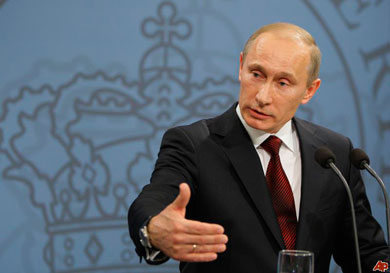
Putin says Russia ready to provide funds for Greece’s Turkish Stream extension

putin_390

Russian President Vladimir Putin told Greek Prime Minister Alexis Tsipras by phone on Thursday that Russia was willing to provide financing to Greek companies involved in a planned extension to the Turkish Stream gas pipeline project.

The Kremlin said in a statement that Putin had made similar assurances to Tsipras during the Greek leader’s visit to Moscow in April.

Tsipras’s office had said earlier on Thursday that the two had talked by phone but did not give any details of what they had discussed.

Russia started working on the Turkish Stream project after it abruptly abandoned the South Stream project in December, citing objections from Europe.

Russia’s Gazprom plans to supply up to 63 billion cubic metres (bcm) of gas per year via Turkish Stream and create a gas hub on the Turkish border with Greece, through which it wants to transit 47 bcm annually into countries in southern Europe.

Russia has been speculated about as a potential source of funding for Greece if it fails to reach a deal with European Union and International Monetary Fund lenders, but Athens has denied plans to turn to Moscow for help.

Athens is fast running out of money but a deal with European lenders has proved elusive so far.

source:ekathimerini.com

Tsipras, Juncker point to convergence on red lines

A store in downtown Athens pictured on Wednesday advertises its sales with a poster depicting Finance Minister Yanis Varoufakis and the words: “Wow!!! prices until the end of the negotiation.”

After fears of a new obstacle in ongoing negotiations between Greece and its creditors, a joint statement issued on Wednesday by Prime Minister Alexis Tsipras and European Commission President Jean-Claude Juncker pointed to a will to converge on contentious issues.

Tsipras and Juncker discussed the two major stumbling blocks in talks – pension system and labor sector reforms – and agreed on the need for an overhaul of the pension system and the creation of a “modern and effective collective bargaining system.” The statement said the two leaders “took stock of progress” in negotiations. But it remained unclear whether officials involved in those talks have started grappling with the thorny issues that must be resolved before creditors can unlock crucial rescue funding.

The move by the two leaders appeared to be aimed at appeasing tensions which peaked after Athens blamed the lack of progress in talks on divisions between the European Commission and the International Monetary Fund. Sources said Tsipras had been uncertain what approach to take vis-a-vis the creditors as some of his ministers had pressed for a hard line, including a possible refusal to pay Greece’s next installment to the IMF. Instead Tsipras’s office issued a non-paper accusing Greece’s creditors of “blatant inconsistency” that was undermining negotiations.

Responding to the dig from Athens, Greece’s creditors also issued a joint statement on Wednesday, saying that they “share the same objective of helping Greece achieve financial stability and growth.” “All three institutions are working hard to achieve concrete progress on May 11,” the statement added, referring to a Eurogroup meeting due to take place on Monday in Brussels.

Most European officials have said that a deal unlocking funding will not be reached then. The meeting could serve as a “platform” for an eventual accord with creditors, Finance Minister Yanis Varoufakis said during an official visit to Rome. A European official told Kathimerini that for this to happen the pace of progress in talks must speed up significantly over the next few days. “We’re not there yet,” he said.

One area where Greece appears ready to make some concessions is pensions. Alternate Social Security Minister Dimitris Stratoulis told Kathimerini that some changes are possible with early retirements and that funds may be merged but that this will not affect payouts. According to sources, creditors are insisting that Greece implements the zero deficit clause with auxiliary pensions, meaning that their shortfalls will no longer be subsidized by the state.

It remains unclear whether the concessions Greece appears ready to make will be adequate to win round creditors as state coffers run low. In a bid to secure a liquidity injection, Deputy Prime Minister Yiannis Dragasakis and alternate foreign minister Euclid Tsakalotos, who is coordinating Greek negotiations, held talks with European Central Bank President Mario Draghi on Tuesday. As expected, however, the ECB is not prepared to approve an increase in the amount of treasury bills that Greece can issue. At a meeting of its governing council on Wednesday, no decision was taken to increase the haircut on collateral provided by Greek banks in exchange for liquidity. What the council did do was to approve increasing emergency funding to Greek banks by 2 billion euros.

source:ekathimerini.com