Category Archives: Uncategorized

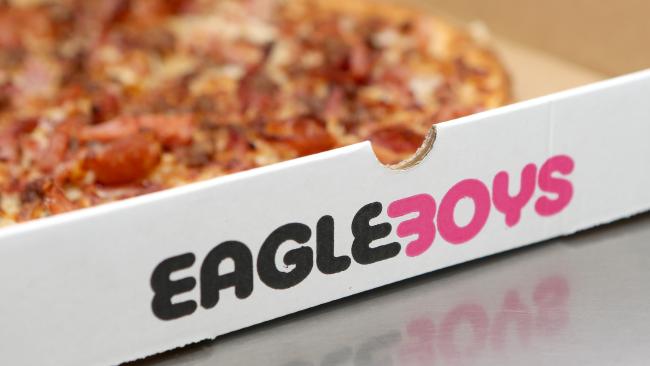
EAGLE Boys Pizza has collapsed into voluntary administration.

1780c4f2b8b2564ab60128084da9c674

The nation’s third-largest pizza chain behind Domino’s and Pizza Hut confirmed the news in a statement on its website on Friday afternoon.

“The Eagle Boys Dial-a-Pizza Pty Ltd (Eagle Boys) Board of Directors confirm the Australian Head Franchisor has been placed in Voluntary Administration as of Thursday evening 14 July 2016,” the statement said.

“This does not extend to franchisees — all Eagle Boys stores remain under the control of individual franchisees and will continue to operate normally.”

Administrators SV Partners have taken control of the day-to-day running on the business and will attempt to negotiate a sale.

“The administrators are in the process of identifying restructuring measures,” it said.

“Eagle Boys stores across Australia will continue to trade during this process. For Eagle Boys customers, franchisees, employees and suppliers it’s ‘business as usual’ while the administrators’ review is underway.

“The Eagle Boys national franchise remains on the market for sale.

“The Eagle Boys management team is looking forward to the prospect of growing the brand under new ownership and would like to thank Eagle Boys customers, franchisees and team members for their ongoing support during this time.”

The pizza chain has faced significant difficulties over the past five years. In 2014-15, nearly half of its stores closed down, dragging its market share from its estimated peak of 8.1 per cent in 2013-14 with 340 stores to 4.6 per cent in 2016-17, according to IBISWorld.

Domino’s has about 25 per cent market share of the $3.7 billion industry, with Pizza Hut lagging behind at 10.7 per cent.

Eagle Boys, caught in the middle of an aggressive price war between Domino’s and Pizza Hut, found itself unable to pay its debts. Fairfax last year reported that 30 Eagle Boys franchisees were considering taking legal action against head office.

Customer food traffic data by market research firm NPD showed Domino’s increased its traffic by 14 per cent last year, while visits to Pizza Hut collapsed 15 per cent, and Eagle Boys lost 7 per cent.

IBISWorld industry analyst Andrew Ledovskikh said the huge success of Domino’s versus its competitors highlighted how stores that failed to adapt to changing consumer preferences would suffer.

“Changing consumer trends have favoured premium and healthy food produce in recent years, to the detriment of traditional fast food outlets,” he wrote on Tuesday.

“This trend has played out in the pizza restaurant and takeaway industry, as Pizza Hut has struggled to maintain growth as smaller pizza store operators have increasingly offered premium produce. However, Domino’s Pizza has bucked this trend by making use of its extensive store network to focus on convenience.

“Instead of attempting to compete with premium pizza stores or add healthy options to its menu, the company has expanded its store network, which has grown by over 100 stores in the past five years, and focused on technology-related convenience.

“For example, Domino’s implemented an SMS ordering system and a 20-minute delivery guarantee in 2015, and trialled a 10-minute delivery guarantee in New Farm, Brisbane, in the same year.”

He added that the rise of online ordering platforms such as DeliveryHero, Menulog, Foodora and Deliveroo had allowed smaller restaurant and takeaway businesses to access a wider customer base and more effectively compete with larger food brands.

“However, these ordering platforms usually charge a percentage of the transaction as a fee to the restaurant operators, which can reduce profit margins for companies that use these services,” Mr Ledovskikh wrote.

source:news.com.au

A Greek on the Clinton ticket?

NFstavridis_wikipedia

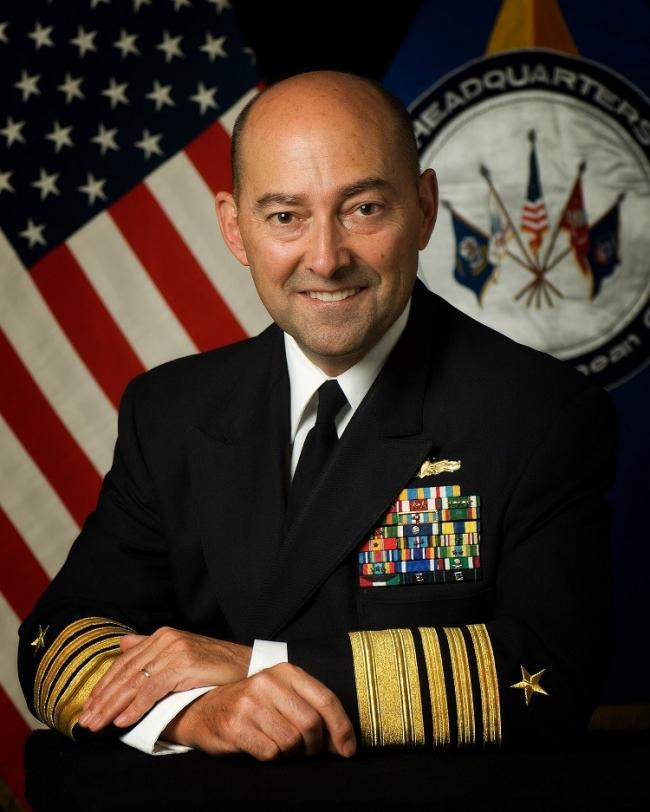
Hillary Clinton’s campaign is currently vetting retired Admiral James Stavridis as potential vice-president candidate

It’s been almost 30 years since a Greek name appeared in association with the higher ranks of American politics. Then it was Michael Dukakis, who lost the 1988 presidential elections to George H. W. Bush. Now it’s James Stavridis, who is said to have been vetted by the Hillary Clinton presidential campaign to be her running mate, as a candidate for vice president of the United States.

The news was broken by a handful of major news organisations, among them The New York Times and NBC News, claiming sources inside the Clinton campaign confirmed Stavridis’ name as a potential vice president.

According to The New York Times, “sources close to Secretary Clinton say she was always likely to have someone with military experience on her vice-presidential shortlist, and Mr Stavridis […] fits the description. James Stavridis is a retired four-star US Navy admiral who served as the 15th Commander, US European Command and NATO’s 16th Supreme Allied Commander Europe. In that role he oversaw operations in the Middle East — Afghanistan, Libya and Syria — as well as in the Balkans and piracy off the coast of Africa. He retired from the Navy in 2013 after 30 years of service; following that, he became Dean of the Fletcher School of Law and Diplomacy at Tufts University, the oldest school in the United States dedicated solely to graduate studies in international affairs. Stavridis himself earned a PhD and Master of Arts in Law and Diplomacy from the Fletcher School of International Relations in 1984, where he won the Gullion Prize”.

If he gets his name on the Clinton ticket, James Stavridis would be the first naval officer to ride to the highest offices in the US, but also the first Greek American since Dukakis to seek such an office. If elected, he’d be the first Greek American VP since Spiro Agnew, who served under the Nixon presidency (1969-1973).

Born in 1955 in West Palm Beach, Florida, he is the son of Shirley Schaffer and P. George Zafiris Stavridis. His grandparents were Pontian Greeks, raised in northeastern Anatolia, who emigrated to the United States.

Stavridis himself offers a more detailed account of his Greek refugee origins in his 2008 book Destroyer Captain: Lessons of a First Command.

“In the early 1920s, my grandfather, a short, stocky Greek schoolteacher named Dimitrios Stavridis, was expelled from Turkey as part of ‘ethnic cleansing’ (read pogrom) directed against Greeks living in the remains of the Ottoman Empire. He barely escaped with his life in a small boat crossing the Aegean Sea to Athens and thence to Ellis Island. His brother was not so lucky and was killed by the Turks as part of the violence directed at the Greek minority,” he wrote.

Further in the book, he describes a NATO exercise off the coast of modern Turkey as the “most amazing historical irony [he] could imagine,” which prompted him to write of his grandfather: “His grandson, who speaks barely a few words of Greek, returns in command of a billion-dollar destroyer to the very city – Smyrna, now called İzmir – from which he sailed in a refugee craft all those years ago.”

source:Neos Kosmos

Remos to sing for the elite

imagesY1MO994Z

The singer’s annual performance in Mykonos’ lush seaside restaurant ‘Nammos’ sparked controversy, the moment the ticket prices were revealed

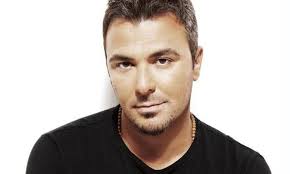
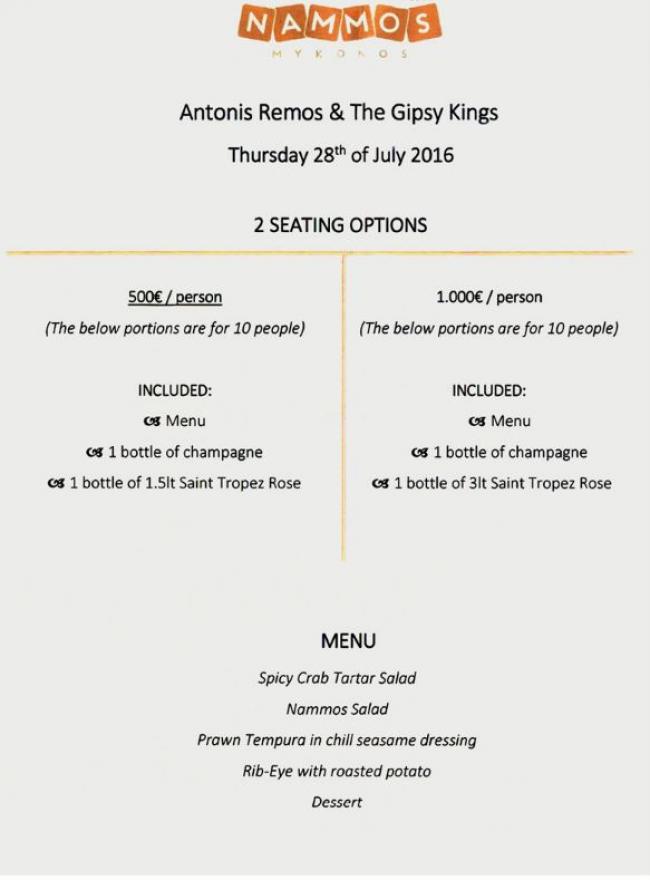
How much would you pay to see Antonis Remos? Apparently, the answer depends on the location. Tickets to his recent Melbourne show sold at $69, $89, $99 and $110. But in order to see him perform at Nammos, the famously lush seaside restaurant in Mykonos, one should expect to fork out at least €500 ($729). Granted, the price includes a five-course meal (crab salad, prawn tempura, rib-eye steak, dessert), a bottle of champagne and a 1.5lt bottle of Rose Wine. For double the price (i.e. €1000/ $1460), there’s a 3lt. bottle of wine on offer for the 10-party company – because, it has to be noted that these two options are not tailored per person, but per table, accomodating up to ten patrons, so there are parties that will be charged either €500 or  €1000, regardless of how many will be actually sitting on the table and sharing the bill. It should also be noted that the entertainment is not limited to the popular Greek singer, as the event, which will take place on Thursday 28 July, features another act billed along; world music perennial favourites Gipsy Kings, whose songs “Bamboleo”, “Djobi Djoba” and their cover of “Volare” were very popular in Greece – in the late 1980s.  

Even so, this price is far from seeming even remotely close to what one would think as “value for money”. But this does not preoccupy the patrons of Nammos, who are flocking to see Remos live in what is now an annual event. The concert is tailored to the tastes and habits of a small elite of Greek and international businessmen, celebrities and socialites, notoriously spending as though things are “business as usual” in Greece. Past events were reported as being poor excuses of tasteless extravagance, with drunk patrons engaging in food wars – with thousand dollar worth of lobster as ammunition.

NFremos

If such behaviour is seen as a hubris in a country where 40% of the population lives in poverty and in which one in two young people have no prospect of finding employment, some argue that in a free country and in a free economy, people can spend their money as they please, provided they pay their taxes. But it has been reported that this same elite that glaringly participates in these events, comprises of infamous tax-avoiders and businessmen who have declared bankruptcy, all the while ensuring their personal fortunes in tax havens around the world. And it was Antonis Remos himself who added insult to injury, when in 2014, while performing for the same crowd at the same place, he seized the opportunity to make a speech against the ‘foreign-inflicted austerity’ that has crippled Greece. Who knows what he has to say this time round. 

source:Neos Kosmos

Disastrous Battle of Fromelles remembered

untitled

Barbara Martin says her father didn’t talk about the Great War and it was only by reading his letters after he died that she realised the horrific experience he went through.

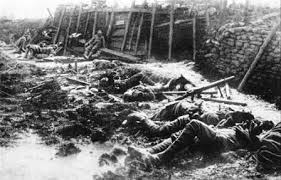
That included surviving the disastrous Australian action at Fromelles on July 19, 1916 – the worst day in Australian military history.

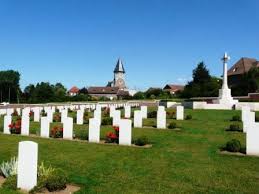
The 82-year-old Ms Martin was at the Pheasant Wood War Cemetery in the northern French village on Monday on the eve of a commemorative service marking the centenary of the 14-hour battle that cost more than 1900 Australian lives.

It was the first major action involving Australian troops on the Western Front in World War I and the Australian death toll was almost a quarter of that lost over eight months at Gallipoli.

Ms Martin, from Camberwell in Victoria, said it really hit home when she walked the ground where her father fought and was injured during the Australian offensive against well-prepared German defenders.

Her father lost an arm in later fighting and after he died in 1978 at the age of 88 the family found a letter to his brother describing the battle at Fromelles and instructing him not to show it to their mother.

“It was a very graphic letter of what happened, the slaughter that occurred,” Ms Martin told AAP.

“He described it with great feeling, the men who were coming back crying for their mothers.

“He said physical wounds will heal but these wounds won’t.”

She said she hadn’t realised how much empathy and understanding he had, given that the war appeared to have added “a bit of hardness and lack of emotion” to him.

At Fromelles, Australian troops advancing against experienced German troops alerted to the attack were cut to pieces by shellfire and mowed down by machine-gun fire, with no real gains made.

The Pheasant Wood cemetery was the first created by the Commonwealth War Graves Commission since World War II after a graveyard of 250 mainly Australian troops was discovered in the area in 2009-10 and their remains recovered and reburied.

Of those, the remains of 149 Australian soldiers have been identified thanks to personal items found and DNA testing involving living relatives.

Tuesday’s commemorative event will include the rededication of six headstones at the cemetery following the latest identifications.

Commission spokesman Peter Francis was involved in the recovery and told AAP that as archaeologists carefully removed the bodies it was clear they had been carefully buried by the Germans.

“They hadn’t been thrown into these graves, they’d been buried by their German foes side by side, certainly with some reverence.

“It was something that really touched me, it broke down the statistics of the battle and gave it a human face.”

Mr Francis said the artefacts recovered during the excavation included personal items such as good-luck charms and French phrase books including such terms as ‘Don’t shoot, I’m an Australian”.

“One thing that had us all in tears was a return train ticket, which one soldier tucked into the rubber bit of his gas mask.

“It was a return ticket from Fremantle to Perth and of course that young man never got to use that ticket.”

source:news.com.au


The successful Greek Australians of Queensland

papadakis1018

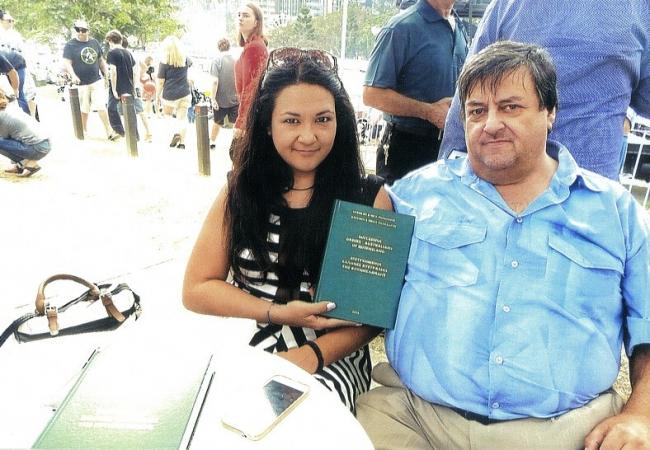
Co-authors, (R-L) Vasiliki and Nick Papadakis.

A book documenting and celebrating the stories of 148 Greek Australians across the sunny state

It’s no secret that Australia is home to a number of successful Greek Australians, and journalist Nick Papadakis has made it his mission over the last three decades to ensure that they are honoured and remembered.

In 1987 he released a book on the Successful Greek Australians of Victoria, followed by an equivalent for those in NSW in 1992, and this time around it’s Queensland’s turn.

“Through this project, the aim is for the next generations to be able to see what the first comers from Greece in Australia have done, and to know how they educated their kids, acquired property, and everything else the Greeks have done in Australia,” Mr Papadakis told Neos Kosmos.

A self-funded project, his criteria for compiling Successful Greek Australians of Queensland was simple; at the end of each interview he would ask his subject who they identified as being a successful Greek Australian, which led to an impressive database to work with.

“When I had three matches or more, I would contact them. So the people in the book chose the rest of the people,” he explains.

The book, which features 148 Greek Australians across the sunny state, is predominantly made up of first and second generation migrants, with their stories delving into how they ended up living Down Under, their back stories revealing the intimacy of their lives.

“We also found a few third and fourth generation, and the first comers were in the 1900s. So they told us as much as they could about their great-grandparents, which was probably the most interesting part; learning about who the first ones were,” tells Mr Papadakis.

Officially launched last month at Brisbane’s Greek Club, the event was opened by Honorary Secretary of the Greek Consulate in Brisbane, Tsambico Athanasas.

A four-minute video was projected, showing the Patris on one of its many trips of the 1960s from Piraeus Port to Australia, before Professor of Ancient Greek Bob Milns took to the floor to speak about the impressive contribution Greeks have made in Australia.

Vasiliki Papadakis also addressed those gathered, having worked alongside Mr Papadakis on the project as a co-author.

She praised the book as ‘a university of life’, having had the chance to meet a number of highly-qualified people through the experience, who despite adverse circumstances managed to thrive and excel.

“Through your true stories, I felt the emotion – sadness, happiness, affection, love and respect. For all these feelings, I want to tell you that it was an honour to get to know you and to understand the true meaning of Australia’s Hellenism,” she said.

To purchase Successful Greek Australians of Queensland, contact Nick Papadakis directly on 0410 383 535.

Source:Neos Kosmos

UK MPs introduce bill to return Parthenon Marbles to Greece

Mark-Williams-MP-by-LIberal-Democrats

Welsh Liberal Democrat MP Mark Williams. Photo: The Welsh Socialist Democratic Party.

Led by Welsh Liberal Democrat MP Mark Wiliams, the motion might pave the way for a historic turn of events

A brief history of the Parthenon Marbles Looting
The ancient temple – arguably the most important standing monument of classical Greece – had stood intact as a functioning building for centuries, but was ruined during the siege of Athens in 1687, when Francesco Morosini, captain-general of the Venetian forces, used a cannon on the site, which was used as a munitions store by the Ottomans. The explosion caused the marble roof, most of the walls, 14 columns from the north and south peristyles and carved metopes and frieze blocks to collapse, scattering ruined artwork which could be easily grabbed by looters. Morosini himself tried to remove large sculptures, but the device used broke, dropping them downhill and breaking them into pieces.

The most notorious looter was Thomas Bruce, 7th Earl of Elgin and 11th Earl of Kincardine, who served as ‘Ambassador Extraordinary and Minister Plenipotentiary of His Britannic Majesty to the Sublime Porte of Selim III, Sultan of Turkey’ between 1799 and 1803. In this capacity, in 1800, he commissioned skilled artists and modellers to make drawings and casts of the ancient monuments of Athens.

In 1801, Lord Elgin received a controversial firman from the Porte which allowed his agents not only to ‘fix scaffolding round the ancient Temple of the Idols [the Parthenon] and to mould the ornamental sculpture and visible figures thereon in plaster and gypsum’, but also ‘to take away any pieces of stone with old inscriptions or figures thereon. Due to the loss of the original firman, it isn’t sure that the translation is correct, though an existing original Italian translation dispels the claim that this is an official document by any means.

It is now believed that Lord Elgin bribed local Ottoman authorities into permitting the removal of about half of the Parthenon frieze, 15 metopes, and 17 pedimental fragments, in addition to a caryatid and a column from the Erechtheion, upon his departure from the Ottoman Empire in 1803. Lord Elgin’s agents performed excavations on the site, retrieving sculptures, but the actual removal was a decision taken on the spot by Philip Hunt, Elgin’s chaplain (and temporary private secretary, i.e. representative, in Athens), who persuaded the voivode (governor of Athens) to interpret the terms of the firman very broadly.

The excavation and removal went on after Lord Elgin’s departure and was completed in 1812; it cost him about £70,000. At first, he used the antiquities to decorate his mansion in Scotland, but later on, as his fortune waned, he tried selling them to the British Museum, to no avail. Then, on 11 July, 1816, the House of Commons granted the purchase of the ‘Marbles’ by Great Britain for £35,000, considerably below their cost to Elgin, and deposited them in the British Museum. Many opposed the British parliament thus sanctioning the improper removal, not least among them Lord Byron, who deemed Lord Elgin a “vandal”.

Talks for the return of the ‘Parthenon Marbles’ to Greece began in the aftermath of the creation of the modern Greek state, to limited support. A consistent campaign for the return of the ‘Parthenon Marbles’ to its rightful place has been ongoing for decades, becoming the official Greek government stance since 1983, when then Minister of Culture Melina Mercouri committed to the cause.

After the opening of the new and widely acclaimed Acropolis Museum in Athens, which hosts most of the original sculptures (they are replaced on site with high quality replicas, for fear of further corrosion), the campaign has gained momentum. Supporters of the cause seem to think that the time has come for the Parthenon Marbles to return to Greece – and the ongoing crisis has only augmented the voices of support, as this is regarded as something that would boost the economy.

The full text of the draft legislation is as follows:

Parthenon Sculptures (Return to Greece) Bill

CONTENTS
1 Return of the Parthenon Sculptures
2 Amendment of the British Museum Act 1963
3 Other artefacts
4 Short title and commencement

A BILL TO Make provision for the transfer of ownership and return to Greece of the artefacts known as the Parthenon Sculptures, or Elgin Marbles, purchased by Parliament in 1816; to amend the British Museum Act 1963 accordingly; and for connected purposes.

BE IT ENACTED by the Queen’s most Excellent Majesty, by and with the advice and consent of the Lords Spiritual and Temporal, and Commons, in this present Parliament assembled, and by the authority of the same, as follows:

1 Return of the Parthenon Sculptures
(1)Ownership of the collection of artefacts known as the ‘Parthenon Sculptures’, or the ‘Elgin Marbles’, is transferred to the government of the Hellenic Republic, subject only to subsections (2) and (4).

(2)The artefacts comprising the collection in subsection (1) shall be determined by the Secretary of State by regulation.

(3)Before making a determination under subsection (2), the Secretary of State must consult—
(a)the Trustees of the British Museum,
(b)representatives of the Government of the Hellenic Republic, and
(c)any other person, body or institution that the Secretary of State believes to be appropriate.

(4)Subsection (1) has effect on the coming into force of an agreement between the Government of the United Kingdom and the Government of the Hellenic Republicin which terms are agreed relating to—
(a)arrangements for the suitable transportation of the collection determined under subsection (2);
(b)responsibility for the costs of such transportation;
(c)arrangements and conditions for the maintenance and display of the collection; and
(d)access to the collection for:
(i)experts
(ii)students, and
(ii)members of the public.

(5)The power to—
(a) make regulations under subsection (2), or
(b) enter into an agreement under subsection (4)
is exercisable by statutory instrument which may only be made after a draft of the instrument has been laid before, and approved by a resolution of, each House of Parliament.

2 Amendment of the British Museum Act 1963
(1)In section 5 of the British Museum Act 1963 (disposal of objects), after subsection (4) insert—
“(5)Nothing in this section may be interpreted as applying to an artefact that—
(a)has been determined to be part of the collection under section 1(1) of the Parthenon Sculptures (Return to Greece) Act 2016, or
(b)is under active consideration by the Secretary of State for determination as to whether or not the artefact is part of that collection.”

(2)In section 9 of the British Museum Act 1963 (transfers to other institutions) after subsection (1) insert—
“(2)Nothing in this section may be interpreted as applying to an artefact that—
(a)has been determined to be part of the collection under section 1(1) of the Parthenon Sculptures (Return to Greece) Act 2016, or
(b)is under active consideration by the Secretary of State for determination as to whether or not the artefact is part of that collection.”

3 Other artefacts
Nothing in this Act shall be interpreted as applying to any artefact forming part of a collection within a national museum or gallery other than the artefacts mention in section 1.

4 Short title and commencement
(1)This Act may be cited as the Parthenon Sculptures (Return to Greece) Act 2016.

(2)This Act comes into force on the day after the day on which it receives Royal Assent.

Source: Neos Kosmos

Juventus bring B-team to Australia

1468788035365

Italian champions Juventus have spared 13 players the trip to Australia for the International Champions Cup following their European Championship exploits.

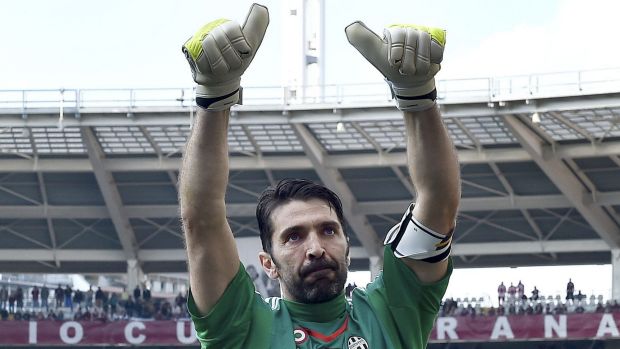
Italy skipper Gianluigi Buffon and France midfielder Paul Pogba are among those given an extended break by the Serie A giants, thus missing their two Melbourne dates this month.

It means Argentina striker Paulo Dybala, on-loan Moroccan defender Medhi Benatia and Bosnian midfielder Miralem Pjanic will spearhead their side for matches against Melbourne Victory (July 23) and Tottenham Hotspur (July 26) at the MCG.

The absences are not surprising given the taxing schedule of Juve players over the last 12 months.

From the club’s first pre-season match in July 2015 through to the end of the European Championships this month, seven Italian internationals were eligible for 71 matches for club and country.

Giorgio Chiellini, Simone Zaza, Andrea Barzagli, Leonardo Bonucci, Stefano Sturaro and Claudio Marchisio – have stayed home following their involvement in France.

So too have German midfielder Sami Khedira, Croatian striker Mario Mandzukic, Swiss captain Stephan Lichtsteiner and France left-back Patrice Evra.

New signing from Barcelona Dani Alves will also not travel according to Juventus’ website.

With 13 players, including Bayern Munich two-year loanee Kingsley Coman, in action at Euro 2016, Juventus provided more players than any other club.

They will still provide a stern test for Victory and English Premier League Tottenham – who finished third last season – their highest spot since 1989/90.

Dybala, 22, scored 23 goals for Juventus if his first campaign for the club and is widely considered to be one of the next global superstars of the sport.

Pjanic returns to Melbourne in black and white stripes after turning out last year in the red and gold of Roma.

JUVENTUS SQUAD FOR INTERNATIONAL CHAMPIONS CUP

Alex Sandro, Asamoah, Audero, Benatia, Blanco, Cerri, Coccolo, Del Favero, Dybala, Hernanes, Kastanos, Lemina, Lirola, Loria, Macek, Marrone, Neto, Padovan, Parodi, Pereyra, Pjanic, Rosseti, Rugani, Severin, Vitale.

source:smh.com.au

MH17: Malaysia Airlines reaches settlement with families

untitled

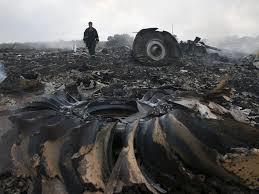
Amsterdam: Malaysia Airlines has struck a deal to settle damages claims for most victims of its MH17 flight that was shot down over eastern Ukraine two years ago, Dutch national broadcaster NOS has reported.

NOS cited Veeru Mewa, a lawyer representing Dutch victims.

Under the Montreal Convention, airlines must pay damages of up to about $A189,366 to victims’ families, regardless of the circumstances of a crash.

All 298 passengers and crew, including 27 Australian nationals, were killed when the Malaysia Airlines flight was hit, with a report from the Dutch Safety Board saying it was brought down by a Russian-built missile fired from an area where Russian separatists were operating.

Foreign Minister Julie Bishop said earlier this week – ahead of yesterday’s two-year anniversary of the disaster – that the federal government was committed to ensuring families received justice.

Eight Australian families, including lead applicant Perth woman Cassandra Gibson, whose mother Liliane Derden was among those killed on the plane, have filed a class action against Malaysia Airlines

“I am very aware of the poignancy of this date and the grief it will continue to bring for families of those who were killed in this incident, Ms Bishop told reporters.

“The Australian government will continue to do all we can to hold those responsible for this atrocity to account.”

The government was awaiting the findings of the joint investigation taskforce, of which Australia is one of five countries involved, Ms Bishop said.

“It has been thorough, it has been done with integrity and I look forward to reading the detail of it,” she said.

“We can then determine what steps, what action we can take in the interests of finding justice for those who were killed and for their families.”

Source:smh.com.au

Fromelles disaster remembered 100 years on

imagesZ8JYEPIX

A hundred years ago next Tuesday, Australian soldiers launched their first major attack in France, a disastrous action which left almost 2000 dead for no gains whatsoever.

This was the Battle of Fromelles, now regarded as the worst day of Australian military history.

From the evening of July 19, 1916 Australian troops attacked German lines, held a small section overnight and were expelled, with casualties of 5533, including 1917 dead and 470 prisoners.

For some people today, the connection is more immediate – it was their DNA which has allowed identification of 150 Australian soldiers whose bodies were found in mass graves on the Fromelles battlefield in 2008. Another 100, mostly Australians but some British, remain unidentified.

Fromelles will be marked by significant commemorations.

In France, a service for re-dedication of headstones of the recently identified will be held at the Pheasant Wood Military Cemetery at 1pm (France time) on July 19.

That’s followed by the main national commemorative service at 5.15pm (France time) at the VC Corner Cemetery and Memorial where more than 400 Australians killed in this battle are interred.

Services will be broadcast live on the ABC.

The Australian War Memorial will mark this tragic initiation to war on the Western Front at the Last Post Ceremony on July 19.

That will recall the lives of Privates David and Colin Barr, brothers from Melbourne who enlisted together, joined the AIF’s 60th Battalion and participated in the Battle of Fromelles.

David Barr, 25, was hit and died in no-man’s land, his body never recovered. Colin Barr, 19, was struck by a shell fragment and died in hospital in England more than a month later.

Of more than 800 men in the 61st Battalion at the start of the battle, just four officers and 61 soldiers were present at the subsequent roll call.

source:news.com.au

Melbourne weather: Victorians wake to frosty morning with more wild weather forecast

1468357748339

Unstable weather patterns continue Wednesday. Road and wind warnings are in place for tomorrow’s icy airflow across Victoria. Vision courtesy Seven News Melbourne.

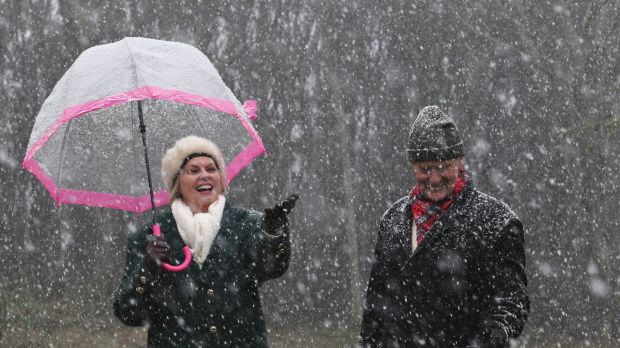
Temperatures have plummeted across Victoria and winds have picked up, leaving the state freezing and wild on Wednesday morning.

Winds of about 90km/h have thrashed bayside suburbs, and paramedics attended two crashes in which trees fell across over the road overnight.

A car hit a tree on Seven Mile Road at Nar Nar Goon just before 5am Wednesday morning, the female driver was flown to hospital in Melbourne with head and back injuries after she was trapped in her car for an hour.

Eight hours earlier a man was injured when his car hit a tree on the Murray Valley Highway at Koetong, he was taken to Albury Base Hospital in a stable conditions.

“Paramedics urge drivers to take care and adjust their driving to the conditions, given the potential for fallen trees, black ice and snow on the roads,” an Ambulance Victoria spokesperson said.

By 6am Wednesday, Melbourne was at its minimum of 5 degrees – while Frankston was at 6.7 degrees – though it felt like -4 degrees.

source:theage.com.au