
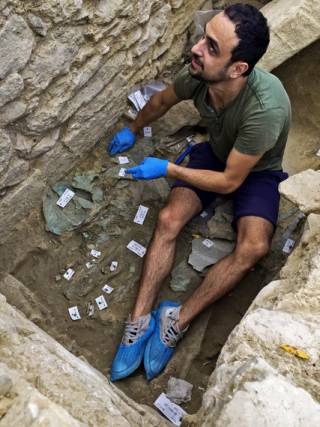
Alex Zokos, a conservator, removed a bronze jug at the site. Photo: Department of Classics/University of Cincinnati
One of the richest graves unearthed in Greece
Archaeologists digging at Pylos, an ancient city on the southwest coast of Greece, have discovered the rich grave of a warrior who was buried at the dawn of European civilization.
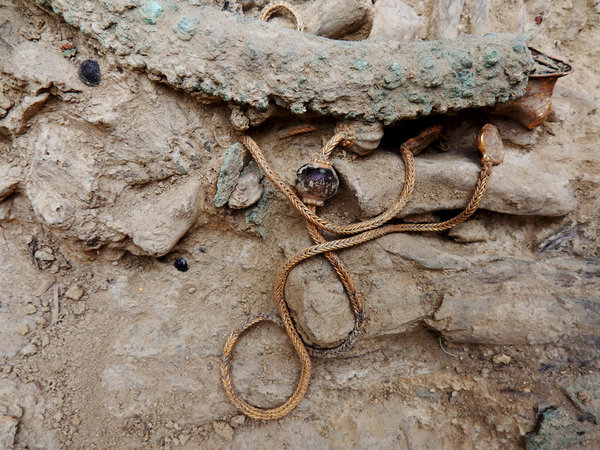
He lies with a yardlong bronze sword and a remarkable collection of gold rings, precious jewels and beautifully carved seals. Archaeologists expressed astonishment at the richness of the find and its potential for shedding light on the emergence of the Mycenaean civilization, the lost world of Agamemnon, Nestor, Odysseus and other heroes described in the epics of Homer.
“Probably not since the 1950s have we found such a rich tomb,” said James C. Wright, the director of the American School of Classical Studies at Athens.
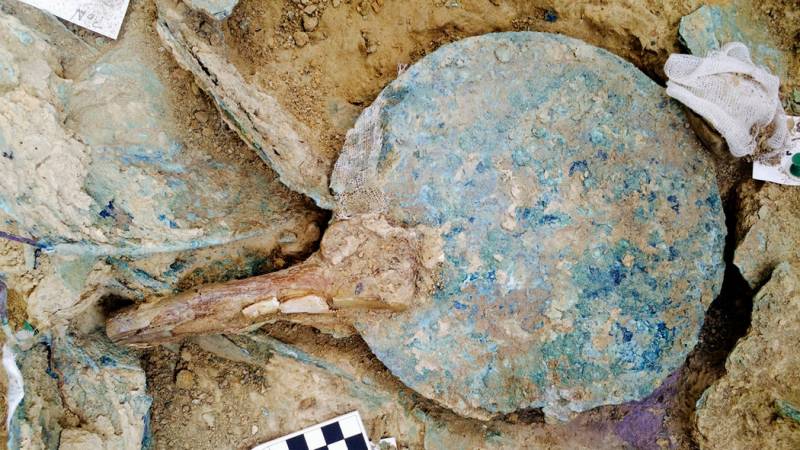
A bronze mirror with an ivory handle found in a grave of a warrior at Pylos in Greece.
Seeing the tomb “was a real highlight of my archaeological career,” said Thomas M. Brogan, the director of the Institute for Aegean Prehistory Study Center for East Crete, noting that “you can count on one hand the number of tombs as wealthy as this one.”
The warrior’s grave belongs to a time and place that give it special significance. He was buried around 1500 B.C., next to the site on Pylos on which, many years later, arose the palace of Nestor, a large administrative center that was destroyed in 1180 B.C., about the same time as Homer’s Troy. The palace was part of the Mycenaean civilization; from its ashes, classical Greek culture arose several centuries later.
The palaces found at Mycene, Pylos and elsewhere on the Greek mainland have a common inspiration: All borrowed heavily from the Minoan civilization that arose on the large island of Crete, southeast of Pylos. The Minoans were culturally dominant to the Mycenaeans but were later overrun by them.
How, then, did Minoan culture pass to the Mycenaeans? The warrior’s grave may hold many answers. He died before the palaces began to be built, and his grave is full of artifacts made in Crete. “This is a transformative moment in the Bronze Age,” Dr. Brogan said.
The grave, in Dr. Wright’s view, lies “at the date at the heart of the relationship of the mainland culture to the higher culture of Crete” and will help scholars understand how the state cultures that developed in Crete were adopted into what became the Mycenaean palace culture on the mainland.
Warriors probably competed for status as stratified societies formed on the mainland. This developing warrior society liked to show off its power through high-quality goods, like Cretan seal stones and gold cups — “lots of bling,” as Dr. Wright put it. “Perhaps we can theorize that this site was that of a rising chiefdom,” he said.
The grave was discovered this spring, on May 18, by Jack L. Davis and Sharon R. Stocker, a husband-and-wife team at the University of Cincinnati who have been excavating at Pylos for 25 years.
The top of the warrior’s shaft grave lies at ground level, seemingly so easy to find that it is quite surprising the tomb lay intact for 35 centuries.
“It is indeed mind boggling that we were first,” Dr. Davis wrote in an email. “I’m still shaking my head in disbelief. So many walked over it so many times, including our own team.”
The palace at Pylos was first excavated by Carl Blegen, also of the University of Cincinnati, who on his first day of digging in 1939 discovered a large cache of tablets written in the script known as Linear B, later deciphered as the earliest written form of Greek.
Whether or not Blegen’s luck was on their mind, Dr. Davis and Dr. Stocker started this season to excavate outside the palace in hope of hitting the dwellings that may have surrounded it and learning how ordinary citizens lived. On their first day of digging, they struck two walls at right angles. First they assumed the structure was a house, then a room, and finally a grave.
“I was very pessimistic about this,” Dr. Davis said, thinking that the grave was probably some medieval construction, or that even if it was prehistoric it would almost certainly have been robbed. But a few days later, he received a text message from the supervising archaeologist saying, “I hit bronze.”
source:neos kosmos







 STUDIO 3 NEWCASTLE AUSTRALIA