
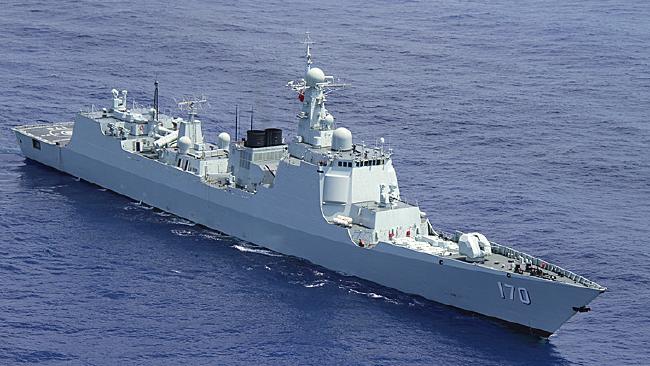
Armed response … The Chinese navy destroyer PLAN Lanzhou, above, is one of two warships deployed in response to the US destroyer USS Lassen passing close to Chinese artificial islands in the disputed South China Sea. Source: mil.cnr.cnSource:Supplied
CHINA has summoned the US ambassador in Beijing to protest the presence of a warship in what it claims as its national waters, and has deployed two of its own destroyers to counter further ‘incursions’.
The US Navy warship sailed past one of China’s artificial islands in the South China Sea yesterday, in a challenge to Chinese sovereignty claims that drew an angry protest from Beijing, which said the move damaged US-China relations and regional peace.
Vice Foreign Minister Zhang Yesui has summoned US ambassador Max Baucus to lodge a formal protest over the issue.
China’s Foreign Ministry said authorities monitored and warned the USS Lassen as it entered what China claims as a 12 mile (21km) territorial limit around Subi Reef in the Spratly Islands archipelago, a group of reefs, islets, and atolls where the Philippines has competing claims.
“The actions of the US warship have threatened China’s sovereignty and security interests, jeopardised the safety of personnel and facilities on the reefs, and damaged regional peace and stability,” the ministry said on its website.
“The Chinese side expresses its strong dissatisfaction and resolute opposition,” the statement said.
Chinese media is this morning reporting two of its own warships have been sent to waters near Subi reef to confront any further ‘trespassing’.
The guided missile destroyer Lanzhou and the patrol vessel Taizhou will enforce China’s sovereignty on the area and deter any further ‘illegal’ activity’.
“This action by the United States threatens China’s sovereignty and security interests, endangers the safety of personnel and facilities in the reef, and harms regional peace and stability,” the state-owned People’s Daily reports.
China says virtually all of the South China Sea belongs to it, while Brunei, Malaysia, the Philippines, Taiwan and Vietnam claim either parts or all of it. Since 2013, China has accelerated the creation of new outposts by piling sand atop reefs and atolls then adding buildings, ports and airstrips big enough to handle bombers and fighter jets.
WAR OF WORDS
The US Obama administration has long said it will exercise a right to freedom of navigation in any international waters.
“Make no mistake, the United States will fly, sail and operate wherever international law allows, as we do around the world, and the South China Sea is not and will not be an exception,” Defense Secretary Ash Carter said earlier this month.
A Chinese Foreign Ministry statement said China adhered to international law regarding freedom of navigation and flight, but “resolutely opposes the damaging of China’s sovereignty and security interests in the name of free navigation and flight.”
“China will firmly deal with provocations from other countries,” the statement said, adding that China would continue to monitor the air and sea and take further action when necessary.
Chinese Foreign Ministry spokesman Lu Kong said such actions by the US might end up spurring further advances in Chinas defence capabilities.
“If any country wishes to disrupt or impede China’s reasonable, justifiable and lawful activities on our own territories by playing some little tricks, I would advise these countries to cast off this fantasy,” Lu said.
Indonesia’s president called last night for all parties to exercise restraint and for China and Southeast Asia’s regional bloc to start discussions on the substance of a code of conduct to manage tensions there.
Widodo, who met President Barack Obama on Monday, said Indonesia supports freedom of navigation but also underlined his nation’s neutrality.
“Indonesia is not a party to the dispute but we have a legitimate interest in peace and stability there. We call on all parties to exercise restraint and refrain from taking actions that could undermine trust and confidence and put at risk the peace and stability of the region,” he told the Brookings Institution think tank.
The Association of Southeast Asian Nations, or ASEAN, and China have made little headway in the past decade on negotiating a binding code of conduct in the South China Sea, which is a major conduit for world trade.
INTERNATIONAL CONCERN
US ally the Philippines welcomed the move as a way of helping maintain “a balance of power.”
Navy officials had said the sail-past was necessary to assert the US position that China’s man-made islands cannot be considered sovereign territory with the right to surrounding territorial waters.
Speaking to foreign correspondents in Manila, Philippine President Benigno Aquino III said he supported the US naval manoeuvres as an assertion of freedom of navigation and as a means to balance power in the region.
“I think expressing support for established norms of international behaviour should not be a negative for a country,” he said. “I think everybody would welcome a balance of power anywhere in the world.”
FACING OFF
Beijing’s response closely mirrored its actions in May when a navy dispatcher warned off a US Navy P8-A Poseidon surveillance aircraft as it flew over Fiery Cross Reef, where China has conducted extensive reclamation work.
A Defense Department official, who spoke on condition of anonymity to discuss the USS Lassen’s movements, said the patrol was completed without incident. A Pentagon spokesman, Navy Cmdr. Bill Urban, declined to comment.
International law permits military vessels the right of “innocent passage” in transiting other country’s seas without notification. China’s Foreign Ministry, though, labelled the ship’s actions as illegal.
The US says it doesn’t take a position on sovereignty over the South China Sea but insists on freedom of navigation and overflight. About 30 per cent of global trade passes through the South China Sea, which also has rich fishing grounds and a potential wealth of undersea mineral deposits.
China says it respects the right of navigation but has never specified the exact legal status of its maritime claims. China says virtually all of the South China Sea belongs to it, while Brunei, Malaysia, the Philippines, Taiwan and Vietnam claim either parts or all of it.
ROUGH WATERS AHEAD
State Department spokesman John Kirby said Monday the US would not be required to consult with other nations if it decided to conduct freedom of navigation operations in international waters.
“The whole point of freedom of navigation in international waters is that it’s international waters. You don’t need to consult with anybody,” Kirby said.
The South China Sea has become an increasingly sore point in relations with the United States, even as President Barack Obama and China’s President Xi Jinping have sought to deepen cooperation in other areas.
Despite those tensions, exchanges between the two militaries have continued to expand, with a US Navy delegation paying visits last week to China’s sole aircraft carrier and a submarine warfare academy.
source:news.com.au







 STUDIO 3 NEWCASTLE AUSTRALIA