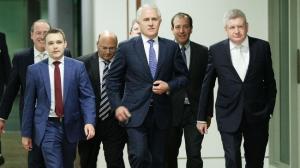
On a cool Sunday evening five weeks ago, Malcolm Turnbull pulled up in his Volvo station wagon and followed a path to the front door of a large home in Queanbeyan set on a bush block. He rang the doorbell, then crossed the threshold to his destiny.
It was September 13 and inside the house, just a 15-minute drive from Parliament House in Canberra, a group of MPs from the Left and Right wings of the Liberal Party had gathered — focused activists now — to discuss a leadership spill to sever Tony Abbott from the prime ministership.
This was the penultimate moment. It was a final opportunity to weigh up numbers, test assumptions, refine a cascade of scenarios, consider the danger points and count — yet again — those who were certain to vote for Turnbull, those likely to vote for him and those who would vote for Abbott. In between lay uncertainties, but the scales had tipped irrevocably towards the removal of Abbott. They had the numbers now.
Turnbull was in striking distance of a dream that had shaped his life for decades.
The gravity of the situation weighed heavily in the air. All in the room were sombre. But they were pragmatists and this was a night for practical decisions. They were preparing to intervene brutally in a democratically elected government with an ambush against Australia’s 28th prime minister.
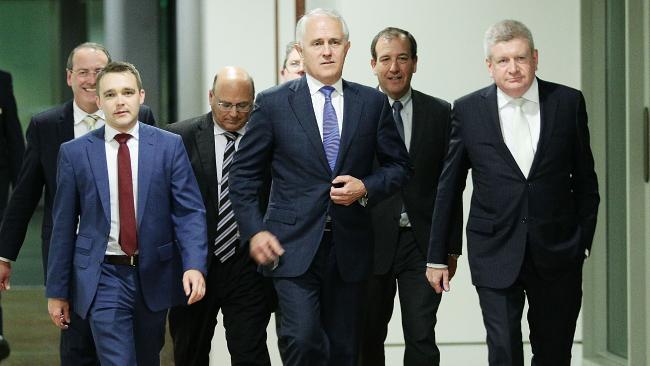
Sharing the light supper on the table that night at the home of Peter Hendy, local member for Eden-Monaro, were eight men: Turnbull; Hendy; Arthur Sinodinos, a leader in the campaign to remove Abbott from power who had long ago lost faith in the PM; James McGrath, a Queensland senator, key numbers man and one-time Tory campaign adviser in Britain who had been close to Turnbull for years; senator Scott Ryan, once a bitter Turnbull detractor who had now lost faith in Abbott; senator Mitch Fifield, a dry from Victoria who had resigned from the frontbench in 2009 in protest against Turnbull’s position on climate-change policy and had voted against a spill motion for the leadership in February; and Queensland MPs Mal Brough and Wyatt Roy, both of whom had backed the spill motion in February — the first step in the eight-month march by Abbott to the edge of the cliff.
When the group parted that night they had crossed the Rubicon. They had weighed every possibility, they had plans and back-up plans; they had tested the numbers, once, twice and thrice. Those among them who had wanted to rush in earlier had been forced to wait; those with more cautious voices were now prepared to move.
Turnbull himself would mull his future late into the night, talking to confidants. By morning, he would be ready to begin the attack to remove Abbott in a stunning coup. Like a man wearing night-vision goggles in daylight, the prime minister would not see it coming.
The following evening, Monday, September 14, by a shocking vote of 54-44, Abbott was slain. Backbenchers, frontbenchers and ministers voted against him just two years after his election as prime minister.
At 9.49pm — against the noisy roar of media with the announcement of new Prime Minister Turnbull — it might have been possible to hear a pin drop, deep inside the Liberal Party psyche.
How the tables turned
Just a year earlier, even acolytes of Turnbull had rated his chances of a comeback to the Liberal leadership as hovering around zero. Some had joked that he might get to be PM if he joined the Labor Party. But the tables had turned. Turnbull, the man once labelled as never a team player, had recalibrated himself after years in the wilderness of his own personal convictions. Abbott, the conservative inheritor, had been destroyed.
Twenty-four hours later on the Tuesday night, at a small private dinner in an anteroom to the prime minister’s office, Abbott, defeated, held court. It was steak, salad and a cake dessert. Everything was drenched with Abbott’s anger. The group included Abbott and his chief of staff Peta Credlin, treasurer Joe Hockey, Trade Minister Andrew Robb, Finance Minister Mathias Cormann, Immigration Minister Peter Dutton, workplace minister Eric Abetz and defence minister Kevin Andrews.
The rage was focused on those whom Abbott and Credlin believed had betrayed him. Credlin was incandescent. As they combed through their suspicions of betrayals — of this person and that one — she produced her phone to reveal a message she said she had received the previous Thursday at 1.43pm from education minister Christopher Pyne, a long-time Abbott supporter who Credlin believed had been shifting in the shadows. The message advised Credlin to get Robb to take some time off. That day, Robb had robustly defended the China free-trade agreement in parliament, accusing the opposition of engaging in xenophobic racist activities over jobs. He had called one member a goose.
“You need to send Robb away next week. He looked like he was going to keel over today,” Pyne texted.
Now, amid all the destruction, Credlin regarded this as a highly loaded message. Robb had in recent years revealed his battle with depression — and successful treatment — bringing it into the light to assist others.
Credlin showed her phone to Robb: was this part of a strategy to get him out of Canberra ahead of a leadership challenge? Robb, back in February, had been “out there” defending Abbott during a wildcat motion to spill the leadership.
Robb, who had his own fears about whether Abbott’s position was sustainable, was stung. He raised another story. On the previous Friday, a day after Credlin received the message from Pyne, Robb himself had received two separate phone calls from colleagues he regarded as friends. Both had used similar words, suggesting he take time off in the week ahead.
Abbott and Hockey, seeing the text message on the phone, were furious. They all believed Robb had been targeted to get him out of Canberra before the vote.
Had they phoned Pyne to ask for an explanation, he might have called it a crazed conspiracy theory. He was entitled to look out for a colleague. But such was the paranoia in the room — after all, the prime minister had been removed and it was still dawning on Abbott how orchestrated the move against him had been.
Late on the Monday night after the spill, Pyne also had sent another message — this time with commiserations to Credlin and Abbott. “I put every fibre of my being into Tony’s leadership and prime ministership,” he texted. “So I am distressed. I feel so very sorry for Tony and you.”
Suspicions would get Abbott and his dinner companions nowhere, but it fuelled anger on the night and in the weeks after, as Abbott darkly took to radio airwaves to talk about dirty water under the bridge.
After the horrible years of Labor knifing successive prime ministers, Abbott had now been dumped two years after leading his party to victory. So deep was the sentiment against him that colleagues such as Victorian senator Ryan — who had voted for Abbott against Turnbull in 2009, publicly backed Abbott in the February spill and advocated support on repeated radio interviews, plus had a bad history with Turnbull — had become a key player to remove the prime minister.
The answer to all this lay with Abbott.
There was no one single moment. But if Abbott’s obsession with matters wholly irrelevant or insulting to much of the population — such as the reintroduction in March last year of knights and dames and the show stopper 10 months later of a knighthood for the Queen’s husband, Prince Philip — had prompted derision, then it was Abbott’s focus on these things while losing any coherent economic narrative and crushing the autonomy of even the most senior ministers in his government that brought despair to his colleagues.
There had been a budget emergency, followed by a line that everything was under control. There had been a truckload of money for Abbott’s extravagant pet project for paid parental leave and slashes to other programs.
A culture of leaking
Abbott’s own office became a byword for leaking against his government. Across the length and breadth of his ministry and his backbench, there were few MPs who did not have a story of discovering that things were leaked against them behind the scenes. It bred not a collegiate whole but a lot of angry colleagues. That leaking, the steel grip on even the tiniest staff decisions in outer offices, and a culture of blame and punishment, rightly or wrongly were laid at the door of Abbott’s chief of staff, Credlin.
One close supporter of Abbott summed up the mood recently, saying privately, “I heard a bit about things being said about me, leaks against me from the PMO. The number of cabinet ministers now telling the rest of us about leaks against them — well, sometimes people were blamed by the PMO for leaking from committees they were not even on.”
By the time of his removal in September, there was barely a member of Abbott’s government, including his closest supporters, who did not believe he had lost the confidence to operate without Credlin.
If there was one overarching, final loyalty from the prime minister, it was to his chief of staff. She had become almost a first lady, accompanying Abbott to everything from private dinners at the New York home of Rupert Murdoch to private snow-skiing holidays with Abbott and his daughter Frances. The chief of staff was the one introduced to foreign leaders. She interrupted to answer questions others put to Abbott, ruled the strategy, and used her power and intellect to barricade his office against the outside. His colleagues came to see their relationship as impenetrable and toxic for the government. But Abbott had empowered Credlin and, in the end, it was Abbott’s call. He gave her free rein. He called his colleagues sexist for challenging her.
Yet the strategy and decision-making around Abbott was so disastrous that this first-term Liberal prime minister was open to an assault by Turnbull, once a loathed and failed opposition leader from the Left of a naturally conservative party. If Credlin was Abbott’s best weapon, then she was also his worst. The proof was there to be seen in the vote of 54-44 on the night of September 14 that swept him out.
The twinned theme of Abbott’s downfall, his failure to create a strong, cohesive economic narrative, mindful of John Howard’s axiom that Australians wanted to feel relaxed and comfortable, came down to both Abbott and Hockey.
Almost as though the election campaign had never happened, Abbott and Hockey fashioned a first budget with a string of measures that promised to make life harder for many in need. Abbott, like a robot with no new script, defended himself by invoking the mantra that he had stopped, or would stop, the boats.
When MPs left for Christmas last year, many were angry. There was talk of a reshuffle. Nothing could break the grip of Credlin. Nothing, it seemed, could assist Hockey to develop, maintain and communicate a clear and coherent message about the national economy. The party was seething about both Hockey and Credlin. Yet both, under Abbott, were safe.
By January, Abbott, hearing drums, was phoning around, calling backbenchers to ask what the problems were. One MP recounted to colleagues later that when he had told Abbott what he thought was wrong on the policy front — the planned GP co-payment, the age pension indexation cut, soldiers’ pay, Abbott swore at him.
By February, the problems around Abbott had exploded to the point that he faced a motion to spill the leadership. It was an ignominious moment for a proud, determined individual.
The vote, won by Abbott, was as bad as it could be without running over to a defeat. By 61-39, Abbott’s colleagues gave him their opinion of his leadership. There was no challenger. Whatever Turnbull’s aspirations, he had not come forward. There was no one opposing Abbott, yet 39 members of his government had voted for an empty chair rather than for the prime minister.
For most of his colleagues Turnbull still remained a bridge too far. His talent, his power in the polls, his undeniable charm and ease of communicating, his delight in riding voter-friendly trains and buses rather than the luxury vehicles he could afford, kept him in the limelight. His ambition kept him in the game. But he had been removed once because of his headstrong views and lack of consultation. A second chance seemed a pipedream. He was anathema to the Right of the party who spoke of him in the same terms Kevin Rudd’s enemies had done on the other side — anyone but Turnbull, they said.
The spill had failed to flush out Julie Bishop or Turnbull to run. Nor would Scott Morrison shift. Several MPs had spoken to Bishop, pushing her; she told them she would not challenge Abbott. If a vacancy occurred, then she might consider running. But only might.
Abbott’s big backers in February, Josh Frydenberg, Cormann and Robb, had hit the airwaves putting down the revolt, nursing back colleagues. Everyone, Abbott’s allies included, knew there was a problem.
But they bought six months of delay for Abbott to turn things around — to remove Credlin from the driver’s seat and to consider a reshuffle to replace Hockey. Or so they thought.
In later months virtually none would privately defend Credlin or Hockey. Abbott gave various commitments about making changes to various people. Later they would say not one thing ever changed.
Immediately afterwards, Abbott issued a memo to ministers. On the PM’s letterhead, signed by Abbott and stamped 9 February — the day of the February spill motion — Abbott issued a series of changes on his office controls. “It will no longer be necessary to refer proposals for travel by departmental or agency officials to me,” Abbott wrote.
A ban on more than one staff member accompanying cabinet ministers overseas would be lifted from one to two. More important, to those watching for Credlin’s fingerprints, the government staffing committee — known across the government as Credlin’s star chamber — would cut some slack. Until this point, every staff appointment across the government had been referred, by order, to Abbott. It was the mechanism to control which staff were hired and to block ministers from choosing their own advisers.
Now, Abbott wrote, “In order to improve this process, the GSC will now only consider proposals at the classification of Adviser or above rather than all personal staff positions.”
The committee had changed too. It comprised MPs Andrews and Michael Ronaldson, the chief of staff to Deputy Prime Minister Warren Truss, and a staff member from Abbott’s office. Credlin’s name was not listed.
If there was cause for hope among ministers that the iron fist had been prised open, the excitement would be short-lived.
After the budget the polls had risen back to 41 per cent. Then July struck like a missile. Bronwyn Bishop, accused of gross overuse of taxpayer funds to charter luxury helicopters for short trips, conjured up a vision of naked greed, entitlement and disregard; none of this prompted Abbott to shut down the damaging drama. For weeks he supported the Speaker.
To add to the distractions, Abbott embarked on the latest of many fights with the ABC’s Q & A program. The economic debate was buried by the front page coverage of Bronwyn Bishop and the ABC. If it was an example of sharp strategy from Abbott’s office, then he was heading for disaster. The drama kicked on for almost three weeks as Abbott vanished from view — until finally Bronwyn Bishop resigned as Speaker, but not without a final embrace from Abbott who remarked that she was a victim of the system.
If his colleagues had needed a better example of a prime minister out of touch with the sentiments of the nation, the Bishop fracas could not be bettered.
If talk of increasing taxes and pushing GST rises on to the states had tangled any economic strategic message, then the booing treatment of football legend and Sydney Swans star Adam Goodes prompted a public fight over racism. NSW Premier Mike Baird stood up for Goodes, calling his treatment totally unacceptable.
Instead, Abbott had locked himself away writing a speech on one of his passions — the subject of BA Santamaria and the Catholic Church. On July 30, Abbott launched a biography of Santamaria written by Gerard Henderson. A day later he responded to the Goodes drama, calling for fans to act with civility and dignity.
After the Bronwyn Bishop turmoil, the polls slumped back to 38 per cent, where they had been in February. Despondency set in again and Turnbull supporters restarted cautious discussions around the party about the inevitability of change.
Hendy was an economist and one-time Liberal adviser in the John Hewson era who had worked on Hewson’s big economic Fightback policy. He had been head of the Australian Chamber of Commerce and Industry and was a former chief of staff to Brendan Nelson. Ahead of his run for the seat of Eden-Monaro in 2013, Julie Bishop sought to appoint him as a trade adviser on her staff. After opposition from the Prime Minister’s Office, the Foreign Minister pushed back. Hendy was hired but he was excluded from meetings involving Abbott.
In July, Hendy went to see Turnbull to press him to make up his mind about what he might do. A lot of people think we’ve turned the corner, Hendy told him. Hendy predicted, however, that for every positive there would a negative with Abbott. “When we come back in August you need to spend two weeks deciding,” he said. “And if you decide to, then you need to run in September.”
Turnbull replied cautiously, saying, “Well, that’s very good of you Peter, but you’d need to convince Julie and Scott.”
Morrison talked often to Turnbull. He was close to Abbott as a conservative, but he had a long tail reaching back to Turnbull from early days. The two had known each other well since Turnbull’s arrival in federal politics in 2003 when Morrison had been the Liberal’s NSW director. Morrison and then PM Howard had devised a plan to support the promising newcomer. Howard loyalist, senator and former state president Bill Heffernan had moved into Turnbull’s Point Piper home for three months. He would go out on the campaign trail in the 2004 federal election, teaching the smart rookie the ropes.
Late last year, Turnbull, who made huge efforts to support MPs in their electorates as he rebuilt his political fortunes, went to Morrison’s end-of-year electorate bash at the Sharks Leagues Club for the Cook 200 Club. Taking the 5.55pm train from Edgecliff, Turnbull arrived at Woolooware station at 6.50pm where he was picked up by Scott Briggs, a close confidant of both men.
Briggs was in an unusual position. Commercial director at Fox Sports, he was also Morrison’s campaign director and chairman of Morrison’s Cook electoral council.
Back in 2003, Briggs had been Turnbull’s campaign director, running his preselection challenge for Wentworth. He subsequently ran Turnbull’s election campaigns in 2004 and 2007 before going on to become the Liberals’ NSW deputy director.
Last year, Briggs was selected as the next NSW state director, with his official appointment imminent. He was set to sign off when Credlin introduced another candidate. Sensing an immovable rock, Briggs declined the position and ultimately former Howard adviser and strategist Tony Nutt was appointed.
Morrison and Turnbull have not been strangers in recent times, with Morrison twice visiting Turnbull privately at his Edgecliff electorate office in the past year and with a number of dinners in the glare of the national capital.
On February 23 this year Turnbull’s office staff arrived at Walt & Burley on a rainy night in Canberra, only to discover their boss already in the room, dining with Morrison and assistant minister for defence Stuart Robert. They were spotted by eagle-eyed Sunday Herald-Sun columnist Samantha Maiden, who promptly recorded their meeting in the paper. For good measure, Maiden added another sighting within days, at Morks on the Kingston Foreshore, where Turnbull had joined Morrison, MP Steve Irons from Morrison’s group, and Greg Hunt, the Environment Minister.
By the eve of the challenge these relationships were in plain sight. At young MP Wyatt Roy’s Queensland bash to celebrate five years in parliament, guests in the crush included Turnbull and Morrison, Dutton, Frydenberg and George Brandis; Michael Photios, the NSW powerbroker close to both Turnbull and Morrison, attended. Turnbull and Morrison were said to be virtually inseparable on the night. It was Wednesday, September 2, and the coup against Abbott was less than two weeks away.
The days of senior colleagues shunning the lefty, climate-changey Turnbull were fast evaporating. Even those who remained close to Abbott had open doors.
Robb had been to see Turnbull last year, a meeting for other purposes, but where the pair settled their differences, putting the old enmities behind them. By the middle of this year, Robb’s concern was that the government was sinking; with a war of destabilisation closing in from both sides, he came to fear Abbott’s position could be unsustainable.
Turnbull enjoyed a good relationship too with Finance Minister Cormann; the pair spoke often through their overlapping roles in relation to the National Broadband Network. Outside the parliament, but influential within, Turnbull had sought out Peter Costello. The pair had lunched together in April and the phone lines were open. Costello might be gone but he was not over. Turnbull called the former treasurer every now and then. They talked through the way the Liberal Party functioned. They discussed what to do about the budget, about tax. Turnbull was approaching all the elders.
He had steadily built bridges with senior colleagues where previously there had been swamp. Elsewhere in the party, young turks and hotheads swung back and forth, supporting Abbott, then agitating for change, then swinging back again. The two problems raised endlessly in discussions were how to break the power paradigm of Credlin and the inability of Hockey to pull ahead as treasurer. Astonishingly, his chief of staff remained a point of serious tension between Abbott and much of his government.
On July 25, Abbott and Credlin were photographed by The Daily Telegraph, skiing together with Abbott’s daughter Frances — Abbott in a red jacket and Credlin in quilted white. The photographs prompted annoyance in Canberra, where one question roiled MPs: would Howard have gone away on a private ski holiday with his chief of staff Sinodinos?
A vague campaign committee for Turnbull began to take shape. There was no chairman except for Turnbull himself. Sinodinos, who would eventually become the strategic leader of the campaign to roll Abbott, was not fully engaged.
Sinodinos had his own bare-knuckle run-in with Credlin in a battle last year that sank Sinodinos’s trust in the prime minister. In December, a leaked newspaper story to the effect that Abbott was considering a reshuffle and would move against Sinodinos was published. Sinodinos had already stood aside as assistant treasurer while awaiting findings from a NSW Independent Commission Against Corruption inquiry.
Sinodinos, for whom the leak destroyed a carefully planned joint announcement with Abbott regarding his future, was furious. Jane McMillan, the communications director on Abbott’s staff, was initially accused of the leak.
Sinodinos issued a stinging criticism and gave interviews where he said he had spoken previously about his position with Abbott and with Brian Loughnane, federal director of the party and Credlin’s husband.
Inside Abbott’s office, an angry McMillan asked her own questions. If she was the communications director and she was not the leaker, then who was? She was set to go on holidays, but before she went she confronted Credlin, accusing her of leaking. In a subsequent discussion in front of Abbott, McMillan said she believed Credlin had leaked the Sinodinos reshuffle story. Abbott backed Credlin. It was the last straw for McMillan, who did not return from leave, and it was the last straw for Sinodinos, who turned to Turnbull.
In August Howard, with his trademark caution, discussed the dire political situation for Abbott with Rupert Murdoch during a lunch in Sydney. Howard had expressed concern back in February during a private dinner with a cross-section of Australia’s media executives. While defending Abbott as an excellent opposition leader, he had declared himself mystified that Abbott had not made a satisfactory transition to government in the then 17 months since the September 2013 election. He appeared to lack self-belief and conviction, said Howard.
The party’s private polling was worse than the public polls, and the public polls were dire for Abbott. It was six months since the near death. MPs briefed on the situation in Liberal marginal seats realised Abbott was heading towards losing in a landslide.
The campaigners for Turnbull were an eclectic group, each with differing strengths and experience. But their numbers swelled as a handful of deeply disaffected former Abbott backers switched sides.
Some in Abbott’s close circle knew they were being sounded out about the inevitability of change. Some were approached by backbenchers in the Parliament House swimming pool; others casually in corridors, before or after meetings.
Older and more conservative heads warned the young turks around Turnbull that if they continued with open destabilisation, they increased the chances of retribution after any leadership change. If they wanted to do something, they should press Turnbull to show courage. He could not sit back and wait for a magic carpet to lift him to the leadership; he must make his own moves. Such was the mood in the Valley of Death.
A fight over same-sex marriage in August hung like a pall after Abbott had sought to bring the Nationals into a joint partyroom debate, a manoeuvre that prompted a furious Pyne to warn Abbott against branch-stacking. Afterwards, some Turnbull agitators remarked to each other, “It looks like we’ve got Christopher.”
Eden-Monaro: landmark where Abbott’s fate was sealed
The decision to finally roll Abbott would be made in the bellwether seat of Eden-Monaro in the semi-rural home of Hendy. In every federal election since 1972, Eden-Monaro had gone to the government of the day. Now it was the landmark where Abbott’s fate was sealed.
Julie Bishop had been aware of the rumblings for weeks, having been approached by colleagues seeking out her disposition to a change on and off since February. But Turnbull was always counting numbers. She would not go to Abbott with every rumour.
Bishop had dealt with poison flowing from Abbott’s office throughout the period of the government. Credlin had locked horns early and Bishop had pushed her back, shocked that a staff member could attempt to order around the Foreign Minister and deputy leader. As recently as May this year Credlin had blocked Bishop’s appointment of a junior policy adviser. Abbott, who eight weeks before had promised colleagues that things would change, backed Credlin against Bishop, refusing to sign the staff approval. Credlin had never stepped back from her star chamber. She continued to win the battles with Abbott’s blessing.
On Wednesday, September 9, Bishop received a visit from three colleagues. Ryan, who had once sworn to Bishop that he would never support Turnbull, had joined forces with Fifield and Michaelia Cash to lobby for Bishop’s support to axe Abbott.
If there was a spill, Ryan told Bishop, then he was voting for Turnbull and he urged her to do the same. The point of the meeting was to show Bishop that people who previously had supported Abbott and had helped put him into the leadership were now prepared to back Turnbull. They wanted to discuss the way forward. All three were from the soft Right and they wanted Bishop to understand that MPs such as themselves, from the more conservative side, wanted change.
Cash had been an Abbott supporter. But she had come to believe that the PMO had become a locus of dysfunction infecting the entire government. Cash brought credibility to the argument that sections of the Right in the party were seriously on the move. Bishop was noncommittal, but she heard them out.
After the meeting with Bishop, another meeting took place on the Wednesday in the office of assistant education minister, Simon Birmingham. It included Fifield, Hendy, McGrath, Ryan and Brough. They sifted through the numbers again. They had deferred their countdown after finding Abbott poised to leave for Papua New Guinea. Abbott left for PNG straight after question time on September 9. He remained there through Thursday.
On Friday, as Abbott returned, the government was electrified by a report in The Daily Telegraph that the PM planned a reshuffle, potentially dropping a string of ministers including Abetz, Robb and Andrews. Both sides would blame the other. The PMO told reporters it was a Turnbull leak. But the journalist involved was known for his close links to Abbott and Credlin. It seemed inconceivable that such a leak, with momentous consequences should it be wrong, would not have been run past the PMO before publication. If it were wrong, the argument went, it would have been crushed.
Most pointed the finger at Credlin, accusing her of leaking to create instability. It was the same script many claimed she and Abbott had been pushing for months — to sack Robb and others, but save Hockey — thus indicating to the backbench that there was room for new blood.
It was the final straw, pushing several Turnbull doubters across the line into the new anyone-but-Abbott-and-Credlin camp.
The wheels were turning. One key player in Turnbull’s ascension, Bradfield MP Paul Fletcher, had been parliamentary secretary to Turnbull in the communications portfolio since the election in 2013. A leading light in the NSW moderates, Fletcher brought many of these votes with him. He would become a member of Turnbull’s inner sanctum.
By contrast with February, the strategy was carefully managed; different silos had been established, separate but consulting with each other. They had sought second and third opinions on the softer votes for Turnbull. People had been approached repeatedly. What were the touchstones for the 20 or so MPs in the middle ground, they asked themselves. What were the ambitions, seat security and sense of putting the party first — when married with the bankrupt proposition that the government could recover.
The count was strict. Unless there were two people vouching that an MP was rock-solid for Turnbull, the name did not go on the Turnbull list.
There had always been two schools of thought: those who thought they should push the button as soon as possible, and those who believed they could only act once they were entirely confident — and that meant Bishop or Morrison bringing their votes and their influence across.
With his senior colleagues, Turnbull held conversations directly. The government had been flatlining for 18 months. Steadily, more and more of the conservatives in the party came to join this view. But for conservatives to shift, they had to believe Turnbull could take them somewhere.
On Saturday, September 12, Abbott was in Perth campaigning for the Canning by-election. By Sunday he was in Adelaide, where he met up with Pyne. They exchanged tense words about the leadership. Abbott had begun to feel the cool air on his face. But he left sure that Pyne was still with him. Over that last weekend Turnbull and Bishop saw each other at a Sydney dance gala. But it was hardly necessary for plotting or planning. They had known each other for three decades and both were handy with a telephone. Over the weekend Turnbull contacted Bishop to say he had the numbers.
On Sunday night Turnbull and his war room met at Hendy’s house over dinner.
They discussed some of the planning for a transition — calls to be made immediately afterwards: to Senate crossbenchers, party leaders, media editors. It was agreed Turnbull should approach Abbott the next day after question time.
Their principal objective was a partyroom meeting the same day, before Abbott could fight back. If Abbott attempted to delay or do nothing, then someone in the group would move for a spill. Birmingham, flying into Canberra late on a plane with Pyne, phoned into the meeting when he landed.
Turnbull still was cautious late on the Sunday night. The decision had been made, but he continued thinking about it. With his closest confidants he was still asking, “Do you really think I should go now?”
On the morning of Monday, September 14, at 8.30am, Abbott was on his feet at the Norwood Traffic Centre with South Australian Premier Jay Weatherill and local MP and assistant minister for infrastructure Jamie Briggs, announcing funding for an expressway. During a press conference, Abbott batted away leadership questions, calling them gossip.
Abbott flew back to Canberra with Briggs. They discussed the leadership speculation on the plane. Abbott still was not taking the likelihood of a challenge seriously.
Briggs had been close to Abbott and he was friends with Credlin. But he also had connections with many who would roll over to Turnbull. He had been close friends for a decade with McGrath, one of the leaders of the Turnbull strategy group; McGrath in turn shared a house with Ryan in Canberra. Briggs himself was anxious about the research in his own seat of Mayo; it was a pox on both houses. Turnbull had raised the polling with Briggs already. “What do you think?” Turnbull would say, as he did with everyone. “What do you think?”
Throughout that Monday morning, Loughnane had been active. He had visited various ministers’ offices warning there was some stirring and to keep on the lookout through the week ahead.
In Canberra, the insurgency was already under way as Turnbull’s group prepared to visit Julie Bishop. Turnbull told Bishop he had resolved to challenge that day.
The Turnbull group had considered a last round of scenarios — and whether cabinet ministers should be asked if they would agree to join Turnbull to walk in on Abbott.
They asked Bishop. She refused. She did not want to be part of a delegation. She was the deputy leader, and no matter her concerns, on this she would go alone. Turnbull asked Bishop to join him alone to approach Abbott, with no delegation. Again she said no.
At 10am Bishop phoned Pyne and asked him to come up to her office. Bishop told Pyne about the delegation she had met the week before — Ryan, Cash and Fifield. By the time she had finished assessing all the names on the move, it was clear to Bishop that there was a large breakout. She sat for a while alone, deciding what to do.
And then she sent Abbott a text message asking to see him and he replied immediately. Abbott had flown in from Adelaide and she was in his office by midday. She explained the situation. She told him that she believed the numbers were there for a challenge to his leadership. She proposed three options.
Abbott could do nothing and find out if Turnbull and the plotters were bluffing; he could do nothing and wait to see if a challenge materialised; or he could take matters into his own hands and call on a challenge himself.
Abbott asked Bishop for the names on the list and she refused, saying, “It’s your cabinet and I’m not going to dob people in.”
By mid-afternoon, the media had begun to sniff hints, but after the endless frisson of leadership talk over the weekend, and with the Canning by-election on the near horizon, most talked down the prospect of anything imminent. At 3.10pm, after question time, Turnbull accosted Abbott and accompanied him to the prime minister’s suite, talking all the way.
At 3.30pm, as broadcasters went to air describing rumours of a challenge as rubbish, Turnbull stood in Abbott’s office challenging the prime minister.
Turnbull told Abbott that not only was he challenging him because he believed he was a poor prime minister, but that he regarded him as a danger to the economy.
Abbott pushed back, telling Turnbull that having got it off his chest he could return to being a productive member of the cabinet. Turnbull’s shattering riposte concluded the conversation. Turnbull was proceeding to the Senate courtyard and from there would hold a press conference to challenge Abbott. He was ready to stab the prime minister in the front.
After Turnbull had left Abbott’s office, the dam broke.
In a press conference just after 4pm, Turnbull declared: “A little while ago I met with the prime minister and advised him that I would be challenging him for the leadership of the Liberal Party. And I ask him to arrange or facilitate a meeting of the partyroom to enable a leadership ballot to be held. Of course I’ve also resigned as communications minister. Now this is not a decision that anyone could take lightly.”
Turnbull mounted a fusillade against Abbott, and Hockey too, without naming him, saying the prime minister had been unable to provide the economic leadership the nation needed. He had been urged, he said, by a number of people, over a long period.
Abbott’s office swung into action. A debate about delaying a vote was put down by Abbott who feared the impact in Western Australia on Canning. The ballot would be that very night at 9.15.
In desperation, Abbott sought Morrison to offer him the position of deputy leader if Morrison would join a joint ticket. It was a clear message. Not only was Abbott offering Bishop’s job to Morrison, he was clearly putting Hockey’s job as treasurer up as well. As deputy leader, Morrison would have his choice of portfolios.
Morrison refused. In the bitter bloodletting that followed, Morrison would characterise Abbott’s proposal as tantamount to throwing Hockey under a bus — and this after backing Hockey through more than a year of party criticism. After a first knife wound from Turnbull, Abbott was ready to ditch the treasurer.
Had Abbott won the ballot, he would have been faced with an extraordinary situation. Who would be his deputy? Morrison had declined, Robb had not offered, Bishop had been thrown under a bus, Hockey sidelined by the offer to Morrison. It was a desperate strategy with no end.
Abbott’s manoeuvre also meant Bishop was now free to throw in her lot with Turnbull, but she would not run on a joint ticket.
On the way into the vote, MPs were asked to leave their phones outside; as the vote proceeded, Morrison ensured that others saw that he marked his paper for Abbott.
During the long interregnum, Hockey’s office staff, rather than making a bet on the outcome, bet instead on how long the meeting would take.
After the vote, many followed Abbott back to his office. Some, such as Dutton, went round to Hockey’s office first for drinks and later they all decamped to Abbott’s. Briggs would emerge the following morning in Parliament House being pushed in a wheelchair. He insisted, looking bashful, that he had sustained an injury running. Behind the scenes, there was talk that Abbott had crash-tackled him in jest at the party the night before and he had smashed to the floor.
Payback and vituperation would flow openly in the days to come. During Abbott’s post-loss dinner the night after the challenge, suspicions about Morrison’s role played out. Everyone was suspicious. He was the colleague Abbott felt most betrayed by, even if he had voted for Abbott. MPs in Morrison’s clique had voted for Turnbull.
According to the discussion between Abbott, Credlin, Robb, Hockey and others at the Tuesday dinner, Morrison had seen Abbott the previous Friday but nothing had been mentioned about a coming challenge.
According to the dinner conversation, Morrison had called Credlin later in the day with a proposal to consider a co-ordinator for the settlement of Syrian refugees. At the end of the chat, Credlin had asked how things were going. She told those at dinner that Morrison had replied that the week had gone well but there were a couple of disgruntled people who needed watching. Abbott had phoned Morrison later on that Friday evening to thank him for his advice. Morrison had not set off any sirens.
This conversation, and the subsequent differing interpretations of what was said between Abbott and Morrison, and Credlin and Morrison, laid the basis for a searing round of denunciations. On Friday, September 18, Morrison was challenged by radio host Ray Hadley on whether he had betrayed Abbott. Hadley was close to both men.
Morrison responded that he had warned Abbott’s office the previous Friday that things were “febrile” and they should be on high alert.
The following Monday, Abbott threw a broadside at Morrison during a beachside attack interview where he said Morrison had warned no one and accused him of misleading the public. It would take days to get the fight under wraps.
In the face of sinking polls, Turnbull had made himself electable. Turnbull had the patience. It was the scale of his triumph. Instead they had thrown Tony off the heights.
Afterwards, Howard stepped forward to play a role of his own, the statesman, the party legend, the voice of reason. There were thanks to Abbott and a pointed accolade to his wife, Margie, and then on to praise for Turnbull. Howard would calm the base. It was an appearance without precedent, but then this was a moment, for the Liberal Party, without precedent.
On the following weekend after the challenge, the voters in Canning went to the polls. For the ALP, their own campaign material posed a challenge; they had Abbott’s face plastered across how to vote cards and billboards and the sides of trucks. Yet Abbott was gone.
The Liberals had made no mention of Abbott in the campaign material. It was all about the Liberal Party and the candidate, Andrew Hastie. Julie Bishop’s face and quotes were everywhere. But Abbott’s image was nowhere to be seen. The PM who had vanquished Gillard and Rudd had been eradicated from the campaign even before it went to the printers.
Abbott had been the victor of 2013 and even, by some judgments, 2010. There had been not a murmur against him in the party. He had been untouchable. But he had nurtured a chief of staff who appeared to control him; and a treasurer who seemed out of his depth. He had lost his way in a series of gaffes and bad judgments. He had broken a promise to the nation. In government, Abbott had become the architect of his own demise.
Now he was gone altogether.
Source:theaustralian.com.au










 STUDIO 3 NEWCASTLE AUSTRALIA