The Hague: Shaking his head at the complexity of the investigation, Ian McCartney lays out interwoven threads more like the imaginings of novelist John le Carre, and then the assistant commissioner of the Australian Federal Police wonders aloud: “Put all that on the table in scenario training at the AFP College, and I reckon they’d kick you out of the room – it’s just too fantastic.”
It’s still quite fantastic, despite the release this week of a 279-page report by the Dutch Safety Board, which concludes that Malaysia Airlines flight MH17 was brought down, killing all 298 people on board, by a warhead and missile system model which, analysts say, is held by the Russian security forces.
Little has been revealed of the interior of a daunting, parallel criminal investigation, which includes a significant Australian Federal Police contingent.
But in September the AFP authorised a group of its senior officers on secondment to the multinational investigation to be interviewed by Fairfax Media in The Hague and by phone from Australia about an assignment that requires them to produce a prosecutor’s brief with sufficient bulletproofing to withstand a critical onslaught from Moscow, which as a powerful sponsor of the separatist militias accused of firing the fatal missile, also stands accused of providing the weapon – and possibly the crew that manned it.
Fifteen of McCartney’s officers are in the Netherlands, working with Dutch, Malaysian, Belgian and Ukrainian colleagues, who together comprise a joint investigation team, or JIT, established after the disintegration of the aircraft over eastern Ukraine on July 17, 2014. Another six are in the Ukrainian capital, Kiev, working on evidence and witness interviews.
Meanwhile, Australia and the other JIT governments are forced to keep shopping for a credible jurisdiction in which the perpetrators, when charged, can be tried, because in July 2015 Russia exercised its veto in the UN Security Council to torpedo plans for a UN-mandated international tribunal, despite a yes vote from the other 14 countries on the council.
Even before publication of Tuesday’s safety board report, Russian officials had lambasted “inefficiencies” in the JIT effort, and the AFP interviews reveal the inevitable limitations of conducting a criminal investigation in a war zone, which likely will be exploited by Moscow and a hyperactive internet community of conspiracy theorists as they seek to undermine its credibility.
More than a year into the investigation, a Dutch prosecution official told reporters that the JIT had narrowed its focus to a group of individuals, so-called people of interest, who it believed had carried out or had ordered the strike on MH17, but he said it was too early to call them “suspects”.
Interviewed just weeks later, McCartney was more upbeat: “I’m sure we have everything we need by way of evidence.”
But when AFP Detective Superintendent Andrew Donoghoe, now in his second rotation as head of the Australian MH17 team in The Hague, was asked about progress, he said: “We’re not at the stage of being able to say enough in terms of evidence and credible witnesses.”
Interviewed in a conference room at the Australian Embassy in The Hague, he estimated that the JIT would need as much as another year to complete its work.
Asked if circumstances, and in particular Moscow’s intransigence, could defeat them, he said: “If the brief is presented, it’ll be good enough, [but] I’d say we still have 12 months’ work ahead of us, and taking other similar incidents as a benchmark, it [might] be five or 10 years before this case is closed.”
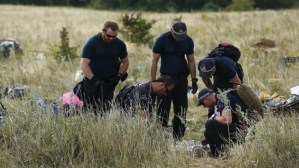
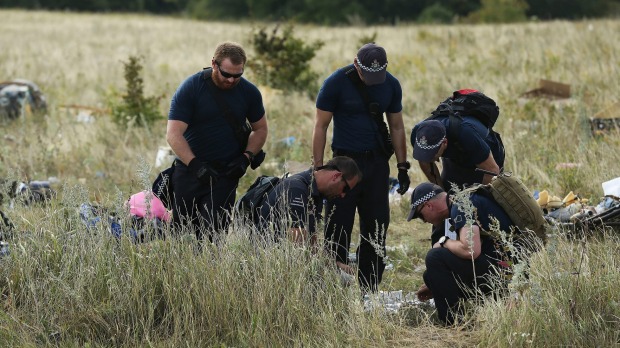
A good cop needs to know his crime scene. But that was not an option in the MH17 case because a separatist war, in which thousands have died, was being fought across the sprawling, cropped fields where the passenger jet went down.
After the 2002 Bali bombing, the AFP and Indonesian investigators worked in the maw of the carnage. The bombed ruins of Paddy’s Pub and the Sari Club were a pinprick on a map of the island – just four hectares, which an army of more than 500 investigators searched painstakingly for more than a month.
By contrast, the MH17 crash site was 45 square kilometres, which only a handful of investigators could examine and for no more than 18 hours, during which they focused on recovering the remains of the dead. There was none of the photography, tagging and labelling that usually is done to document the vital chain of custody, by which prosecutors vouch for the provenance of evidence and exhibits.
Slightly less than half of the crash site is deemed to be “of particular interest”. But Donoghoe acknowledged: “We can’t secure it and we don’t control it. In Australia, we’d have control of it for as long as we needed – recovery [of the victims] would have been methodical; and in parallel, we’d be doing forensics to ensure we controlled the integrity and the chain of custody of the evidence.”
There was constant shelling in the days when investigators tried to work the crash site and heavy clashes between rebel fighters and Ukrainian armed forces made everyone jittery and unpredictable.
Donoghoe’s AFP colleague, Senior Sergeant Rod Anderson, recalled running for his life as bullets sliced the air while his Malaysian colleagues were in the process of collecting small pieces of wreckage from locals in Rassypnoe, the village where the MH17 cockpit landed.
“You could hear the bullets whizzing past,” Anderson said. “We got our [bulletproof] vests and helmets on and we were out of there. We’re expected to be polite, but I was swearing and yelling [to the Malaysians], ‘Leave it, leave it!'”
In effect, MH17 became an investigation without a crime scene. The nearest investigators are pinned down in Kiev, the Ukrainian capital, and “Kharkiv is the limit”, Donoghoe said, alluding to a city in the far north-east of Ukraine, about 300 kilometres north of the crash site.
But some of the crime scene came to them – sufficient of the remains to allow all but two of the 298 people on board to be formally identified, along with what the Ukrainian rebels estimate were about 2500 pieces of the wreckage and baggage, hauled to The Netherlands in a convoy of 12 trucks.
Seeing the convoy arrive at Gilze-Rijen, a Dutch Air Force base, in December 2014, was a moment of relief for Donoghoe. Recalling the offloading of the wreckage, he said: “It was a win for us because finally we were getting our hands on a small part of the crime scene – it could never be tampered with again.”
There is a consensus in Western capitals that Russia provided the Buk system to the rebels, and possibly a crew to operate it. The JIT’s calls for witnesses, released on YouTube, include a remarkable montage of video and still images of a Buk system apparently moving into and away from the crash area and excerpts from rebel phone traffic seemingly acknowledging that they had shot down a civilian passenger aircraft.
But there is a significant dissenter that can’t be dismissed lightly – the German foreign intelligence service or BND. Gerhard Schindler, head of the BND, reportedly briefed a parliamentary committee in October 2014 on a detailed analysis that concluded that the rebels had used a Buk system, but it had not come from Russia. According to a report in Der Spiegel, Schindler contradicted US Secretary of State John Kerry and then Australian prime minister Tony Abbott when he produced satellite images and photos to support an argument that the rebels had commandeered the Buk when they overran a Ukrainian military base.
Berlin subsequently seemed to back-pedal, claiming that Der Spiegel’s account was “arbitrary … and out of context”, though without specifying how.
In August 2015, the “Buk did it” theory seemed to become unassailable when Dutch prosecutors announced that investigators had recovered what were believed to be Buk missile parts at the crash site, prompting speculation that they would be able to identify the arsenal from which the missile came. This week’s report by the safety board is even more convincing.
Despite persistent Russian claims that Ukrainian fighter jets attacked MH17 and animus between the two countries that has only deepened since Moscow’s annexation of the Crimean Peninsula in 2014, Donoghoe had no qualms about the credibility of the JIT being undermined by the presence in its ranks of Ukrainian investigators. He insisted: “We work to the high standards of all five countries. Everything we do is independently reviewed by each of the countries involved – and sometimes that review is done jointly.”
Donoghoe described the JIT as settled into the long, hard graft of the investigation – “the noble cause of establishing the cause of the crash and of bringing people to justice”. But much of what the Aussie cops had to say about the investigation would be music to the ears of any defence counsel.
Donoghoe complained that extreme weather and time inevitably degraded the quality of evidence – a parade of people had traipsed through the crash site, some picking up or removing evidence. A particular challenge was access to witnesses: “People with direct evidence of what they saw, smelled and touched, but in many cases we can’t approach them or get them to a safe place. There’s anecdotal evidence of threats to many and they can’t be seen to be helping the police investigation.”
The mutual hostility among locals loyal to Moscow or Kiev, each accusing the other of complicity in the MH17 crash, raises dire questions about the credibility of witnesses – how can they be believed when they are coming out of an area to which the investigators can’t even travel?
In defending the process, Donoghoe reveals even more challenges: “We have to assess each witness on their merits. The passage of time tends to interfere with a witness’ recall; as does constant media reporting, very little of which is unbiased in the area.
“But establishing their credibility is no different than in a drug importation or murder case in Australia. One of the best ways is to test the veracity of what they say against the known facts, and to establish if others corroborate it. If their story doesn’t hold, the majority of detectives will see through it.
“It doesn’t mean external forces have corrupted them – the passage of time degrades memory, as does exposure to other stimuli before and after the incident … But we don’t have an ability to go back to the scene to do our own inquiries. We can’t go east of Kiev.”
Pointing to a map of the MH17 debris field on the wall, Donoghoe said: “Many points on that map haven’t been searched properly. At the time, the only evidence was our direct observations at the site [while recovering remains] and what we saw in the media – this is why the issue of access to the crash site is so frustrating.”
He refused to reveal how many witnesses had come forward. But claiming that “a whole manner” of witnesses had been interviewed, Donoghoe lifted the veil just a little: “It’s far safer to do witness interviews out of the area – you have to be concerned for their safety. We’re not going to send investigators into danger, but the witnesses can appear to be going on holidays.”
And in addressing these issues, Donoghoe and his colleagues made another observation that could be used to cast doubt on their final report. In arguing that an end to the separatist conflict at some time in the future would produce “a whole new bunch” of witnesses that could change the “whole direction of the inquiry”, could they be confident of the case they are pulling together now?
The images of the 38 Australian victims killed on MH17 on the wall in the Australian embassy in The Hague, above the Australian Federal Police team’s mission statement.
The images of the 38 Australian victims killed on MH17 on the wall in the Australian embassy in The Hague, above the Australian Federal Police team’s mission statement. Photo: Kate Geraghty
In Europe, victims’ families and others have accused investigators of dragging their feet, blaming the reliance by various capitals on Russian gas to heat their homes and fire their factories, in the face of Moscow’s propensity to slow or cut gas supplies to achieve its geopolitical objectives. Even as the JIT effort continues, lawyers for the relatives of 20 Dutch victims accused the JIT of failing to build a strong enough legal case – and have demanded that the investigation be handed over to a UN special envoy.
“I’m not sure we will officially ever know who was behind this – there are too many political and economic interests,” said Silene Fredriksz, whose son Bryce died in the crash along with his girlfriend Daisy Oehlers. And Thomas Schansman, whose 18-year-old son Quinn died in the crash, wondered about the veracity of a report by Dutch journalist Robert Bas on the fate of the crew that manned the Buk missile system – “my sources believe that these people might have changed their identities or even been executed by [the] Russian secret service in order to hide everything”, Bas said.
Meanwhile the parents of victim Fatima Dyczynski – Jerzy and Angela Dyczynski, of Perth – have struck out on their own, filing a case to the International Criminal Court in The Hague, in which they hold Ukrainian and Dutch officials accountable for allowing MH17 to transit Ukrainian airspace at time when military aircraft were being knocked from the sky, an argument for which there was some support in the Dutch Safety Board’s report.
source:smh.com.au









 STUDIO 3 NEWCASTLE AUSTRALIA