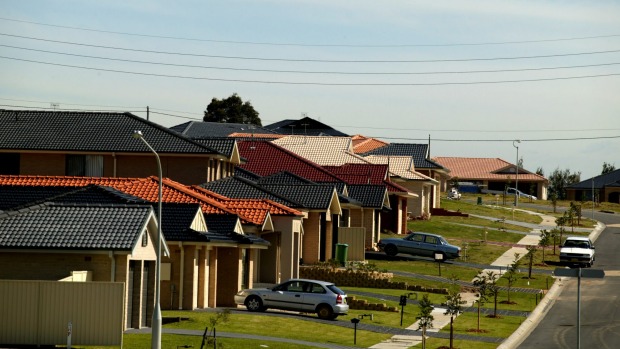
History will show that if there was a day that marked the start of the end of Australia’s residential property boom, it was today.
Regulators and legislators who’ve spent the past two years worrying about an overheated property market should now be diverting attention to the fallout when the home market starts to deflate. That market appears to be increasingly close to being caught in a pincer between a big increase in supply and the start of moves by banks to increase interest rates on home loans.
It is a fair bet that in the Australian banking landscape – where there is limited price based competition between the major lenders – that others will follow.
There have been plenty of mortgage holders still hoping that the Reserve Bank will usher in another cut to official rates this year and they’ll be jolted at the news of the a first large bank increasing rates.
Those predicting a fall in residential property prices as early as the first quarter of calendar 2016 should be feeling like they’re on safer ground.
Bigger safeguards
The reason for the rise in interest rates is simple enough. The amount of capital that the banks need to hold against mortgages has increased by 50 per cent thanks to recent regulatory changes.
Banks are also feeling the pressure from additional requirements to hold more capital in the interests of making the banking system as a whole safer. Over the past six months all the banks have been fortifying their balance sheets by either raising fresh equity or selling assets to bolster cash.
Westpac is the last of the four majors to make a big move in this regard but on Wednesday announced it would raise $3.5 billion.
The bottom line to regulatory moves to ensure the major banks are in the top quartile when it comes to capital safeguards among their global peers – as recommended by the Murray Financial System Inquiry – was always going to come at a cost.
And there were plenty of banks executives who, while disagreeing with the need to raise more capital, made it clear enough that those costs were more likely to be passed onto customers than to shareholders.
The head of the consumer bank at Westpac George Frazis said raising interest rates was a “difficult decision and one that is not taken lightly. We acknowledge that it does impact customers, even in an environment where interest rates remain near historic lows”.
“We have sought to carefully balance the needs of our borrowers, depositors and our shareholders, as well as the competitive market we operate in. Increases in the cost of doing business inevitably influence business decisions, including price,” Mr Frazis said.
Gilze-Rijen air force base: Malaysia Airlines flight MH17 crashed last year after it was hit by a Russian-made Buk surface to air missile, an air safety investigation has found, which killed the pilots immediately but may have left passengers alive for up to a full minute and a half.
A report by the Dutch Safety Board, released on Tuesday in the Netherlands, found that a Russian-made Buk missile exploded just a few metres above and to the left of the plane’s cockpit.
“(The) impact (of the missile shrapnel) was only instantly fatal to the occupants of the cockpit,” the report found.
Within a second the plane began to break up, exposing other crew and passengers to deafening noise, “abrupt deceleration, decompression, reduced oxygen level, extreme cold, powerful airflow (and) objects flying around”.
“Some occupants suffered serious injuries that probably caused their death. In others, the exposure led to reduced awareness or unconsciousness in a very short space of time.”
However it was not possible to say when they died.
“It cannot be ruled out that some occupants remained conscious for some time during the one to one and a half minutes for which the crash lasted,” the report said.
There were no signs of ‘conscious actions’ from passengers such as composing text messages or taking photographs on mobile phones. However, “one passenger was found with an oxygen mask around the neck… it remains unclear whether the person concerned put on the mask in a reflex or that it was done by someone on the ground after the passenger’s death.”
Relatives were briefed by the board about the findings and one man, Barry Sweeney, whose 28-year-old son Liam was on board, told the BBC they were told the explosion of the missile would have caused disorientation and confusion in the rest of the plane.
“Hopefully most people were unconscious by the time this happened and death would have occurred pretty quick,” he said.
“That is a comfort for 298 sets of relatives.”
Risks not properly identified
The investigators’ report found that the airline and air traffic bodies had not “adequately identified the risks to civil aviation brought about by the armed conflict in the eastern part of Ukraine”.
Ukraine itself came in for strong criticism, for not closing the airspace over a region where scores of military aircraft had been shot down in the previous few months.
MH17 crashed in Ukraine’s east on July 17, 2014, killing all 283 passengers and 15 crew members aboard the Boeing 777 – including 39 people who called Australia home.
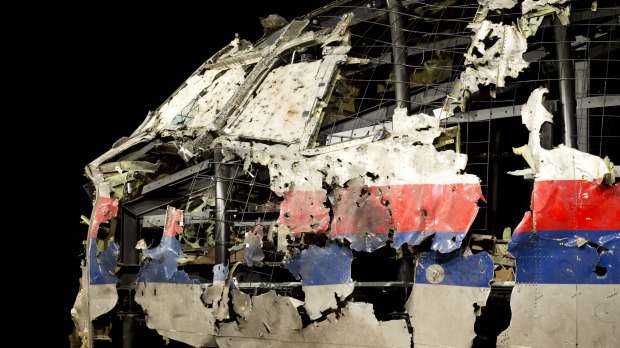
The report was presented at Gilze-Rijen air force base in the Netherlands, by Dutch Safety Board chairman Tjibbe Joustra, standing in front of a reconstruction of the front third of the plane, rebuilt from wreckage recovered from the fields of eastern Ukraine.
The reconstruction showed the cockpit area riddled with holes, punctured by shrapnel from the exploding missile. Buk missiles are designed to explode next to their targets, rather than collide directly with them.
“Flight MH17 crashed as a result of the detonation of a warhead outside the airplane,” Mr Joustra said. “None of the aviation parties involved recognised the risks posed to civil aviation by the conflict on ground.”
There was sufficient reason to close airspace as a precaution, Mr Joustra said, as more than 60 military aircraft had been brought down in the months prior, and there was evidence of weapons systems that could reach civil aircraft cruising altitude.
The reason for the omission was “straightforward and disquieting”, he said – “Nobody had thought that civil aviation was at risk (even though) there was undeniably an armed conflict taking place on the ground.”
Ukraine, which was responsible for the safety of the airspace under international law, came in for strong criticism for not closing its airspace as a precaution. However other states and airline operators were also at fault, and international rules needed to be changed, the investigators said.
Alternative theories ruled out
Investigators forensically examined the wreckage of the plane, recovered from the fields of eastern Ukraine, and eliminated the possibilities that the plane was brought down by an internal explosion, by gunfire or air-to-air attack.
They even excluded one theory that it was hit by a meteor.
“We investigated and eliminated the possibilities one by one,” Mr Joustra said.
Investigators found a Buk warhead detonated outside the aircraft, slightly in front and above the left side of the cockpit. Thousands of pre-formed metal fragments penetrated the front of the plane with great force.
Computer simulations backed up this theory, and it was also corroborated by millisecond analysis of the cockpit voice recorder.
The front of the plane broke off, the rest of the plane broke up in mid air. The tail section crashed first, then the centre, with the engines, hit the ground upside down and caught fire.
Mr Joustra said the launch site of the missile could be narrowed to a 320 square km area in eastern Ukraine, but further work narrowing this area was beyond the investigators’ mandate.
The finding contradicts one theory pushed by Russia and its supporters, that the plane was shot down by a Ukrainian fighter jet.
However the investigators did not directly confront another Russian theory: that the missile was fired by the Ukrainian army, rather than by Russian-backed separatists (or Russian soldiers working with the separatists).
Russian missile manufacturer rejects findings
Before the Dutch report was released, Russia’s state arms producer (and Buk missile manufacturer) Almaz-Antey announced the results of its own investigation.
The manufacturer said it had fired Buk missiles at a decommissioned jet plane, similar to a Boeing 777, so they could examine the pattern of impact.
They said the results demonstrated that MH17 was shot down by an old form of Buk missile – a 9M38 – which was not in use by the Russian army, and is a decade past the ‘use-by date’ intended by the manufacturer.
The last missile of this type was produced in the Soviet Union in 1986 and Russia decommissioned its remaining 9M38s in 2011, Russian state-sponsored Sputnik News reported.
“The results of the experiment completely contradict the results of the Dutch commission on the type of missile and the location of its launch,” Almaz-Antey CEO Yan Novikov told journalists.
His company’s report also said the missile was fired from near the village of Zaroschenskoye – an area reportedly under Ukrainian control at the time.
However they produced no eyewitness evidence of a Buk in that region at the time, in contrast to the significant amount of eyewitness, video and photographic evidence of a Buk in rebel-controlled territory on the day MH17 came down.
And Dutch TV reporter Rudy Bouma Tweeted that he had visited Zaroschenskoye recently and “villagers didn’t witness (a) Buk launch previous to (the) crash”, though the Ukrainian army was around 5km away at the time.
The Dutch report was not intended to address “questions of blame or liability”, a DSB spokesman said.
However one DSB source told the Dutch newspaper Volkskrant the BUK missile is developed and made in Russia, and “It can be assumed that the rebels would not be able to operate such a device. I suspect the involvement of former Russian military officials”.
World leaders react, vow justice
Australian Prime Minister Malcolm Turnbull and Foreign Affairs Minister Julie Bishop released a joint statement welcoming the findings, saying their thoughts and prayers were with the families and loved ones of those killed on the flight.
Ms Bishop said the reports findings provided critical insight into the incident.
“It determines the plane was shot down by a surface-to-air missile, consistent with the Australian government’s initial assessment of the incident,” she said.
The criminal investigation into who was responsible for the tragedy is run separately by an international ‘Joint Investigation Team’, including Australian federal police, who recently told Fairfax it may be another year before the case is ready for prosecution.
And in any case it is still unclear where the case could be tried. Russia vetoed a proposal for an international tribunal that was proposed by Australia and the Netherlands at the United Nations in July.
“We, and other partner governments of the Joint Investigation Team, remain absolutely committed to seeing justice done,” said Ms Bishop.
Malaysia’s prime minister Najib Razak said countries must work together to hold those responsible for “this murderous” act after speaking with Mr Turnbull about the MH17 findings, and labelled the attack as “unforseeable”.
“Fifteen months have passed but our commitment to bringing the perpetrators to justice remains as strong as it was on that fateful day when hundreds of innocent people lost their lives in a conflict that was not theirs,” Mr Najib said in a statement.
“This was an unforeseeable act and, of the 160 flights that were on MH17’s general route that day, not one was advised by the relevant authorities about any specific threat,” he said.
The White House released a statement calling the report an “important milestone in the effort to hold accountable those responsible.”








 STUDIO 3 NEWCASTLE AUSTRALIA