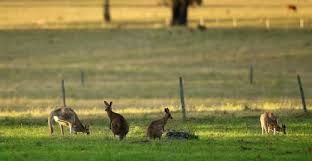
MOBS of hungry kangaroos are on the march across the Hunter, destroying crops and stock pastures.
Farmers are calling on the state government to act before the population gets out of control.
Groups of up to 100 eastern grey kangaroos have been spotted on properties between Nelson Plains and the Barrington Tops, with most circulating on land around Seaham, Clarence Town, Paterson and Vacy.
The influx also extends west around Singleton and Muswellbrook where groups of 30 to 40 are grazing on farmland and on the roadside.
Some farmers are taking matters into their own hands, shooting the protected animals and risking fines that can climb as high as $11,000 for killing without a licence and $1100 per kangaroo.
Mobs of kangaroos are also a serious hazard for motorists, with more than 1000 hit in the region each year.
A mob of 70 recently destroyed Josh Evans’ newly sprung rye grass crop, which he replanted within a fenced paddock near Vacy after the April super storm. The kangaroos ate the grass before it was high enough to nourish his beef cattle herd.
The mob has since moved on and he has only seen three kangaroos on his property since. ‘‘They thought the crop was much better than grazing on grass and they hung around for a while – I saw them mostly in the early morning and at dusk. They would get under the shade during the heat of the day and then come back out to feed in the late afternoon,’’ Mr Evans said.
‘‘I didn’t do anything about them being here – I’m not against kangaroos, I’m happy to co-exist with them.’’
See your ad here
It’s unclear how the region’s problem is changing, because the state government does not track the Lower Hunter’s kangaroo population – it is not part of the commercial harvest zone, which extends into parts of the Upper Hunter.
It “has no plans to undertake region-wide population surveys where there is no commercial harvest” because kangaroos are protected under the National Parks and Wildlife Act, a spokeswoman said.
Landholders and the NSW Farmers Association want the government to start monitoring in the Lower Hunter as part of a regional approach to kangaroo management.
They argue the lack of eastern grey population data in the Lower Hunter will be “bad for kangaroos and bad for farmers” as numbers become out of control.
Association Hunter region manager David Banham said “solid evidence” was needed to analyse the annual population so kangaroos and farming can “comfortably co-exist”.
“Farmers would prefer to keep them off their property instead of shooting them,” Mr Banham said.
“Culling is just one way to deal with the situation. If we’ve got data we can accurately say this is what is happening in the Lower Hunter.”
Landholder Peter Lawrence, of Gresford, has questioned how culling on individual Lower Hunter properties is an effective control method when nobody knows how many eastern greys are in the area.
“[Monitoring the population is] as much for the sake of the kangaroos as it is farming – if their numbers get out of control and there is a serious drought they are going to suffer trying to find enough feed to survive, and nobody wants that,” he said.
NSW Office of Environment and Heritage research suggest farms and kangaroos can co-exist most of the time and the kangaroo population followed a “boom and bust cycle” that “correlated with drought and good conditions”.
Upper Hunter landholders within the kangaroo harvest management plan zone can engage commercial shooters to cull on their land and help meet a specific quota that the NSW Office of Environment and Heritage releases annually.
The population count within the zones determines the quota, which is set at no more than 15 per cent of the population.
Lower Hunter landholders have to apply to the National Parks and Wildlife Services for a licence to cull and tag a specific amount.
Requests are likely to be approved if the landholder can prove how many kangaroos are on the property and the economic harm and damage they have caused.
Cull quotas not being met due to a lack of demand
A LACK of demand for kangaroo meat has left culling quotas in the Upper Hunter largely unfulfilled. Annual quotas for eastern grey kangaroos have only been met three times in the past 15 years.
In the past two years 38,040 eastern greys were identified for culling in the Upper Hunter under the NSW kangaroo harvest management plan, yet only 8895 were shot.
Contract shooters haven’t come close to meeting the annual target since 2007, when they reached 98per cent of it, and 2003 when they achieved 93per cent.
In 2013, only 19per cent of the 25,125 eastern greys identified were culled.
NSW MLC Robert Brown, a Shooters and Fishers Party member, blamed the lack of demand for kangaroo meat overseas and the geographical location of the Upper Hunter.
He said commercial shooters could easily make $1000 to $2000 a week shooting kangaroos out west on flat ground and keep their running costs down. He said shooters in the Upper Hunter had to contend with hilly country and “work a lot harder” to find enough kangaroos in a group to make it financially viable.
“They might drive around for half an hour before they find a kangaroo … Why do that when they can go out west and get 100 of them in a night. If they are running the car they want to be shooting,” Mr Brown said.
The NSW Office of Environment and Heritage releases a quota of eastern grey, red, western grey and wallaroo kangaroos that can be culled every year under the harvest plan. These species are classified as abundant and are not at risk of becoming vulnerable because of the cull.
Upper Hunter landholders within a zone identified in the plan can engage commercial shooters to take a certain number of kangaroos on their property.
The shooters place the dead kangaroos in chillers and pass them onto processors.
Exporting kangaroo meat is expected to be the next big thing for the industry and could be worth about $600million a year. The federal government already has an agreement with 70 countries to export kangaroo meat. The first tonne went to Peru in March after an agreement between the two countries was created five years ago. It cost $6 per kilogram to transport.
But Kangaroo Industry Association of Australia executive officer John Kelly said the industry needed to conquer bigger markets like China.
If that happened the amount of kangaroos harvested every year could dramatically increase, he said.
Mr Brown said Russia was a strong customer until President Vladimir Putin banned a range of Western food, including kangaroo meat, last year.
Patrick Medway, who sits on the NSW kangaroo management advisory panel on behalf of the Australian Wildlife Society, said the industry could thrive in Australia if the nation relinquished its “emotional attachment” to the native animal. He argued the lack of demand for meat and skins within Australia was deterring commercial shooters from participating in the harvest.
He said shooters were paid $2 to $3 per kilogram, while kangaroo fillets sold in supermarkets for $21 per kilogram and mince fetched $9 per kilogram.
“The return to shooters isn’t high enough and unless that changes the actual take won’t reflect the set quota,” Mr Medway said. “If the price of kangaroo meat reflected the rising cost of beef, lamb and chicken it would be a viable business.”
source:theherald.com.au