
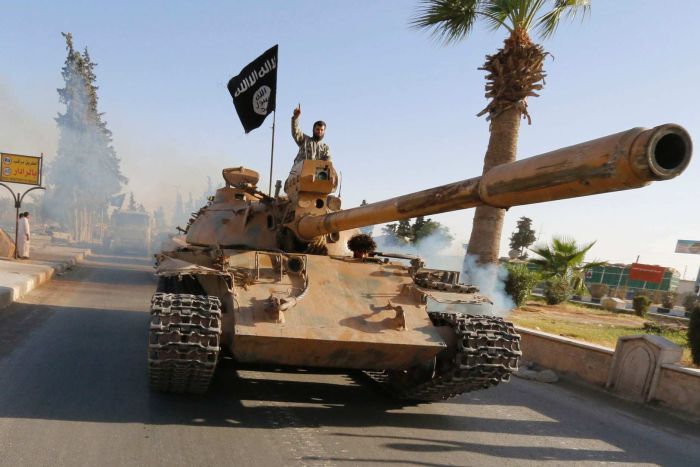
If Russia is serious about backing the Assad regime to defeat Islamic State, then maybe it’s time for the West to reposition itself. Because it appears the Russians are the only ones with a clear-headed strategy, writes John Blaxland.
Russia has long defended the Assad regime in Syria from Western sanctions and intervention, blocking UN consensus by exercising its veto powers in the UN Security Council and maintaining low-key but strong ties to ensure access to military port facilities on Syria’s Mediterranean coast.
The West has so far not been prepared to use force to circumvent the UN and overcome Russia’s support for the Assad regime, despite the mounting atrocities perpetrated by Assad’s forces. Although it is one of Assad’s enemies, Assad’s toxic actions over the last three years helped foster the emergence of the so-called Islamic State, Daesh, as a proto-state, spanning across the borders of what we once knew as Syria and Iraq.
Daesh is exercising the ugliest of primeval practices with the aid of 21st century weapons and technology in the name of a deranged manifestation of Islam. Assad, understandably, welcomes Russian support to suppress them. With many at fault all around, the result is the absence of any clarity of who is worthy of the West’s support.
In response, the West has been lukewarm in its enthusiasm to curb Assad and defeat Daesh. Australia, alongside a range of other Western powers, is making a carefully calibrated force contribution to wind back Daesh, knowing full well that, on its own, its niche force contribution will make at best only a marginal difference to the outcome of events there. Australia’s commitment of fighter aircraft to bomb Daesh targets in Syria as well as Iraq was intended, it appears, to send a message of support to the United States and to prompt a more forthright American response to the festering security problem.
This unusual approach reflects a gaping absence of a coherent strategy by the West for dealing with the crisis in Syria and Iraq. The replacement of Tony Abbott by Malcolm Turnbull could well see this approach to metaphorically “shirt-front” Daesh taper off in the absence of other coalition partners rallying to the cause. Canada’s PM, Stephen Harper, for instance, looks set to be defeated in coming elections and the successor government likely will be far less enthusiastic about maintaining combat aircraft over Iraq and Syria.
But a confluence of factors seems to be bringing the simmering crisis to a head and there are pointers of an alternative way forward.
In recent months Putin has understandably been demonised for his actions in Ukraine, Crimea and elsewhere in Eastern Europe. But in Syria he seems to be acting in a way consistent with one of the West’s objectives when it comes to Daesh.
Recent Russian military deployments to Syria appear to have changed the geopolitical equation in Syria, reinforcing the prospects of the Assad regime outlasting Daesh and its other rivals.
The escalation of the refugee crisis in Europe, emanating largely as a result of events in Syria and its neighbourhood is focusing European minds on breaking the prolonged impasse over finding a diplomatic solution to the crisis. The refugee crisis is demonstrating that there are causal links and simply building fences will not deal with the root causes of the conflict. European powers understand now that what happens in Syria is perpetuating the problems on their borders. So there is an incentive to find a creative solution to break the impasse.
In seeking such a solution, the interests and intentions of the neighbouring middle powers needs to be taken into account. Predominantly Sunni Saudi Arabia has long been happy to see Assad struggle and there are numerous indicators of support from within Saudi Arabia for their Sunni co-religionists in Daesh.
In contrast, Shia Iran, with its proxies in Iraq, is seeking to bolster the Shia regime in Baghdad and prevent Daesh from extending its reach further. But the limited commitment of both the Iraqi and Iranian forces indicates they do not have the will to push back and defeat Daesh in Iraq, let alone in Syria. Even if they were to be successful in reclaiming the Sunni territory ruled by Daesh, they have not indicated they would be in a position to rule thereafter with stability and empathy for the predominantly Sunni people living there.
Turkey, it appears, begrudgingly acceded to American requests for permission to conduct strike operations against Daesh from its air bases, but has used this concession as an excuse to crack down on its own Kurdish minorities. It shows little heart for defeating Daesh either.
There is an adage that “the enemy of my enemy is my friend”. If Russia is serious about backing Assad to defeat Daesh, then perhaps it is time for the West to reposition itself. More than 12 months of backing and training Iraqi forces has left better trained troops, to be sure, and the ADF contingents have done a sterling job. But their proficiency as a result of effective training will never substitute for a determined political resolve to win back the Sunni heartland of north-western Iraq.
Perhaps it is time to rethink our role there. Putin’s Russia seems to have a clear plan. In recent months Putin has understandably been demonised for his actions in Ukraine, Crimea and elsewhere in Eastern Europe. But in Syria he seems to be acting in a way consistent with one of the West’s objectives when it comes to Daesh.
A creative approach to engaging Russia on this may well help defuse tensions and mistrust elsewhere.
source:abc.net.au










 STUDIO 3 NEWCASTLE AUSTRALIA