
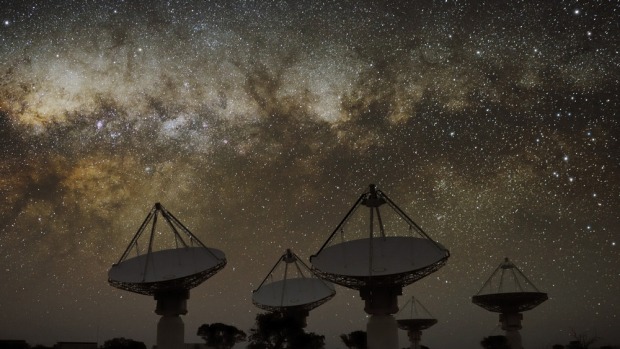
Matthew Bailes isn’t convinced aliens exist but he’s going to give the search for ET his best shot.
Professor Bailes will lead Australian researchers using the CSIRO’s Parkes radio telescope in a quest to find evidence of alien life. He will be joined by some of the world’s eminent astronomers and astrophysicists after Russian billionaire Yuri Milner yesterday said he would spend at least $US100 million ($138m) on the quest.
“We’ve never seen any evidence of alien life,” Professor Bailes said. “But I certainly believe there are a ridiculous number of planets out there and it wouldn’t surprise me if some of them develop life. Whether or not it ever gets to the point where it can communicate with us is another question.”
Professor Bailes has a particular interest in pulsars, or fast-spinning celestial objects that emit radio, X-ray and gamma radiation at regular intervals.
“When they were first discovered in 1967, astronomers wondered whether they were an alien transmission,” he said.
“But they then noticed other signals coming from other directions which looked a bit the same. They decided pulsars were unlikely to be teeming with aliens. We now know pulsars are the most hostile environment in the universe and would be very unlikely to host any life form. The gravity is about one billion times stronger than on Earth so it would crush anything that came near it.”
Professor Bailes needs incredibly clear signals to locate pulsars and radio bursts. It is these signals that could lead the way to alien life.
Several science luminaries are backing the project, including physicist Stephen Hawking and astronomers Martin Rees and Frank Drake.
Nobel laureate Brian Schmidt said: “My guess is it is unlikely if we will find evidence of aliens, but it is going to drive innovation.”
source:theaustralian.com.au







 STUDIO 3 NEWCASTLE AUSTRALIA