Daily Archives: July 17, 2015

Germany, not Greece, should say goodbye to the euro

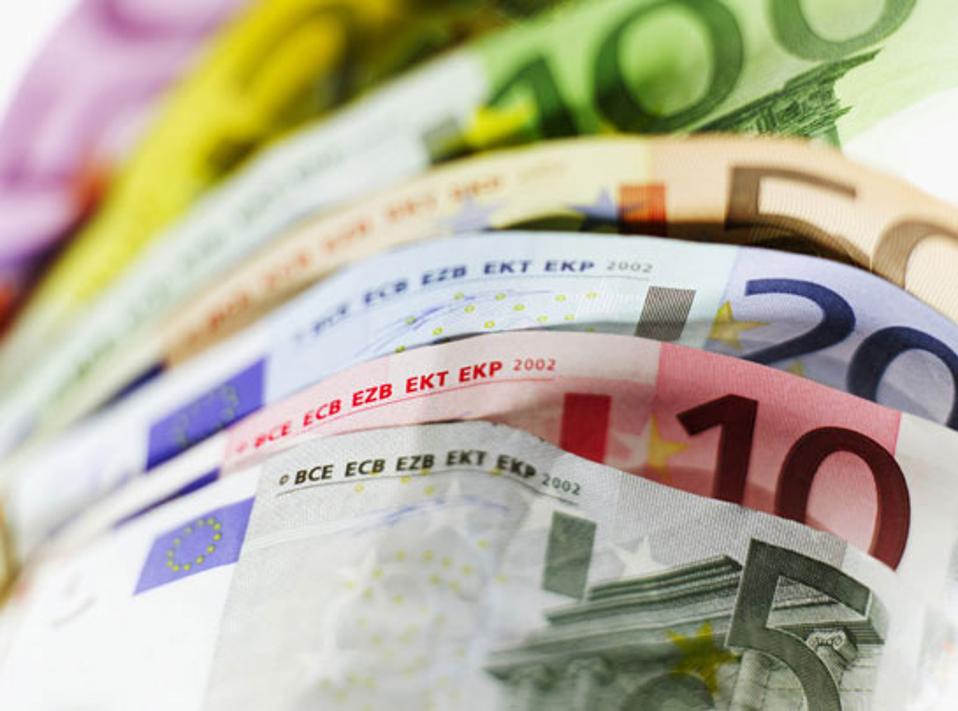
euros22--2-thumb-large

The latest round of wrangling between Greece and its European creditors has demonstrated yet again that countries with such disparate economies should never have entered a currency union. It would be better for all involved, though, if Germany rather than Greece were the first to exit.

After months of grueling negotiations, recriminations and reversals, it’s hard to see any winners. The deal Greece reached with its creditors — if it lasts – pursues the same economic strategy that has failed repeatedly to heal the country. Greeks will get more of the brutal belt-tightening that they voted against. The creditors will probably see even less of their money than they would with a package of reduced austerity and immediate debt relief.

That said, the lead creditor, Germany, has done Europe a service: By proposing the Greece exit the euro, it has broken a political taboo. For decades, politicians have peddled the common currency as a symbol of European unity, despite the flawed economics pointed out as far back as 1971 by the Cambridge professor Nicholas Kaldor. That changed on July 11, when European finance ministers agreed that it could be both sensible and practical for a member country to leave. “In case no agreement can be reached,” they said, “Greece should be offered swift negotiations for a time-out.”

Now that the idea of exit is in the air, though, it’s worth thinking beyond the current political reality and considering who should go. Were Greece to leave, possibly followed by Portugal and Italy in the subsequent years, the countries’ new currencies would fall sharply in value. This would leave them unable to pay debts in euros, triggering cascading defaults. Although the currency depreciation would eventually make them more competitive, the economic pain would be prolonged and would inevitably extend beyond their borders.

If, however, Germany left the euro area – as influential people including Citadel founder Kenneth Griffin, University of Chicago economist Anil Kashyap and the investor George Soros have suggested – there really would be no losers.

A German return to the deutsche mark would cause the value of the euro to fall immediately, giving countries in Europe’s periphery a much-needed boost in competitiveness. Italy and Portugal have about the same gross domestic product today as when the euro was introduced, and the Greek economy, having briefly soared, is now in danger of falling below its starting point. A weaker euro would give them a chance to jump-start growth. If, as would be likely, the Netherlands, Belgium, Austria and Finland followed Germany’s lead, perhaps to form a new currency bloc, the euro would depreciate even further.

The disruption from a German exit would be minor. Because a deutsche mark would buy more goods and services in Europe (and in the rest of the world) than does a euro today, the Germans would become richer in one stroke. Germany’s assets abroad would be worth less in terms of the pricier deutsche marks, but German debts would be easier to repay.

Some Germans worry that a rising deutsche mark would render their exports less competitive abroad. That is actually a desirable outcome for the world — and eventually for Germany, too. For years, Germany has been running a large current account surplus, meaning that it sells a lot more than it buys. The gap has only grown since the start of the crisis, reaching a new record of 215.3 billion euros ($244 billion) in 2014. Such insufficient German demand weakens world growth, which is why the U.S. Treasury and the International Monetary Fund have long prodded the country to buy more. Even the European Commission has concluded that Germany’s current-account imbalance is “excessive.”

Germans know how to live with a stronger exchange rate. Before introduction of the euro, the deutsche mark continuously appreciated in value. German companies adapted by producing higher-quality products. If they reintroduce their currency now, it will give them a new incentive to improve the lagging productivity in the services they produce for themselves.

Perhaps the greatest gain would be political. Germany relishes the role of a hegemon in Europe, but it has proven unwilling to bear the cost. By playing the role of bully with a moral veneer, it is doing the region a disservice. Rather than building “an ever closer union” in Europe, the Germans are endangering its delicate fabric. To stay close, Europe’s nations may need to loosen the ties that bind them so tightly.

source:ekathimerini.com
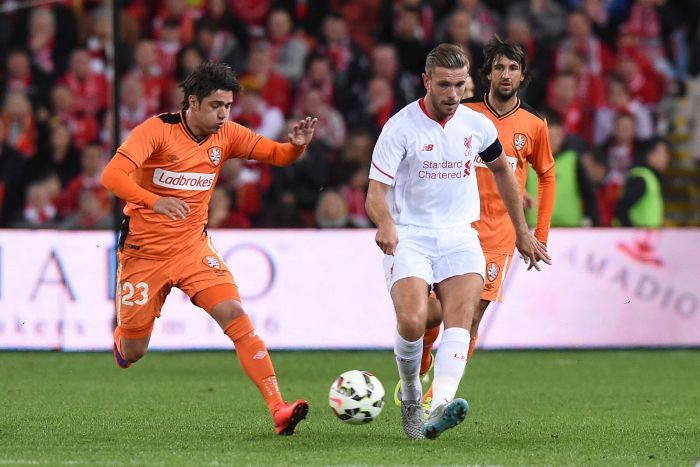
Liverpool beats Brisbane Roar 2-1 at Lang Park in Premier League side’s first game in Australia

6629746-3x2-700x467

It may just have been an early season hit-out for both sides, but Liverpool’s 2-1 win over the Brisbane Roar at a chilly Lang Park was another unforgettable occasion for Australian Reds fans.

It was always going to take a monumental effort to match the MCG crowd’s rousing rendition of Liverpool fan anthem You’ll Never Walk Alone before the game against the Victory in 2013, but the more intimate atmosphere and brilliant acoustics of the Cauldron ensured the visiting players well and truly felt the love once more as the song was belted out at full volume.

Supporters of the Premier League outfit had been practicing the tune for hours before at the nearby entertainment district of Caxton Street, along with less family-friendly ditties praising the virtues of recently departed ‘King’ Steven Gerrard or pointing out the flaws of bitter rival Manchester United.

Outside the stadium itself, the sea of red was broken only occasionally by the orange of a Brisbane Roar shirt or scarf, while selfies were snared with the bronze statue of the king of another football code, Wally Lewis.

The action on the pitch was high on entertainment, especially considering both sides had the right to be somewhat rusty.

In the 17th minute Roar young gun Dimitri Petratos found space in the area before dancing himself into a shooting position and stroking the ball past a diving Simon Mignolet for an opener good enough to feature on Match of the Day.

Adam Lallana sent the decibels in the stands much higher a short time later, however, when he brought a high cross down brilliantly and curled it into the top corner for a cracking Liverpool equaliser.

Visiting Merseyside journalists were full of praise for Brisbane’s upbeat style of possession-based football, and highly impressed by the debut of teenager defender Joe Gomez.

Most heartening for Liverpool manager Brendan Rogers will be the strong performance of James Milner, the man brought in as a replacement for Gerrard at the heart of the midfield.

Milner’s well-taken goal in the 75th minute saw the EPL giants take the lead for the first time in the match.

It became a case of hanging on to a very respectable scoreline after that for the hosts, as legs tired and Liverpool threatened to blow out the margin.

source:abc.net.au

Greece’s Surrender: A Return to 1919, or to 1905?

Cassidy-Tsipras-Parliament-690-472-16183751

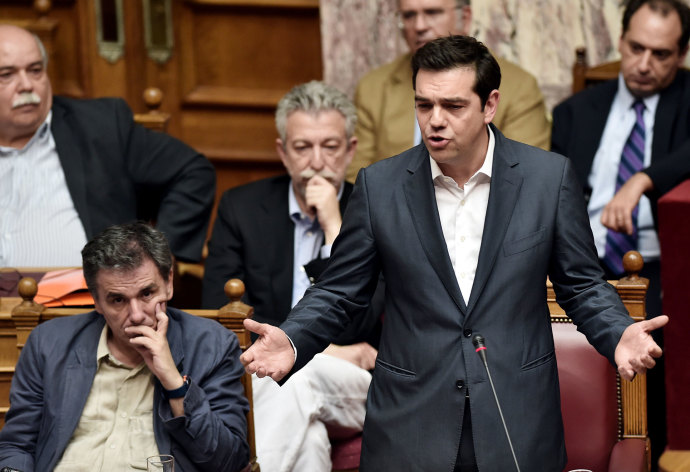
With the vote by Greece’s parliament, early Thursday morning, to accept the harsh terms demanded by the country’s creditors, the debate about how we got to this point is sure to intensify. In a post earlier in the week, when Prime Minister Alexis Tsipras first agreed to the deal, Larry Elliott, the Guardians economics editor, pointed the finger at Tsipras’s Syriza government, saying, “Greeks will be asking today what has been the point of the last month of diplomatic theatre: the endless meetings, the violent rhetoric, the walkouts, and the calling of the referendum. The answer is less than nothing. Untold damage has been caused to the Greek economy for no purpose whatsoever.”

That is a harsh judgment. But Elliott was only echoing what some of Tsipras’s critics inside Greece, on the left as well as on the right, have been saying. This time last year, the country’s blighted economy was enjoying a modest recovery, and its former Prime Minister, Antonis Samaras, was talking of the country abandoning its existing bailout, funded by the troika of the European Central Bank, the European Commission, and the International Monetary Fund, and seeking financing on the private markets instead. Now, almost six months into Syriza’s rule, the economy is in another deep recession. An assessment released last week by the European Commission says that Greece’s G.D.P. will decline by between two and four per cent this year, and that positive growth won’t return until 2017. With tax revenues declining and the budget deficit widening, the Greek government desperately needs more credit to stay afloat—perhaps seventy-five billion euros between now and 2018, according to the E.C. assessment. The country’s banks are on the brink of collapse, and, even assuming an emergency financing deal is finalized in the coming days, capital controls may need to remain in place for months, or years, to prevent Greeks from moving their savings abroad.

And all of this, for what? Two weeks ago, Greeks voted against an offer from the country’s creditors, in the belief that it would keep the economy stuck in the trap caused by the troika’s austerity policies; with this new deal, the country has accepted a package that is equally, or even more, severe. Yanis Varoufakis, the former Greek finance minister, who resigned after the referendum, was one of more than thirty Syriza parliamentarians to vote against the deal. Before the vote was taken, he described the measures agreed upon in Brussels over the weekend as “a new Versailles Treaty”—a reference to the Carthaginian peace that Germany’s enemies imposed upon it after the First World War.

Setting aside the awkward truth that Varoufakis was an architect of the negotiating strategy that led Greece to this juncture, his historical analogy is worth considering. This is not because it’s a dig at the Germans, who have had such outsized influence in imposing austerity measures on Greece, but because it provides an example of an unrealistic agreement between a sovereign state and its creditors—one that had to be repeatedly amended and, ultimately, scrapped.

After the First World War ended, France and the other victorious powers demanded about twelve and a half billion dollars in reparations, which was a bit more than Germany’s G.D.P. at the time. Since Germany clearly couldn’t pay that sum all at once, the Allies asked for annual payments of five hundred million dollars a year, or about four per cent of G.D.P. In 1923, after Germany fell behind on its payments, the Allies occupied the Ruhr, but that didn’t improve matters. The next year, and again in 1928, under the Dawes Plan and the Young Plan, the country’s debts were revised and extended, but this didn’t work either. Eventually, in 1932, most of the reparations were cancelled. (By then, tragically, Adolf Hitler was just months away from being invited to form a government.)

Currently, Greece’s debts amount to about a hundred and seventy-five per cent of its G.D.P., and, unlike Weimar Germany, it doesn’t have powerful export industries that could theoretically generate the funds to pay them off. Going forward, there is little doubt that some of Greece’s obligations, which have already been revised once, in 2012, will have to be written off. Twice in the past couple of weeks, the International Monetary Fund has said as much, and even Wolfgang Schäuble, Germany’s finance minister, appears to agree. In Schäuble’s view, however, which he took public on Thursday, such write-offs violate the rules and spirit of the eurozone—and so, he said, leaving the currency zone and negotiating a new debt agreement from the outside “would perhaps be the better way for Greece.”

It is now patently clear that Schäuble and many of his countrymen would like to get rid of their pesky southern neighbors, leaving unchallenged the German vision of the eurozone as a modern-day gold standard. The Greeks, however, have no intention of leaving, and therein lies a glimmer of hope. For all of their U-turns and failures, Tspiras, Varoufakis, and their colleagues did succeed in highlighting the illogic of endless austerity policies, and they also succeeded in putting debt restructuring on the table. (On Thursday, Mario Draghi, the chairman of the European Central Bank, became the latest expert to say that debt relief is necessary.) For those who viewed the last five months as not just a dispute about the finances of a small country but as part of a much larger battle about the future of Europe, these are important developments. And they will affect not only Greece but other other heavily indebted countries, such as Ireland, Portugal, Italy, and France.

From this perspective, Saturday’s agreement with the creditors isn’t the end: it is the beginning of a movement to wrench Europe away from technocracy, debt deflation, and Teutonic fiscal orthodoxy. This was the vision that Varoufakis spoke about in a speech he gave in Berlin last month, when he called for an end to the vicious cycle of austerity and depression and for a new Europe. And it is the vision that motivates Tsipras and other members of Syriza. “The neoliberals have had the upper hand in Europe for thirty years and we want to move away from that, in form as well as substance,” Dimitris Tzanakopoulos, Tsipras’s chief of staff, told Robert Misik, an Austrian journalist, who has just published a long piece about Greece on Social Europe. “These are political mechanisms that, in the end, disenfranchise whole nations, and you can’t change them all within four months.”

In the Marxist intellectual tradition, from which many senior members of Syriza hail, progress comes about gradually. To overthrow the existing order, you have to first mobilize the masses by stripping back the democratic veil and showing the real workings of the system: only then will the “objective conditions” be ripe for revolutionary change. Tsipras and Syriza didn’t create the conditions to change. But in bringing Greece to the brink, and demonstrating that its creditors were willing to see it collapse if it didn’t buckle to their demands, they did, arguably, succeed in showing up the eurozone as a deflationary straightjacket dominated by creditors. And they did this with all of the world watching. “One must know who the enemy is, in order to fight the enemy,” Alex Andreou, a Greek blogger who is sympathetic to Tsipras, wrote last week. “Syriza has achieved that. Now, it is over to you, Spain. Take what we’ve learned and apply it wisely.”

Under this analysis, Syriza’s surrender wasn’t necessarily an ignominious one. As Lenin commented of the failed 1905 revolution in Russia, it was a retreat for a new attack, which ultimately proved successful. “I’m not going to sugarcoat this and pass it off as a success story,” Tsipras said to parliament on Wednesday, prior to the vote, acknowledging that the spending cuts and tax increases contained in the agreement would deal another blow to the Greek economy. However, that wasn’t the full story, Tsipras insisted. “We have left a heritage of dignity and democracy to Europe,” he said. “This fight will bear fruit.”

Only time will tell if that was wishful thinking.

source:newyorker.com