
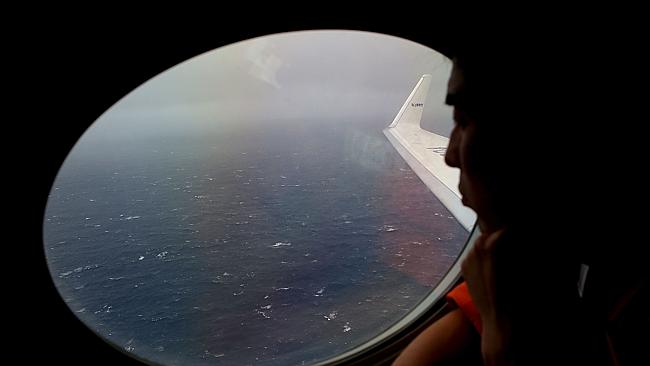
THE four acoustic pings detected in the search for missing Malaysia Airlines Flight MH370 are not from the plane’s black boxes, according to the US Navy.
A Navy official has told CNN that the pings are now universally believed to have come from a man-made source unrelated to the missing jetliner, and not from the plane’s data or cockpit voice recorders.
Michael Dean, the Navy’s deputy director of ocean engineering has told CNN that if the pings had come from the recorders, searchers would have found them.
“Our best theory at this point is that (the pings were) likely some sound produced by the ship … or within the electronics of the Towed Pinger Locator,” Dean said.
“Always your fear any time you put electronic equipment in the water is that if any water gets in and grounds or shorts something out, that you could start producing sound.”
When asked if the other nations involved in the search effort also believed the pings were unrelated to MH370, Dean answered “yes”.
He went on to tell CNN that it is not possible to categorically rule out that the pings came from the black boxes but that there is no evidence to suggest they did.
This comes after News Corp Australia last week revealed that underwater scientists have labelled the search for MH370 a “debacle” and say Prime Minister Tony Abbott was playing politics when he prematurely announced the black box pingers had been found.
The acoustic experts, who do not wish to be identified, said the four crucial signals detected by a US pinger locator were almost certainly not from the missing Malaysian Airlines plane’s black boxes, but from another man-made source.
They insisted that the signals were in the wrong frequency and detected too far apart to be from the boxes.
“As soon as I saw the frequency and the distance between the pings I knew it couldn’t be the aircraft pinger,” one scientist told News Corp Australia.
That conclusion is supported by the lack of success from a detailed search of the area conducted by the US deep sea drone ‘Bluefin 21’.
In answer to questions from News Corp Australia the Joint Agency Coordination Centre (JACC) said that the signals were “likely” sourced from electronic equipment and were “believed to be” consistent with the Flight Data Recorder.
However the scientists said the 33.3 kilohertz frequency of the signal was very different to the 37.5 kilohertz generated by underwater acoustic beacons. The signals were also detected some 30km and four days apart.
The JACC has refused a request to release recordings of the signals for independent analysis and it did not release the exact location or precise depth of the signals.
Agency head retired defence chief Air Chief Marshal Angus Houston said the signals were still being analysed to ensure nothing was overlooked.
Meanwhile the families of passengers aboard missing flight MH370 accuse Malaysia of a cover-up over newly released satellite data, saying it is incomplete and does not prove that the plane crashed in the southern Indian Ocean.
This comes as the first stage of the search off the west coast of Australia concludes without finding any debris from the missing Boeing 777.
The Malaysian Airlines flight, with 239 passengers and crew on board, disappeared in the early hours of March 8 on a flight from Kuala Lumpur to Beijing. Since then no trace of the jetliner has been found, despite a multi-million dollar search effort.
source: news.com.au








 STUDIO 3 NEWCASTLE AUSTRALIA