
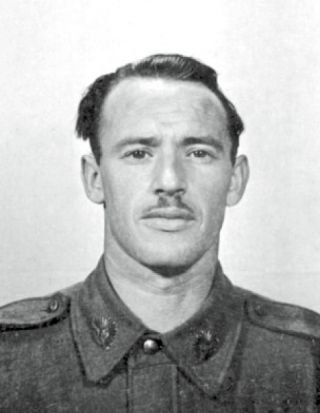
Vale James Dimitri Zampelis.
Every May we gather to commemorate the service and sacrifice of those who served in the battle of Crete, defending the Island from the German invasion in May 1941.
One of those we should honour is Gunner James Dimitri Zampelis. Among the 2,500 Australians of Hellenic heritage who served in the Second World War, James is the only one who was killed in action in the battle of Greece and Crete.
His story is that of thousands of other Australians who fought on Crete – and in the defence of the Greek mainland before that. It is the story of an ordinary man, who once walked the streets of Melbourne as we do, enjoying life- and where his Greek-born father had made his new home. A man like so many others who sailed overseas into harm’s way, leaving a worried family behind – including a young son. And like so many others their fears would be answered by his sad death on the beautiful but suddenly dangerous Island of Crete.
James and the Zampeli Odyssey
James was born in Melbourne on 22 December 1912, a new addition to the growing Zampeli family. He was the son of Gerasimos and Louisa Zampelis.
The Zampeli’s came from the village of Marantohori on the Island of Lefkada. When James’ father decided to migrate to Australia in 1900, he is said to have been the first to have done so from his village. After short stints in Kalgoorlie and Sydney, Gerasimos finally settled in his new home of Melbourne in 1903. At the time Melbourne had only a small Hellenic community, with the 1901 census listing only 181 Greeks living in Melbourne.
James’ mother was Louisa Elizabeth Sievers, who had married Gerasimos in Melbourne’s Greek Orthodox Church in 1910. Louisa and her husband would have three children – Helena arrived in 1911, followed by Dimitri (or James as he would be known) in 1912 and finally Harold Andrew in 1916. Sadly, when young James was only 7 years old his mother passed away, at just 28 years of age.
Like many Greek immigrant families, Gerasimos did not take long in establishing a new business for his family in Melbourne. After sponsoring his cousin Nicholas to follow him to Australia in 1924, they opened Nick’s Café at St Kilda’s big intersection, the then St Kilda Junction.
Young James was soon working as a waiter. And so began the Zampeli family’s long association with Melbourne’s hospitality industry.
From St Kilda to War
The Second World War broke out in early September 1939. Barely four weeks later, James went to the Army Recruitment Centre at the No. 7 Drill Hall in Chapel Street, East St Kilda, and joined up as Gunner Zampelis. He was 26 years old.
By this time, James had started a family of his own, adding his son Peter James Zampelis to the Zampelis presence in St Kilda. Separated from his wife Doris, James listed his son Peter as his next of kin on his enlistment papers.
It’s no surprise that when he was enlisted into the 2/2nd Australian Field Regiment he was given the job of mess steward – a job he was eminently qualified for given his employment and family history!
James’ first experience of army life was months spent at training camps at Broadmeadows and Puckapunyal, near Seymour. But on 14th April 1940 James departed from Port Melbourne as part of the second convoy of the 2nd Australian Imperial Force – following in the wake of the Anzacs of the First World War.
The 2/2nd became one of Australia’s famous fighting units in the Second World War. With it, James would take part in some of the major engagements fought by the Australian Army in the Middle East, as well as Greece and Crete.
The unit was commanded by Lieutenant Colonel Cremor who took a keen interest in the conditions experienced by his men. A former school teacher, he was affectionately known as “old bugger and blast” by James and his fellow diggers. One of the other officers in the unit was Captain William Refshauge, the Regimental Medical Officer, who would come to know James personally during the unit’s campaign in Crete.
James’ First Battle Honour Bardia
James arrived at the Kantarra Army camp in Egypt on 18 May 1940, the unit being incorporated into the artillery component of the famous Australian 6th Division commanded by Major General Iven Mackay. The unit’s routine of artillery training was ended with the Italian declaration of war on 11 June.
The 2/2nd took part in the defence of Egypt against the initial Italian invasion and in the famous Allied counter-attack led by Major General Richard O’Connor. The campaign resulted in the rout of enemy forces in Libya. One of the battle honours of the unit was its role, with the rest of the 6th Division, in the battle of Bardia in Libya.
This battle took place over three days in early January 1941, with the twenty-four guns of the 2/2nd taking part in the artillery bombardment of this heavily defended port and supply base. It was famously reported that some of the diggers advanced at the attack singing an Aussie parody of the popular song of the time – “South of the border, down Mexico way!”
The Australian success was hailed in Australia, compared to those of the First AIF in the First World War. Recruitment surged back in Australia in the wake of the news of the victory. Australia’s official historian of the Second World War noted the vital role of the artillery to the victory, its effectiveness and planning having “subdued the enemy’s fire at the vital time”.
While the battle was followed up by a rapid advance, often referred to as the “Benghazi Handicap”, James and the 2/2nd would not be able to take part in these fruits of their victory at Bardia. They were off to defend the land of his father – Greece.
James – An Anzac in Hellas
source: Neos Kosmos







 STUDIO 3 NEWCASTLE AUSTRALIA