
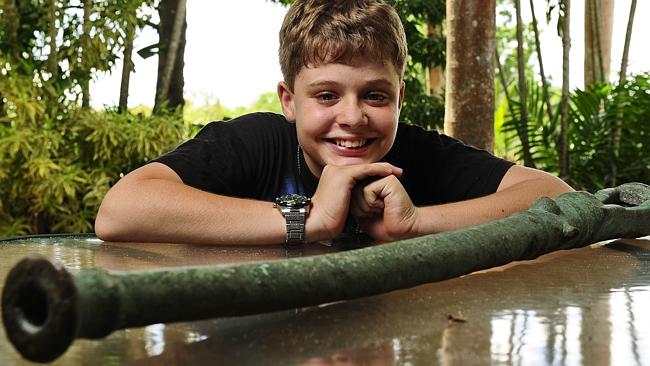
THE history of Australia could be at a turning point thanks to the type of lead found in a 16th-century-style cannon unearthed off a remote beach.
Scientists have linked the lead to an ancient Spanish mine — bolstering theories that Portuguese explorers reached Australia well before the Dutch in 1606 and Captain James Cook in 1770.
The cannon — known as a swivel gun — was discovered in 2010 by Christopher Doukas, 13, off Dundee Beach, about 120km southwest of Darwin, when freak low tides revealed it partially buried offshore.
Research by the University of Melbourne, which compared lead in the cannon to ore samples obtained from 2000 European sources, showed that it most closely resembled metal found at the ancient Coto Laizquez mine in the Andalusia region in Spain’s south.
Until the research was revealed this week — coinciding with the cannon going on display in Darwin — the gun was thought likely to have been a later Asian copy of a 16th-century-style Portuguese swivel gun probably lost off the Australian coast by Indonesian traders in the early 18th century.
However, the new research shows that the lead in the cannon is, of all the sources tested, most similar to that found in the south of Spain where it had been mined since ancient times. The cannon resembles those made in Portugal in the early 16th century.
A Darwin-based heritage group, Past Masters, which commissioned the research on the cannon, said yesterday that the findings showed that the lead in the gun was mined on the Spanish Iberian Peninsula.
A spokesman for the group, Mike Owens, told The Times: “It is simply likely therefore that the gun is of similar origin. European origin shouldn’t be discounted just because it is obvious.”
“This truly is the smoking gun of the Portuguese discovery of northern Australia,” the heritage group posted on its Facebook page.
Others, including the scientist who conducted the research on the cannon, expressed caution.
Matt Cupper, of the University of Melbourne, who tested the lead, said that even if it was from the Spanish mine, it remained a possibility that the lead was recycled from another object and used to make the gun in Asia. “Lead objects were frequently melted down and recast, so the gun could have been manufactured elsewhere,” he said.
The Dutch navigator Willem Janszoon made the first documented European landing on the Australian continent in 1606, at Cape York Peninsula. In 1770, Captain Cook made the first European landing on Australia’s east coast.
However, there have been persistent theories that Portuguese navigators reached Australia between 1521 and 1524.
Among evidence claimed to support the theory are the Dieppe Maps, 16th-century French world maps which depict a large land mass between Indonesia and Antarctica, interpreted by some scholars as showing Australia.
source: theaustralian.com.au







 STUDIO 3 NEWCASTLE AUSTRALIA